
The short answer
Wipro’s move from vegetable oil to computers was a staged transformation of an existing company. Its founding in 1945 belongs to Mohamed Hasham Premji; Azim Premji took responsibility in 1966 and later helped direct diversification. The 1981 endpoint marks entry into computing, not the sudden completion of a global software-services business.
Chronology
A timeline of the turning points
Western India Vegetable Products
The company is incorporated with a vegetable-oil business based in Amalner.
Indian public offering
Wipro’s current filings date its Indian IPO to 1946.
Generational change
Azim returns from Stanford after his father’s death.
A broader industrial portfolio
Consumer products and engineering activities expand the business beyond oils.
Computing milestones
Sources use 1981 for early IT entry and a computer, and 1982 for a subsequent IT-products milestone.
Later development
PC selling and international software services grow after the guide’s main period.
The 1945 company began with oils rather than software
Western India Vegetable Products Limited was incorporated on 29 December 1945. It began as a vegetable-oil manufacturer at Amalner in Maharashtra, with consumer products developing later. Mohamed Hasham Premji established that enterprise. His son Azim was born in the same year and could not have been its active founding manager.
The corporate identity therefore links several generations of business activity. An incorporation date answers when a legal company began; the later Wipro name and its familiar technology operations answer different questions. Wipro’s current investor material dates its Indian public offering to 1946, which should not be collapsed into the 1945 incorporation merely because the events were close together.
Azim Premji took responsibility after a family death
In 1966 Azim Premji interrupted engineering studies at Stanford after his father died and returned to run the business. The change placed a young successor in charge of a functioning manufacturer rather than an empty startup. Products, equipment, distribution, workers and shareholder expectations already existed and needed attention.
Retrospective accounts emphasize his determination to learn. That personal quality is relevant, but the transformation also required a growing organization. Later recollections of managers such as Ashok Soota show that recruitment and delegation were integral to the technology business. The period is more useful as a history of capability building than as a claim that one person mastered every technical and commercial task.
Diversification connected manufacturing with new technical markets
During the 1970s the business expanded into products beyond edible oils, including consumer-care lines and industrial engineering. Those activities did not themselves make Wipro a software company. They did broaden its experience of manufactured products, sales channels and professional management, providing a setting in which another technical business could be attempted.
The emergence of computing was also shaped by India’s market and policy environment. Stanford’s account of Premji’s management talk links the opportunity to the space left by IBM’s departure. Wipro was among several Indian firms exploring computers; it neither created the global microprocessor nor entered a market without competitors. Its contribution lay in organizing a viable local technology business.
The 1981 milestone is an entry point, not the whole transition
A Forbes India retrospective records a 16-bit multitasking computer launched in 1981 with overseas collaboration. The Economic Times timeline likewise dates IT entry to 1981. A Business Today timeline uses 1982 for an IT-products milestone. These sources describe adjacent stages in a developing division; they should not be forced into one universal birthday for everything Wipro later did in technology.
The cautious conclusion is that Wipro’s computing business emerged around the turn of the 1980s, with 1981 an important early milestone. Collaboration is part of that history: producing a computer commercially involved adapting technology and building the team to sell and support it. It does not establish an unsupported claim that Wipro invented every component or the personal computer itself.
Machines and software services followed different commercial paths
Wipro’s formal filings describe IT expansion during the late 1970s and early 1980s and date the selling of personal computers to 1985. They place the international software-services expansion in the 1990s. A pioneering computer project in 1981 and a later PC-sales milestone can coexist because development, launch and a sustained product business are not identical measures.
Services added another change in what customers bought. Instead of only acquiring a manufactured machine, clients commissioned technical work, software development and research. Stanford’s account traces this movement as hardware became more standardized. The skills and relationships involved required continued adaptation; the later services enterprise cannot be projected backwards as the full character of the 1945 oil manufacturer.
The later corporate structure should not be backdated
Wipro subsequently separated its non-IT businesses into Wipro Enterprises in 2013. That event matters when reading modern product lists: activities with a shared history need not all belong to the same listed company today. Equally, a present-day technology description does not erase the importance of oils, soaps or industrial equipment in the enterprise’s earlier development.
The 1945–1981 story thus contains a founding, a family succession, diversification and an early computing venture. Later software services, corporate restructuring and Azim Premji’s philanthropy extend the story but answer separate questions. Keeping the stages visible gives credit to both generations and to the managers and technical teams who converted strategic decisions into operating businesses.
Continue the chronology
Related history guides
Biography context
Explore India through connected lives
Connected biographies
Different routes into Indian technology businesses
1945–present
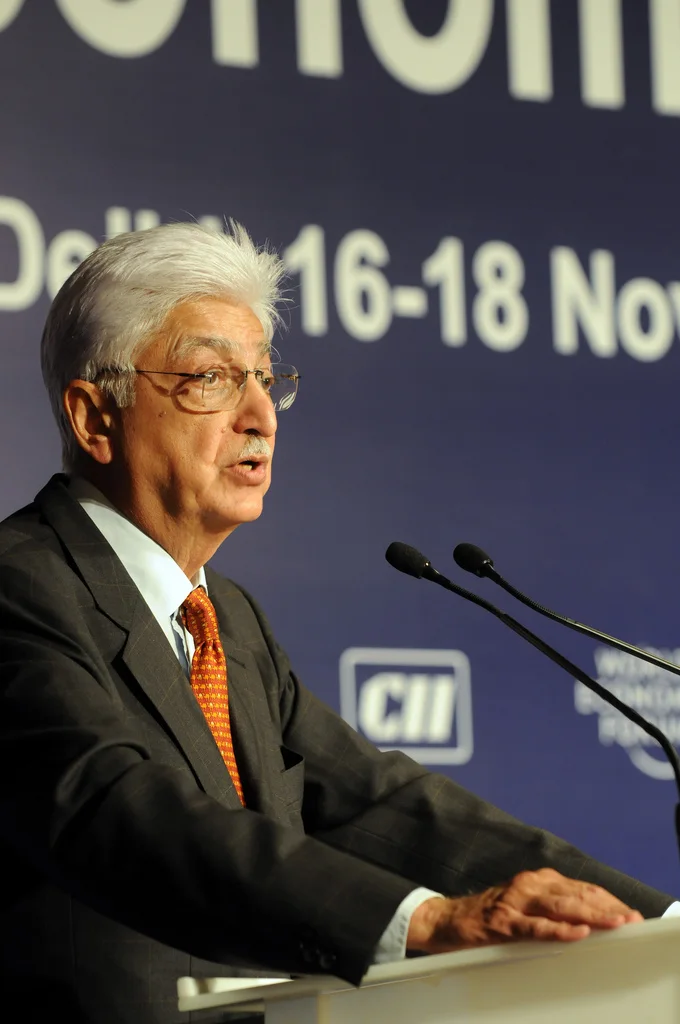
Azim Premji
Wipro business leader and founder of Azim Premji FoundationAzim Premji is an Indian business leader who took over his father’s vegetable-oil enterprise in 1966 and guided Wipro’s growth into technology. He established Azim Premji Foundation in 2001 and committed substantial economic interests to its endowment.Read biography
1945–present
Shiv Nadar
HCL founder and educational philanthropistShiv Nadar is an Indian business leader who founded HCL with colleagues in 1976 and helped develop its hardware and technology-services businesses. Through a separate foundation, he also supported educational institutions ranging from schools to universities.Read biography
1946–
N. R. Narayana Murthy
Infosys co-founder and former chief executiveN. R. Narayana Murthy is an Indian engineer and entrepreneur who co-founded Infosys with six colleagues in 1981. He served as chief executive until 2002 and later held chairmanship roles. His career also includes education, investment and public debate about work and economic development.Read biographyQuick answers
Common questions
- Who founded the original Wipro enterprise?
- Mohamed Hasham Premji founded the vegetable-oil enterprise in 1945. Azim took over in 1966.
- Why does this guide use 1981 when another timeline says 1982?
- Sources date early IT entry and a computer to 1981, while another dates an IT-products milestone to 1982. The guide distinguishes those adjacent stages.
- Was Wipro already a global software-services company in 1981?
- No. Computing began with products and hardware capabilities; international software services developed later, especially in the 1990s.
- Did Wipro abandon all its older businesses when it entered computing?
- No. Diversification produced a mixed portfolio, and the non-IT businesses were separated into Wipro Enterprises only in 2013.
Primary and institutional sources
How this history was checked
Company filings establish legal and business distinctions. Dated independent clippings and a Stanford account provide the transition’s context. Selected filing passages and indexed clipping passages were checked; conflicting milestone labels are disclosed rather than silently merged. This article was reviewed on 23 October 2026.
- WiproForm 20-F 2024–2025: History and Development
- WiproInvestor FAQs: history and 1946 public offering
- The Economic Times / Wipro archivePremji chronology, 25 July 2015
- Business Today / Wipro archiveThe Visionary, 2019
- Forbes India / Wipro archiveLeadership award retrospective, 7 December 2018
- Stanford Graduate School of BusinessPremji on innovation and Wipro’s evolution, 2006
- World Economic Forum / Wikimedia CommonsPremji’s complete 2008 photograph
- Creative CommonsCC BY-SA 2.0