In this biography
Quick facts
- Born
- 13 October 1925
- Died
- 8 April 2013
- Birthplace
- Grantham, Lincolnshire, England
- Country
- United Kingdom
- Nationality
- British
- Known for
- Market-oriented reforms, privatisation, the Falklands War and Britain’s first female premiership
- Prime minister
- 4 May 1979–28 November 1990
- Conservative leader
- 1975–1990
- MP for Finchley
- 1959–1992
- Education secretary
- 1970–1974
- General election victories
- 1979, 1983 and 1987
Why this life matters
Thatcher changed the direction of British Conservatism and the terms of debate about markets and government. Her record involves both political achievement and uneven social costs; the experiences of households, industrial communities and political opponents cannot be collapsed into one verdict.
Timeline
Key moments
Born in Grantham
Born Margaret Hilda Roberts on 13 October to Alfred and Beatrice Roberts.
Studied chemistry at Oxford
Attended Somerville College and became active in university Conservative politics.
Family and legal training
Married Denis Thatcher in 1951; the twins Mark and Carol were born in 1953, when she also qualified as a barrister.
Entered the Commons
Won Finchley after earlier unsuccessful candidacies in Dartford.
Cabinet office and party leadership
Served as education secretary under Edward Heath, then defeated him for the Conservative leadership in 1975.
Became prime minister
Appointed on 4 May after the Conservatives won the general election.
War, re-election and industrial conflict
Led Britain during the Falklands War, won again in 1983 and backed the Coal Board during the 1984–85 miners’ strike.
Third victory and loss of support
A third election win was followed by the poll-tax crisis and party divisions over Europe; she left office on 28 November 1990.
The Lords and later life
Left the Commons in 1992, entered the Lords and died in London on 8 April 2013.
Chemistry, law and local politics preceded national leadership
Margaret Hilda Roberts was born in Grantham on 13 October 1925. Her parents, Alfred and Beatrice Roberts, ran a grocery business; Alfred also served in local government. The family’s Methodist and civic setting helped form her language of responsibility and self-reliance. It did not make her later national career inevitable, particularly in a political profession dominated by men.
She studied chemistry at Somerville College, Oxford, from 1943 to 1947, with Dorothy Hodgkin as her tutor, and led the university Conservative association. After working as a research chemist, she trained for the Bar. She married Denis Thatcher in 1951, had twins Mark and Carol in 1953 and qualified as a barrister that December. Her later legal work specialised in taxation.
Finchley and the education brief provided a route through the party
Thatcher unsuccessfully contested Dartford in the 1950 and 1951 elections before winning Finchley in 1959. She represented that constituency until 1992. Junior government and opposition responsibilities brought experience before Edward Heath appointed her education and science secretary in 1970. Her decision to end free school milk for some children became a lasting political controversy.
After the Conservatives lost office in 1974, she challenged Heath and became party leader in 1975. Her programme gradually combined economic liberalisation with a strong insistence on governmental authority. Its development involved advisers, internal opponents and changing circumstances; the label Thatcherism should not suggest that every policy of the next fifteen years arrived fully formed on the day she won the leadership.
Economic change brought electoral success and uneven social costs
The Conservatives won the 1979 general election, and Thatcher became prime minister on 4 May. Her early government prioritised curbing inflation and reducing the state’s direct economic role. High unemployment and recession made the initial years politically difficult. Later recovery strengthened her argument for continuing reform, but national indicators did not describe every town’s experience.
Privatisation transferred major state businesses to private ownership, while council-house sales increased owner-occupation for participating tenants. Trade-union restrictions and financial deregulation changed bargaining power and business practices. Supporters regarded these measures as a renewal of enterprise; opponents pointed to industrial job losses, reduced security and widening divisions. Her three election victories show durable political support, not unanimous agreement about who benefited.
The Falklands War strengthened her authority without removing diplomacy
Argentina’s military government invaded the Falkland Islands in April 1982. Thatcher’s government sent a task force, and British forces recovered control in June. The islands were administered by Britain and claimed by Argentina, whose name for them is Las Malvinas. Acknowledging the sovereignty dispute does not change the sequence of invasion, military response and British recovery.
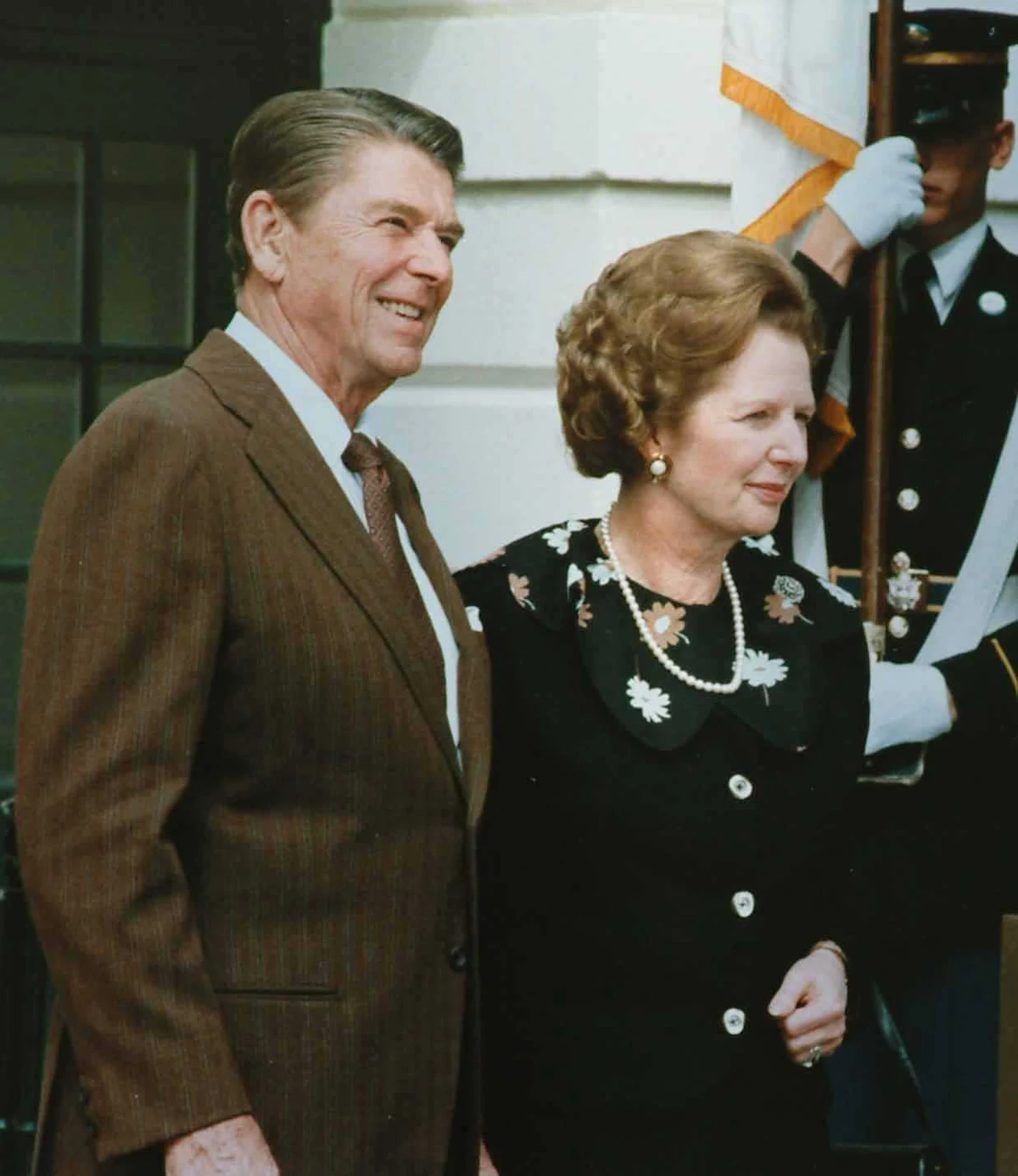
Diplomatic efforts continued alongside preparations for battle. The published archival description of her April meeting with U.S. Secretary of State Alexander Haig records both her opposition to rewarding aggression and discussion of a political solution. Her close relationship with Ronald Reagan did not eliminate differences or make American support automatic. Victory helped restore her political standing before the Conservatives’ substantial 1983 election win.
The miners’ strike exposed a struggle over jobs, law and state power
In March 1984 opposition to pit closures developed into a year-long coal dispute. The National Coal Board, led by Ian MacGregor, faced the National Union of Mineworkers under Arthur Scargill. Thatcher’s government supported the Board and maintained electricity supplies through preparation and continued production. Describing the dispute only as a duel between Thatcher and Scargill erases the different institutions and coalfield communities involved.
The absence of a national membership ballot divided the union, with many Nottinghamshire miners continuing to work. Support groups collected food, money and clothing while families endured prolonged hardship. Mass picketing and policing became central controversies. The strike ended in March 1985 without the settlement the union sought, strengthening the government politically while leaving long-term social wounds and arguments about accountability.
A third election victory did not protect her from her own party
Thatcher won again in 1987, but disputes over European integration and the Community Charge weakened her authority. The charge, widely called the poll tax, replaced domestic rates with a per-adult levy and provoked intense opposition. It was introduced in Scotland before England and Wales. Its political damage compounded Cabinet resignations and concern among Conservative MPs about another election.
She failed to secure a decisive first-ballot victory over Michael Heseltine in the 1990 leadership contest, withdrew and left Downing Street on 28 November, succeeded by John Major. This was a party leadership crisis, not defeat in a general election held that month. She left the Commons in 1992, entered the Lords and died in London on 8 April 2013. Her influence survived her government, as did disagreement over its human and economic balance sheet.
Quick answers
Frequently asked questions about Margaret Thatcher
- Was Margaret Thatcher Britain’s first woman prime minister?
- Yes. She became prime minister on 4 May 1979 and served until 28 November 1990, after leading the Conservatives since 1975.
- What did Margaret Thatcher study?
- She studied chemistry at Somerville College, Oxford, in 1943–1947, worked as a research chemist and later trained as a barrister specialising in taxation.
- How many general elections did Thatcher win?
- She led the Conservatives to victories in 1979, 1983 and 1987. Her departure in 1990 followed an internal party leadership challenge, not a general-election defeat.
- Why is her political legacy disputed?
- Supporters emphasise inflation control, enterprise, privatisation and international resolve. Critics emphasise unemployment, industrial disruption, inequality and confrontations over trade unions and local taxation. Outcomes differed among communities and households.
Keep exploring
Lives connected to this story
- Ronald Reagan
Compare the American president’s economic agenda and alliance with Thatcher, including the limits of their agreement.
- Winston Churchill
Read a different British premiership shaped by war, coalition-building and the changing relationship with the United States.
Sources and further reading
Explore the evidence
These references support the biography and offer further reading. Official records, first-person accounts and independent reporting provide different perspectives; image records document attribution and licensing.
- 1. UK Prime Minister’s OfficeHistory of Baroness Thatcher
- 2. Churchill Archives Centre, CambridgeMargaret Thatcher: A biography
Read for education, early career and policy development. This archive holds her papers; positive judgements about her marriage and political achievements are not treated as independently proven facts.
- 3. Somerville College, University of OxfordMargaret Thatcher: education and public career
- 4. Margaret Thatcher FoundationBrief chronology, 1925–1990
The chronology distinguishes qualifying as a barrister on 1 December 1953 from beginning practice in 1954. It also supports the marriage and twins’ birth dates.
- 5. UK ParliamentParliamentary career for Baroness Thatcher
- 6. Museum of the Prime MinisterThe Fall of Margaret Thatcher
Used selectively for poll-tax opposition and the leadership contest, not its sweeping economic verdicts. Her 22 November withdrawal announcement is distinguished from leaving office on 28 November.
- 7. House of Lords LibraryFalklands War: 35 Years Anniversary, updated 2022
Historical briefing read selectively for the 1982 war and sovereignty context. Its older descriptions of current territorial or European status are not repeated as present-day claims.
- 8. UK Parliament, HansardFalkland Islands: debate of 3 April 1982
- 9. U.S. Department of State / National Security Archive, George Washington UniversitySecretary’s meeting with Prime Minister Thatcher, 8 April 1982: archival description of the memorandum
Read the archive’s public description and quoted memorandum extracts, not all twelve pages of the underlying diplomatic record.
- 10. Sheffield City Council, Libraries and ArchivesMiners’ strike research guide
- 11. People’s History MuseumMiners’ Strike 1984–1985: archival research guide
- 12. Margaret Thatcher Foundation / Churchill Archives CentreWhite House photograph, 29 September 1983: exact free-reproduction statement
- 13. Wikimedia CommonsThatcher and Reagan photograph: licensing and native-resolution file history
Current Commons file history contains a larger rendering. The historical entry described as a direct native JPEG extraction is used instead; the exact Foundation source explicitly permits free reproduction.