In this biography
Quick facts
- Born
- 6 February 1911
- Died
- 5 June 2004
- Birthplace
- Tampico, Illinois, United States
- Country
- United States
- Nationality
- American
- Known for
- Conservative economic policy, Cold War diplomacy and the presidency from 1981 to 1989
- Presidency
- 1981–1989
- California governor
- 1967–1975
- Earlier careers
- Radio broadcaster, actor and Screen Actors Guild president
- Arms-control agreement
- INF Treaty signed with Mikhail Gorbachev on 8 December 1987
Why this life matters
Reagan helped make conservative ideas about taxes, regulation and federal power central to American politics. His record also shows how presidential rhetoric, congressional bargaining, independent institutions and administrative accountability shaped policy outcomes.
Timeline
Key moments
Born in Illinois
Reagan was born in Tampico on 6 February and spent much of his childhood in Dixon.
Hollywood and union leadership
He joined Warner Bros. in 1937 and first became president of the Screen Actors Guild in 1947.
Governed California
Two terms combined conservative campaigning with tax increases and negotiated welfare legislation.
Entered the White House
His first year brought major tax legislation and the dismissal of striking air traffic controllers after an August deadline.
Accountability and arms control
Reagan publicly accepted responsibility over Iran–Contra and later signed the INF Treaty with Gorbachev.
Illness and final years
He announced an Alzheimer’s diagnosis in November 1994 and died in Los Angeles on 5 June 2004.
Broadcasting and Hollywood preceded elected office
Ronald Wilson Reagan was born in Tampico, Illinois, on 6 February 1911 and grew up largely in Dixon. At Eureka College he studied economics and sociology, participated in athletics and drama, and graduated in 1932. Radio offered his first professional audience: he worked as a sports announcer in Iowa before a 1937 screen test led to a Warner Bros. contract.
Film and television supplied experience in public performance, but union work also shaped his political education. First elected president of the Screen Actors Guild in 1947, he dealt with bargaining and disputes over communism in Hollywood. Initially a Democrat, he gradually moved toward conservative Republican politics.
California tested the relationship between ideology and governing
Reagan changed his party registration in 1962. A televised address supporting Barry Goldwater in 1964 enlarged his national political audience, and he defeated Governor Pat Brown in 1966. He governed California from 1967 to 1975, presenting himself as an opponent of excessive government and campus disorder.
His administration nevertheless approved tax increases to balance the budget. Working with the Democratic legislature, he secured a 1971 welfare overhaul that reduced participation while raising benefits for those remaining eligible. Such decisions involved compromise rather than a simple withdrawal of government. After losing the Republican presidential nomination to Gerald Ford in 1976, Reagan defeated Jimmy Carter in the 1980 election.
Economic change brought recovery alongside unequal costs
Reagan entered the presidency in January 1981 promising lower taxes, restrained domestic spending and stronger defense. Congress passed major tax reductions, but military spending and other commitments helped keep budgets in deficit. Federal Reserve chairman Paul Volcker’s independent campaign against inflation raised borrowing costs, contributing to a severe recession before expansion resumed in 1983.
Growth and lower inflation strengthened Reagan politically, yet the recovery’s gains were uneven and federal debt increased. In August 1981 he also enforced a return-to-work deadline against striking federal air traffic controllers. More than 11,000 were dismissed. The decision weakened PATCO, but continuing flight operations depended on other controllers, supervisors, military assistance and years of rebuilding.
Cold War confrontation developed into negotiated arms reductions
Reagan increased military spending and challenged Soviet power, arguing that American strength would improve the position of the United States and its allies. His administration’s approach also included negotiation. Secretary of State George Shultz, diplomats, military specialists and allied governments contributed to decisions that cannot be explained by presidential speeches alone.
Meetings with Soviet leader Mikhail Gorbachev opened opportunities for agreement. On 8 December 1987 they signed the Intermediate-Range Nuclear Forces Treaty in Washington. Further talks addressed strategic weapons and verification. These negotiations helped reduce confrontation, but changes within the Soviet Union and the work of many governments and publics also shaped the Cold War’s ending.
Iran–Contra exposed serious failures of oversight
The Iran–Contra controversy involved secret arms transactions with Iran and the diversion of proceeds to the Nicaraguan Contras. Revelations during Reagan’s second term raised questions about congressional oversight, administration policy and the conduct of national security officials. Investigations damaged the credibility of a presidency that had emphasized strength and public confidence.
In a televised address on 4 March 1987, Reagan accepted responsibility for his administration and acknowledged that the Iran initiative had become an arms-for-hostages exchange. He said he had not known about the diversion of funds. His account distinguished personal knowledge from presidential accountability, while investigations continued beyond the speech. He also announced personnel and national security management changes.
Retirement brought public activity and an Alzheimer’s disclosure
Reagan left office on 20 January 1989 and returned to California. He continued making speeches and supporting Republican candidates, published his autobiography in 1990, and participated in the opening of his presidential library in 1991. Retirement did not immediately end his engagement with political debates or with the public presentation of his presidency.
On 5 November 1994 he publicly disclosed that he had Alzheimer’s disease, explaining that he and Nancy hoped openness would increase understanding of affected families. His public appearances subsequently diminished. He died at his Bel Air home in Los Angeles on 5 June 2004, aged 93, and was buried at the Reagan Library.
Quick answers
Frequently asked questions about Ronald Reagan
- When was Ronald Reagan president?
- He served from 20 January 1981 to 20 January 1989, following two terms as California governor from 1967 to 1975.
- Was Reagan a union leader before becoming president?
- Yes. He was first elected president of the Screen Actors Guild in 1947 and served additional terms. That earlier private-sector union role was distinct from the federal employment dispute with PATCO in 1981.
- Did Reagan end the Cold War by himself?
- No. His military and diplomatic policies were important, including the 1987 INF agreement with Mikhail Gorbachev, but Soviet political changes, other governments and wider public movements also shaped the outcome.
- What did Reagan acknowledge about Iran–Contra?
- In March 1987 he accepted responsibility for his administration and acknowledged an arms-for-hostages exchange. He said he had not known about the diversion of funds to the Contras; investigations continued separately.
Keep exploring
Lives connected to this story
- Jimmy Carter
Read about the president Reagan defeated in 1980 and the economic and international pressures surrounding that transition.
- Harry S. Truman
Explore the earlier Cold War presidency whose containment policy formed part of the background to Reagan’s Soviet strategy.
Sources and further reading
Explore the evidence
These references support the biography and offer further reading. Official records, first-person accounts and independent reporting provide different perspectives; image records document attribution and licensing.
- 1. Ronald Reagan Presidential Library, National ArchivesReagan’s Pre-Presidential Biographical Sketch & Timeline, 1911–1980
- 2. California State LibraryGovernors of California: Ronald Reagan
- 3. University of Virginia Miller CenterRonald Reagan: Domestic Affairs
- 4. Federal Aviation AdministrationA Brief History of the FAA
Dismissals, flight operations and later rebuilding are distinguished. Rounded totals avoid combining different institutional workforce counts.
- 5. University of Virginia Miller CenterRonald Reagan: Foreign Affairs
- 6. U.S. Department of State, Office of the HistorianFRUS 1981–1988, Volume XLIV, Part 1: Editorial Note 243
- 7. Ronald Reagan Presidential Library, National ArchivesAddress to the Nation on the Iran Arms and Contra Aid Controversy, 4 March 1987
A contemporary presidential explanation, not an independent finding about everything Reagan knew. Statements about his knowledge are attributed to him.
- 8. Ronald Reagan Presidential Library, National ArchivesReagan Post-Presidency Chronology
- 9. Ronald Reagan Presidential Library, National ArchivesReagan’s Letter Announcing his Alzheimer’s Diagnosis, 5 November 1994
Used for the dated public disclosure and its purpose. The privately authored letter is paraphrased, not reproduced or treated as federal public-domain text.
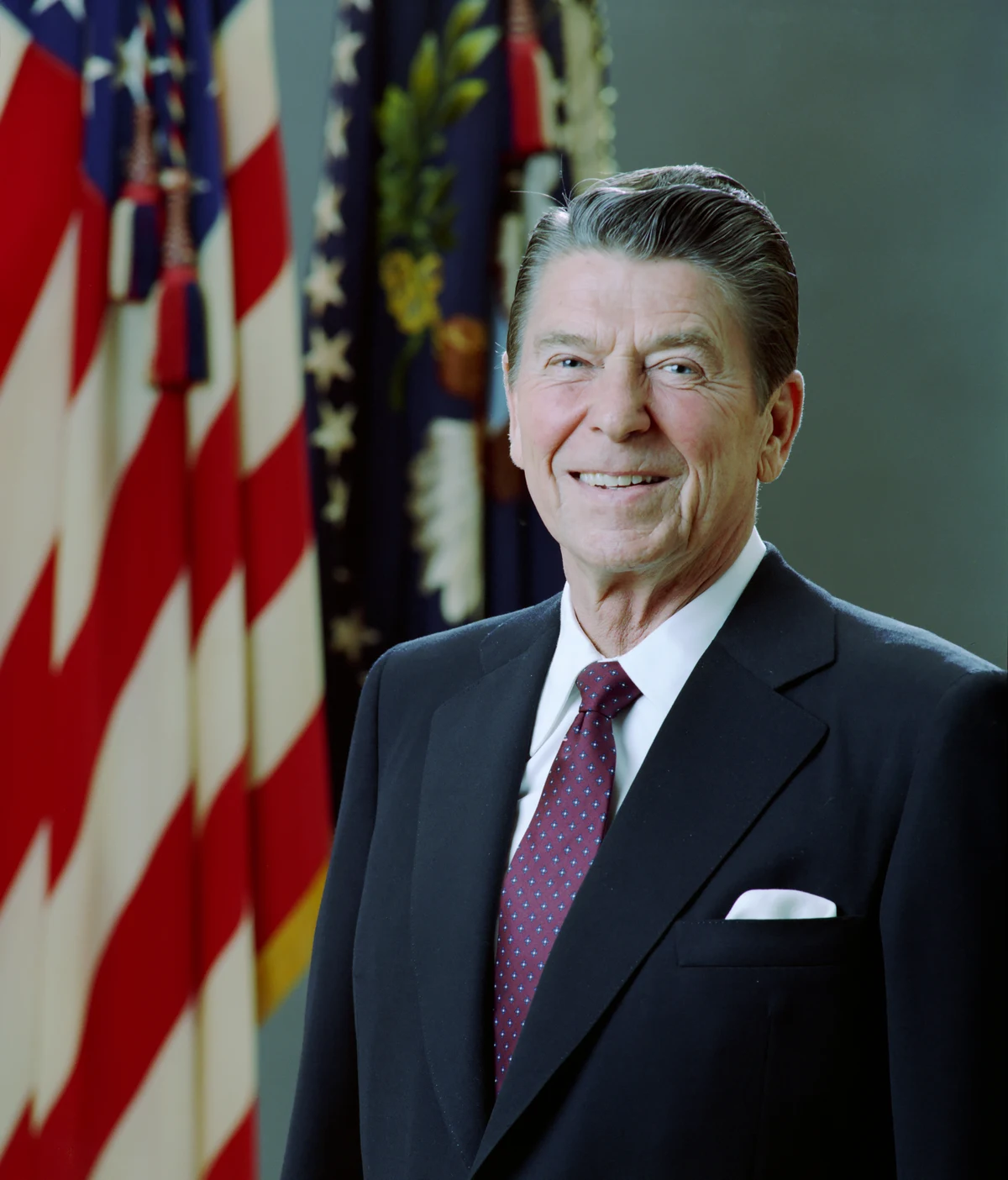
- 10. National Archives via DPLA–Wikimedia CommonsOfficial Portrait of President Ronald Reagan, C584-12, NARA 75856593