In this biography
Quick facts
- Born
- 5 February 1788
- Died
- 2 July 1850
- Birthplace
- Bury, Lancashire, England
- Country
- United Kingdom
- Nationality
- British
- Known for
- The Metropolitan Police, Catholic emancipation, Conservative reorganisation and the 1846 Corn Law repeal
- Prime minister
- 1834–1835 and 1841–1846
- Home secretary
- 1822–1827 and 1828–1830
- Irish chief secretary
- 1812–1818
- Metropolitan Police established
- 1829, while Peel was home secretary
- Corn Law repeal
- Passed in 1846 with a phased tariff transition towards 1849
Why this life matters
Peel’s career shows the power and cost of revising a political position while in office. Administrative reform and cheaper-food arguments coexist with coercive Irish government, restricted representation and the inadequacy of Britain’s response to famine.
Timeline
Key moments
Born in Lancashire
Born on 5 February into a prosperous textile-manufacturing family.
Entered Parliament for Cashel
Patronage helped secure a seat in an Irish borough with a highly restricted electorate.
Chief secretary for Ireland
Developed administrative experience while defending the Union and opposing Catholic emancipation.
Criminal-law and policing reforms
Two periods as home secretary included penal reform and the Metropolitan Police Act 1829.
Supported Catholic emancipation
Reversed his previous position and helped Wellington carry relief legislation.
First premiership
His short minority ministry followed William IV’s dismissal of Melbourne; the Tamworth Manifesto addressed the new political circumstances.
Returned with a majority
His second government restored income tax, reduced tariffs and passed factory legislation.
Famine and the Corn Law rupture
Irish crop failure intensified the case for repeal; it passed, but his government fell on a separate Irish coercion measure.
Died after a riding accident
Died in London on 2 July and was buried at Drayton Bassett.
Industrial wealth provided an entry to an unreformed Parliament
Robert Peel was born at Bury, Lancashire, on 5 February 1788. His father, also Robert, had made money in textile manufacturing and pursued a parliamentary career. The younger Peel attended Harrow and Christ Church, Oxford, where he excelled academically. He inherited both financial advantages and powerful expectations about public life; he did not enter politics as an outsider without connections.
In 1809 he became MP for Cashel in Ireland through patronage within a highly restricted electoral system. His father’s influence helped arrange the seat. He soon held junior ministerial office and, in 1812, became chief secretary for Ireland. Administrative ability developed inside a political order that excluded most of the population from choosing its rulers. The contrast between efficient government and representative government remained important throughout his career.
Irish administration mixed reform with coercion and religious exclusion
As Irish chief secretary until 1818, Peel defended the Union and initially opposed Catholic emancipation. His administration sought stronger emergency powers and a centrally directed police force through measures introduced in 1814. These were instruments for maintaining British authority as well as attempts to manage disorder. Later admiration for his administrative skill should not erase the political and religious inequalities within which he acted.
Daniel O’Connell’s mobilisation and election for County Clare in 1828 brought the Catholic question to a crisis. Serving under Wellington, Peel accepted that exclusion could no longer be maintained without serious danger and helped carry the 1829 relief legislation. The reversal alienated supporters who had regarded him as a defender of Protestant interests. It exemplified a recurring dilemma: changing policy in response to circumstances could achieve legislation while weakening trust within his own political following.
Sources for this section: [2]
The Metropolitan Police belonged to a wider home-office reform programme
Peel was home secretary in 1822–1827 and again in 1828–1830. He revised criminal law and prison administration, reducing the range of capital offences and seeking more systematic government. The best-known institutional result was the Metropolitan Police in 1829. The familiar nicknames bobbies and peelers preserve his association with the force.
It is inaccurate to say that he invented policing everywhere or that the Metropolitan Police was created during his premiership. Earlier local and Irish policing arrangements already existed; the London reform was a particular institutional project under a home secretary. Questions about central authority, public consent and coercion also distinguish the London story from his Irish record. Treating every later policing principle as his personal invention obscures the work of administrators and officers who developed the institution.
Two premierships tested a Conservative accommodation with reform
William IV’s dismissal of Melbourne brought Peel to the premiership in December 1834. The Tamworth Manifesto signalled a willingness to work within the reformed political system rather than simply undo its recent changes. His ministry lacked a secure Commons majority and ended in April 1835. The manifesto was therefore a programme for rebuilding authority, not evidence that the electoral problem had already been solved.
He returned in August 1841 after a Conservative election victory. Income tax and lower import tariffs formed part of an attempt to repair public finances and encourage trade. His government also passed factory and mining legislation restricting the employment of women and children. Reform was selective: these measures did not establish universal workplace equality, a democratic franchise or an entirely free-trade economy. They illustrate how a Conservative administration could revise institutions while seeking to preserve social order.
Repeal won across party lines but did not rescue Ireland from famine
The Corn Laws protected domestic grain producers through import restrictions. The Anti-Corn Law League had campaigned against them before potato blight struck Ireland in 1845. That emergency intensified Peel’s conviction that the policy could not continue. His repeal measure passed the Commons in May 1846 with opposition support, although many Conservatives resisted it. Parliamentary success depended on a coalition different from the party majority that had returned him to office.
In June, repeal advanced while the government lost a separate vote on an Irish coercion bill. Peel resigned, leaving a lasting party split. Repeal did not immediately remove every grain duty, and it did not end the famine: hunger and disease worsened amid failures of relief and access to food. A change in trade law, a prime minister’s motives and the experiences of starving households are related but distinct parts of the historical record.
His legacy extended beyond office to art collecting and political division
Peel did not return as prime minister after 1846. He remained an influential parliamentary figure until a riding accident led to his death in London on 2 July 1850. He was buried beside his parents at Drayton Bassett, not in Westminster Abbey; the Abbey instead commemorates him with a statue. His family life included marriage to Julia Floyd and seven children.
He was also a major art collector. The National Gallery acquired paintings from his collection in 1871, long after his death. Its research records his resistance to immediate abolition of slavery in 1831 and his authorisation of an anti-slavery squadron in 1845, further complicating a uniform reformer label. Politically, his reputation rests on a willingness to reconsider policy and accept personal costs. That reputation is strongest when administrative achievements are read alongside restricted representation, coercion and failures, not when every reversal is made into evidence of inevitable progress.
Quick answers
Frequently asked questions about Robert Peel
- When was Robert Peel prime minister?
- He served in 1834–1835 and 1841–1846. His first ministry began in December 1834; his second began in August 1841.
- Did Peel create the police while prime minister?
- He helped establish the Metropolitan Police in 1829 as home secretary. This was a major London reform, not the invention of every form of policing.
- Why did Peel split the Conservative Party?
- His decision to repeal the Corn Laws broke with many Conservative supporters of agricultural protection. The measure passed with opposition votes, but his ministry then fell on a separate Irish coercion bill.
- Was Robert Peel born on 5 or 15 February?
- The date used here is 5 February 1788, supported by the Dictionary of Irish Biography and his Westminster Abbey memorial. The government biography’s 15 February date is not adopted.
Keep exploring
Lives connected to this story
- Charles Dickens
Compare political responses to industrial Britain with a novelist’s depictions of institutions, poverty and social reform.
- Margaret Thatcher
Trace a later Conservative prime minister’s different approach to markets, public ownership and party loyalty.
Sources and further reading
Explore the evidence
These references support the biography and offer further reading. Official records, first-person accounts and independent reporting provide different perspectives; image records document attribution and licensing.
- 1. UK Prime Minister’s OfficeHistory of Sir Robert Peel, 2nd Baronet
Used selectively for institutions and policy. Its 15 February birth date, confused account of the 1834–35 appointment and June 1841 second-term start are not adopted; institutional biography and the Abbey inscription provide checks.
- 2. Norman Gash / Royal Irish Academy, Dictionary of Irish BiographyPeel, Sir Robert: Irish administration and Catholic emancipation
Used as a scholarly account of Irish government and emancipation, not as an endorsement of its evaluative praise of Peel. British relief policy did not prevent the Great Famine.
- 3. Museum of the Prime MinisterSir Robert Peel: ministry dates and political career
The key-facts tenure dates and the political narrative were read. Its narrative statement that he became prime minister in June 1834 conflicts with its own December tenure dates and is not used.
- 4. Westminster AbbeySir Robert Peel: memorial inscription, family and burial
- 5. National Gallery, LondonSir Robert Peel, 2nd Bt: collection and paintings acquired in 1871
- 6. UK ParliamentThe great famine: relief, repeal and the Irish Coercion Bill
- 7. The National ArchivesThe Corn Laws: education resource and transcribed documents
- 8. UK Parliament, HansardCorn Importation Bill: adjourned debate and division, 15 May 1846
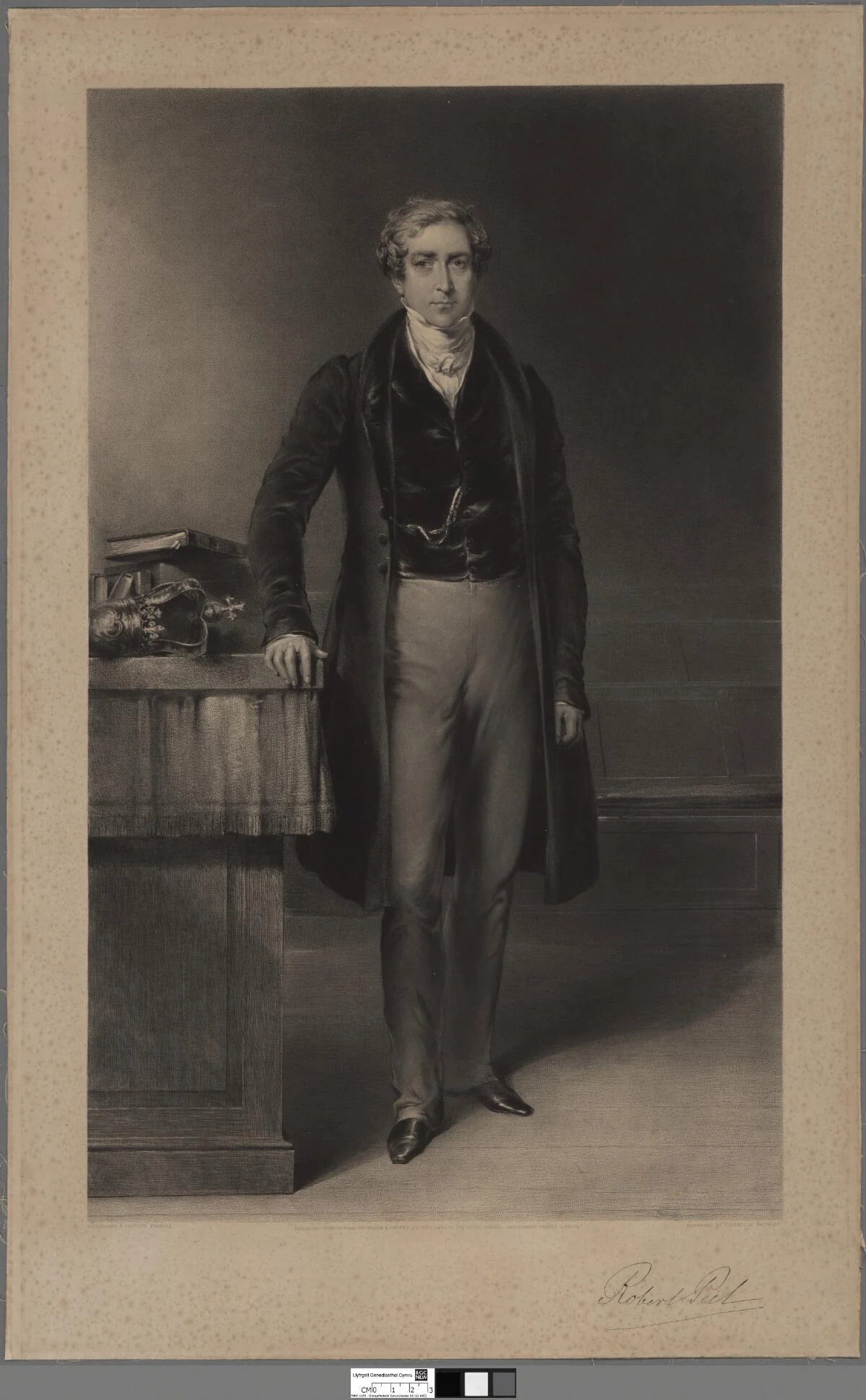
- 9. National Library of Wales / Wikimedia CommonsRobert Peel, Frederick Bromley, 1841: portrait and original scan history
The institutional upload identifies an 1841 Bromley mezzotint and Public Domain Mark. The original 2018 supplied scan was retained, avoiding both the later crop and NPG reproductions carrying third-party claims.
- 10. Creative CommonsPublic Domain Mark 1.0