In this biography
Quick facts
- Born
- 18 September 1895
- Died
- 16 August 1979
- Birthplace
- Neustadt, Ontario, Canada
- Country
- Canada
- Nationality
- Not independently established
- Known for
- The Canadian Bill of Rights, the 1958 election and the Avro Arrow decision
- Prime minister
- 1957–1963
- Party leader
- Progressive Conservative, 1956–1967
- Rights milestone
- Canadian Bill of Rights, 1960
- Profession
- Lawyer
Why this life matters
Diefenbaker made individual rights a prominent federal cause before the Charter, but the Bill of Rights had statutory limits. His premiership connects expanded citizenship with difficult defence choices, cabinet division and the constraints of his vision of one Canada.
Timeline
Key moments
Born in Neustadt
Born on 18 September; his family later moves to the Prairies.
Enters the Commons
Wins a Saskatchewan seat after earlier unsuccessful electoral attempts.
Leadership and government
Becomes Conservative leader, forms government in 1957 and wins a large majority in 1958.
Arrow cancellation
The government cancels the Avro Arrow programme on 20 February.
Two distinct rights reforms
The Bill of Rights receives assent; separate electoral legislation removes status-based barriers to First Nations federal voting.
Government defeat
Cabinet division over nuclear policy precedes the election that brings Pearson to office.
Death
Dies in Ottawa on 16 August while still a member of Parliament.
Prairie law practice helped form a national political voice
John George Diefenbaker was born in Neustadt, Ontario, on 18 September 1895 and grew up partly on the Prairies. He studied at the University of Saskatchewan, served during the First World War and established himself as a lawyer. His courtroom experience helped shape the emphatic speaking style associated with his later parliamentary career.
Electoral success did not come immediately. He entered the House of Commons in 1940, building a national political role from a Saskatchewan base. His emphasis on individual citizenship drew on experiences of regional and ethnic exclusion, though its promise would be tested by the different collective claims within Canada.
A minority victory preceded the 1958 majority
Diefenbaker became Progressive Conservative leader in 1956 and defeated Louis St-Laurent’s Liberals in the 1957 election. His first government was a minority; the much larger Conservative victory came in 1958. Lester B. Pearson was the Liberal leader at that second election, not the prime minister defeated in 1957.
The distinction matters because his premiership passed through different parliamentary conditions. The 1958 result gave him room to legislate, but a large majority did not guarantee agreement inside cabinet or a permanently stable regional coalition. By 1963 defence and leadership disputes had badly damaged the government.
The Bill of Rights was a federal statute, not the later Charter
The Canadian Bill of Rights received assent on 10 August 1960. It recognized freedoms and legal protections, including equality before the law, due process and property rights, and directed how federal laws were to be interpreted and applied. It was an important statutory statement of rights before the 1982 Charter.
Its reach was nevertheless limited: it was ordinary federal legislation, not an entrenched constitutional instrument governing every province. Parliament could also expressly provide that a federal law operated notwithstanding it. Recognizing these limits gives a more accurate account of Diefenbaker’s achievement than treating the Bill as identical to the later Charter.
First Nations voting reform was a separate legislative change
In 1960 federal electoral reform removed the requirement that many status First Nations people give up their status to obtain the federal franchise. Earlier exceptions existed, including for some veterans; it is therefore inaccurate to say that no First Nations person could vote before that year.
The voting change and the Bill of Rights were distinct measures. Nor did a federal ballot settle questions about treaties, land or self-government. Elections Canada’s case study records differing First Nations views about participation in a state that continued to control many aspects of their lives. A wider franchise was significant without constituting the end of colonial restrictions.
The Avro Arrow decision carried industrial and strategic consequences
On 20 February 1959 Diefenbaker’s government cancelled the Avro Arrow interceptor programme. The decision ended a major Canadian aircraft project and brought substantial disruption to the people and industrial capacity associated with it. It became a durable symbol in arguments about technological ambition and dependence on the United States.
The context included escalating costs and changing assessments of missiles and continental defence. Those considerations do not require accepting every government justification, but they do rule out an account in which cancellation had no strategic or financial context. The programme’s termination and the later dispute over nuclear warheads were connected defence questions, not one identical decision.
Nuclear policy exposed cabinet division and complicated his legacy
Disagreement over accepting nuclear warheads for Canadian weapons systems intensified relations with the United States and divided Diefenbaker’s cabinet. By 1963 the government was in crisis; the election brought Pearson’s Liberals to office. Diefenbaker remained Conservative leader until 1967 and continued as an MP until his death in Ottawa on 16 August 1979.
His rights advocacy and his government’s defence reversals should be assessed together. The language of equal individual citizenship challenged some exclusions, yet did not resolve the claims of Indigenous nations or the tensions of linguistic federalism. His career remains important precisely because a forceful promise of inclusion encountered legal limits, strategic dependence and political disagreement.
Quick answers
Frequently asked questions about John Diefenbaker
- When was John Diefenbaker prime minister?
- From 1957 to 1963. His minority victory in 1957 was followed by a large majority in 1958.
- Was his Bill of Rights the same as the Charter?
- No. The 1960 Bill is an ordinary federal statute; the 1982 Charter is part of the Constitution and has a wider governmental reach.
- Did the Bill of Rights itself give First Nations people the vote?
- No. Separate electoral legislation in 1960 removed status-based barriers to the federal franchise. Some First Nations people had been eligible under earlier exceptions.
- Why was the Avro Arrow cancelled?
- The government cited costs and changing defence requirements, including the importance of missiles. Its 1959 decision also carried major employment, industrial and political consequences.
Keep exploring
Lives connected to this story
- John F. Kennedy
Read the American president’s career for the wider Cold War setting of the nuclear-policy dispute.
- Lester B. Pearson
Follow the Liberal leader who succeeded Diefenbaker as prime minister in 1963.
- Pierre Trudeau
Compare the 1960 statutory Bill of Rights with the constitutional rights settlement reached in 1982.
Sources and further reading
Explore the evidence
These references support the biography and offer further reading. Official records, first-person accounts and independent reporting provide different perspectives; image records document attribution and licensing.
- 1. Dictionary of Canadian BiographyDiefenbaker, John George: indexed biographical passages
Indexed scholarly passages were read; direct entry access returned HTTP 429. Dates and roles are cross-checked with archival and historical-society records.
- 2. Library and Archives CanadaJohn George Diefenbaker fonds: biographical history
The fonds description’s summary of Indigenous voting is narrowed using Elections Canada: Inuit enfranchisement and First Nations status restrictions followed different timelines.
- 3. Manitoba Historical SocietyMemorable Manitobans: John George Diefenbaker
- 4. House of Commons of CanadaGovernment Ministries and Prime Ministers of Canada Since 1867
- 5. Department of Justice CanadaCanadian Bill of Rights: full statutory text
- 6. Diefenbaker Canada Centre / University of SaskatchewanThe Canadian Bill of Rights
The exhibit informs the political background; the statute controls the assent date and legal scope. The article does not repeat the exhibit’s wording about the Queen personally granting assent.
- 7. Canadian HeritageHow your rights are protected
- 8. Elections CanadaFirst Nations and the right to vote: case study
- 9. Diefenbaker Canada Centre / University of SaskatchewanFostering a Vision for Canada: the Avro Arrow
- 10. Diefenbaker Canada Centre / University of SaskatchewanThe Nuclear Question in Canada
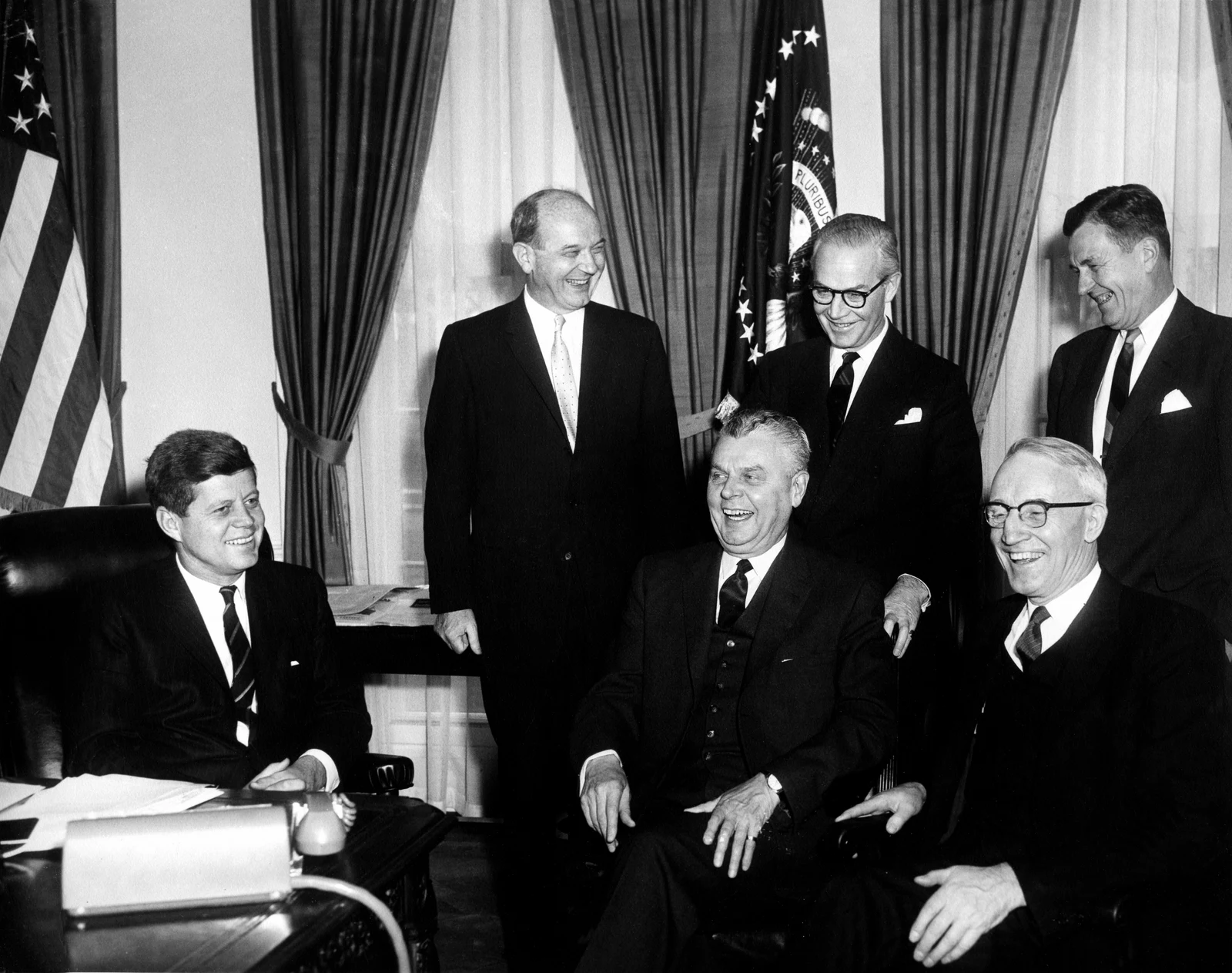
- 11. Abbie Rowe / John F. Kennedy Presidential Library / Wikimedia CommonsKennedy meets Diefenbaker and others, 20 February 1961, AR6363-A
The exact Abbie Rowe archive photograph identifies Diefenbaker seated in the centre. All six people and the complete supplied frame remain.