In this biography
Quick facts
- Born
- 20 March 1939
- Died
- 29 February 2024
- Birthplace
- Baie-Comeau, Quebec, Canada
- Country
- Canada
- Nationality
- Not independently established
- Known for
- Canada–U.S. free trade, the GST, constitutional negotiations and anti-apartheid diplomacy
- Prime minister
- 1984–1993
- Party
- Progressive Conservative Party of Canada
- Trade milestone
- Canada–U.S. FTA in force in 1989
- Tax reform
- GST introduced in 1991 at 7 per cent
Why this life matters
Mulroney changed the framework of Canadian trade and taxation while trying, unsuccessfully, to settle major constitutional disagreements. His policy record and the Oliphant Commission’s ethical findings require separate but equally serious attention.
Timeline
Key moments
Born in Baie-Comeau
Born on 20 March; later studies at St. Francis Xavier and Laval.
Business leadership
Serves as president of the Iron Ore Company of Canada.
Party leader and prime minister
Wins the Conservative leadership, then forms government after the 1984 election.
Bilateral free trade
The agreement is signed in January 1988 and enters into force on 1 January 1989.
Constitutional setbacks
Meech Lake fails in 1990; voters reject Charlottetown in 1992.
GST and environmental agreement
The GST begins at 7 per cent; Canada and the United States conclude the Air Quality Agreement.
Leaves the premiership
Kim Campbell succeeds him; the first Schreiber cash payment follows after his departure as prime minister.
Inquiry and death
The Oliphant report finds inappropriate financial dealings in 2010; Mulroney dies on 29 February 2024.
Labour law and business preceded national office
Martin Brian Mulroney was born in Baie-Comeau on 20 March 1939. He studied at St. Francis Xavier University and Laval, entering a legal career that included labour relations. His early public profile developed through law, the Cliche Commission on Quebec’s construction industry and business leadership.
He became president of the Iron Ore Company of Canada in 1977 and remained there until 1983. That experience was part of his background when he won the Progressive Conservative leadership. It was not an elected mandate: entry into Parliament, party leadership and becoming prime minister were successive stages of his political rise.
The 1984 victory assembled a broad but vulnerable coalition
Mulroney became prime minister after the Progressive Conservatives’ 1984 victory and won another majority in 1988. His coalition brought together Quebec support and Conservative constituencies elsewhere, making regional accommodation central to his governing strategy.
He sought to secure Quebec’s political acceptance of the 1982 constitutional settlement. The Meech Lake Accord failed in 1990 when the required ratification was not completed; the wider Charlottetown package was rejected in referendums in 1992. These were failed amendment projects, not constitutional provisions that later courts simply struck down.
Free trade changed economic policy through several legal stages
His government negotiated the Canada–United States Free Trade Agreement, signed on 2 January 1988 and brought into force on 1 January 1989. It covered more than tariff reductions, addressing investment, services and dispute settlement. The election fought between signature and commencement was a central political test of the project.
The bilateral agreement should not be confused with NAFTA, which added Mexico and took effect in 1994. Mulroney’s government helped negotiate that later agreement, but its commencement occurred under Jean Chrétien. Keeping those dates separate clarifies both Mulroney’s role and the implementation inherited by his successor’s government.
The GST made tax reform visible and politically costly
The Goods and Services Tax began on 1 January 1991 at 7 per cent, replacing the federal manufacturers’ sales tax with a broader value-added structure. Registered businesses could generally recover tax paid on business inputs, while consumers encountered a more visible tax at purchase.
The reform prompted fierce opposition, including a prolonged Senate confrontation. The government used the Constitution’s provision for eight additional senators in 1990. Supporters emphasized a less distorted tax base; opponents challenged the burden and the political means used to enact it. The technical argument for changing a hidden manufacturers’ tax did not remove the distributional and democratic dispute.
Diplomacy included apartheid and cross-border environmental policy
Mulroney opposed apartheid and supported pressure on South Africa, including within the Commonwealth. He also cultivated close working relations with American presidents while pursuing Canadian policy goals. Personal access was one instrument of diplomacy, not evidence that the two countries always agreed.
His government’s record includes the 1991 Canada–U.S. Air Quality Agreement addressing transboundary pollution. These achievements help explain his later honours, but commemorative tributes are not a substitute for evaluating failures. Constitutional defeat, controversial tax reform and the weakening of the Conservative coalition also belonged to the administration that he left in 1993.
The Schreiber inquiry made precise ethical findings, not a criminal conviction
The Oliphant Commission examined business and financial dealings with Karlheinz Schreiber. It found cash payments totalling at least $225,000 in three instalments beginning in August 1993, after Mulroney had left the premiership, though he was still an MP when the first payment was made. The report did not resolve the higher amount alleged in all testimony.
In 2010 the commissioner found the dealings inappropriate and the failure to disclose them inconsistent with the standards of the 1985 Ethics Code. The mandate expressly excluded conclusions about civil or criminal liability. Those findings must neither be inflated into a criminal conviction nor dismissed because the commission was not a criminal trial. Mulroney died on 29 February 2024, leaving a record of major policy change and serious ethical controversy.
Quick answers
Frequently asked questions about Brian Mulroney
- When was Brian Mulroney prime minister?
- From 1984 to 1993, when Kim Campbell succeeded him.
- Did Mulroney introduce the GST?
- Yes. His government introduced the federal GST on 1 January 1991 at 7 per cent, replacing the manufacturers’ sales tax.
- Was the Canada–U.S. FTA the same as NAFTA?
- No. The bilateral FTA began in 1989. NAFTA included Mexico and began in 1994, after Mulroney had left office.
- What did the Oliphant Commission find?
- It found inappropriate financial dealings with Schreiber, at least $225,000 in cash payments and a failure to disclose inconsistent with ethical standards. It was explicitly not authorized to decide civil or criminal liability.
Keep exploring
Lives connected to this story
- Ronald Reagan
Read about the American president who signed the bilateral trade agreement and worked with Mulroney during the 1980s.
- Kim Campbell
Follow the politician who succeeded Mulroney as Conservative leader and prime minister in 1993.
- Jean Chrétien
Continue into the government under which NAFTA took effect and later constitutional and fiscal debates developed.
Sources and further reading
Explore the evidence
These references support the biography and offer further reading. Official records, first-person accounts and independent reporting provide different perspectives; image records document attribution and licensing.
- 1. Canadian HeritageAbout the Right Honourable Brian Mulroney
The government’s commemorative account was read as a favourable retrospective, not an independent verdict on every policy.
- 2. Donald E. Abelson / Mulroney Papers in Public GovernanceFriends in High Places: Brian Mulroney, George H. W. Bush, and the New World Order
- 3. House of Commons of CanadaGovernment Ministries and Prime Ministers of Canada Since 1867
- 4. Mollie Dunsmuir / Library of ParliamentConstitutional Activity from Patriation to Charlottetown (1980–1992)
- 5. Global Affairs CanadaCanada–U.S. Free Trade Agreement: historical background
- 6. Department of Justice CanadaCanada–United States Free Trade Agreement Implementation Act
- 7. Inter-American Development BankImplementing Freer Trade: The Canadian Experience, 1986–1995
- 8. Richard Domingue and Jean Soucy / Library of ParliamentThe Goods and Services Tax: Ten Years Later, 15 June 2000
- 9. Blair Armitage, Senate committee clerk / Canadian Parliamentary ReviewLegislative Reports, 1990, volume 13 number 4: the Senate and the GST
- 10. Mollie Dunsmuir / Library of ParliamentThe Senate: Appointments under Section 26 of the Constitution Act, 1867
- 11. Governor General of CanadaBrian Mulroney: Companion of the Order of Canada citation
- 12. Commission of Inquiry into Certain Allegations Respecting Business and Financial Dealings Between Karlheinz Schreiber and the Right Honourable Brian MulroneyOliphant Commission Report, Volume 1: Executive Summary, 2010
The actual executive-summary PDF was downloaded and selected pages read, including the mandate, payment dates, unresolved amount and ethical conclusions. Payments after the premiership are not described as payments to a sitting prime minister.
- 13. Prime Minister of CanadaStatement on the passing of Brian Mulroney, 29 February 2024
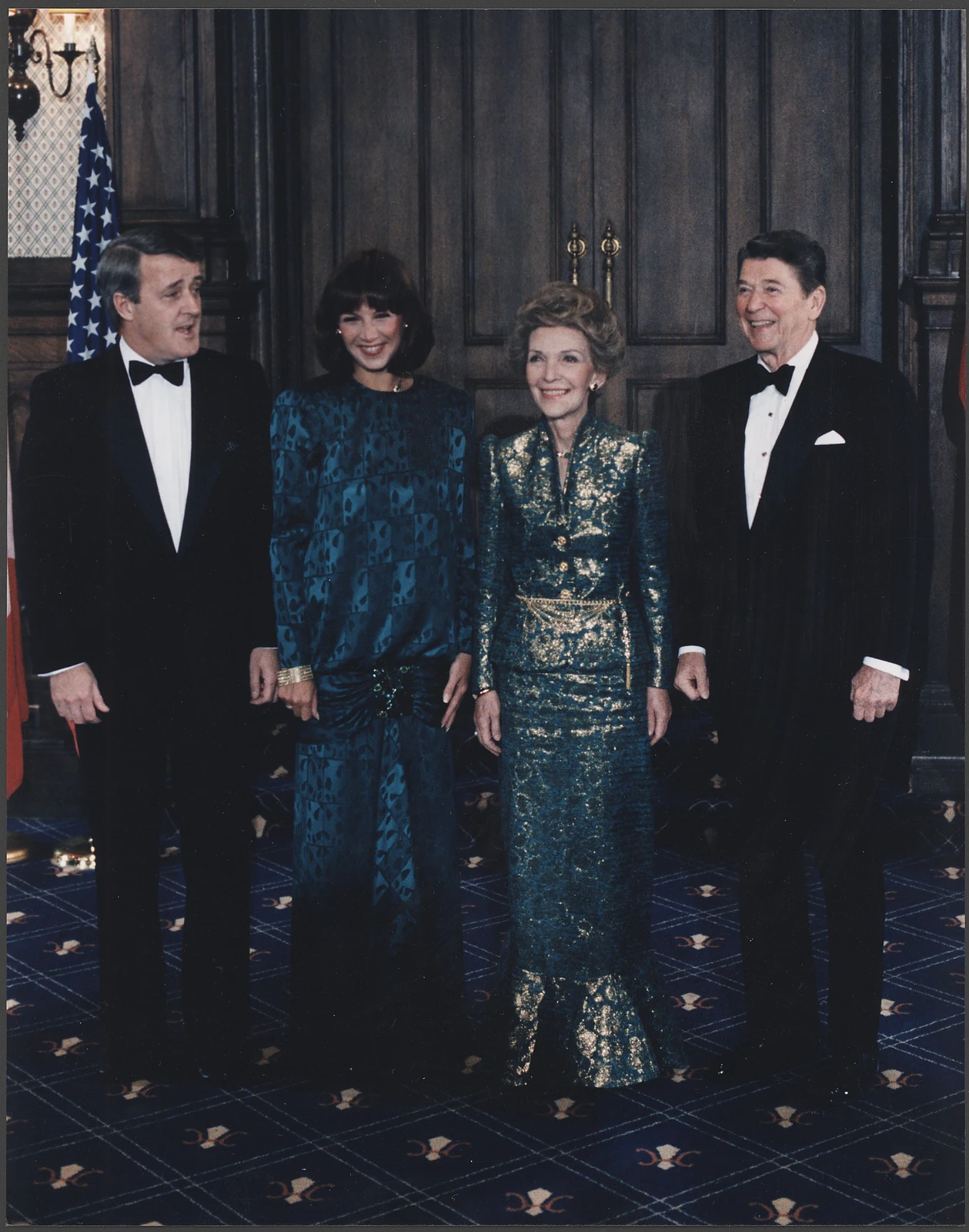
- 14. White House Photographic Office / NARA / Wikimedia CommonsThe Reagans and Mulroneys in Quebec, 18 March 1985, NARA 198561
The exact NARA image record identifies a White House Photographic Office work. Its complete supplied frame, not a later restoration or single-person crop, is used.