In this biography
Quick facts
- Born
- 21 August 1853
- Died
- 25 July 1936
- Birthplace
- Almond, Wisconsin, United States
- Country
- United Kingdom
- Nationality
- British
- Known for
- Burroughs Wellcome & Co, medical collections and the Wellcome Trust bequest
- Origins
- Born in Wisconsin, United States
- London partnership
- Burroughs Wellcome & Co, 1880
- Nationality change
- Naturalised British subject, 1910
- Research laboratory
- Physiological laboratory opened 1894
- Charitable succession
- Wellcome Trust formed under his will, 1936
Why this life matters
His life links pharmaceutical manufacture, branding and scientific patronage with the contested accumulation of wealth and objects in a colonial world.
Timeline
Key moments
Born in Wisconsin
His early life and pharmacy training were in the United States.
Pharmacy qualification
He graduated from the Philadelphia College of Pharmacy.
London partnership
Wellcome joined Silas Burroughs in the pharmaceutical business.
Research and control
The physiological laboratory opened; after Burroughs’s death and litigation, Wellcome gained full control.
Citizenship and institutional growth
British naturalisation preceded the formation of the Wellcome Foundation Ltd.
Death and bequest
His will provided the assets and purpose for the Wellcome Trust.
American beginnings and pharmacy
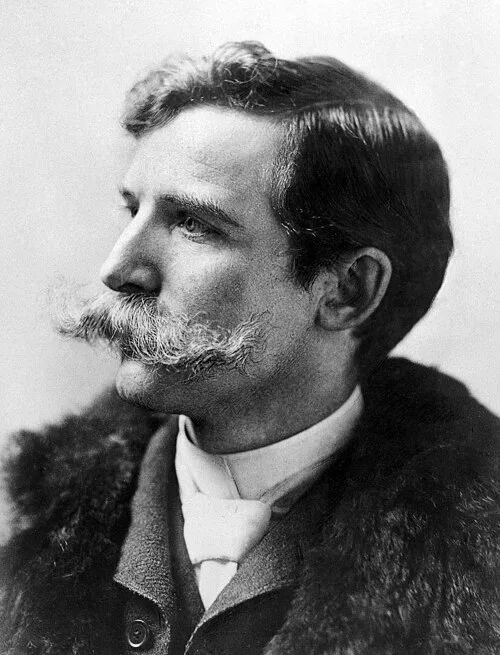
Henry Solomon Wellcome was born at Almond, Wisconsin, on 21 August 1853. He grew up in the United States and gained early experience around a family drugstore before pursuing pharmacy work and study. He graduated from the Philadelphia College of Pharmacy in 1874.
Work as a travelling pharmaceutical representative brought contact with suppliers, markets and potential medicinal materials. This was a commercial education as well as a scientific one. His later British career did not erase his American origins; he became a naturalised British subject only in 1910.
Joining Silas Burroughs in London
Silas Mainville Burroughs had already established a London business importing American medicines when he invited Wellcome to join him. Their partnership began in 1880, with Wellcome initially the junior partner. Selling and producing compressed medicines became a major part of the firm’s growth.
The partners did not remain harmonious. Burroughs sought dissolution in 1889, unsuccessfully. After his death in February 1895, disputes with his widow over the partnership terms continued; the archive biography dates Wellcome’s full control to 1898. The business therefore had a contested transition, rather than a seamless change of ownership.
Products, factories and research
The firm combined manufacturing and promotion with a growing interest in research. Its compressed preparations were sold under distinctive brands, while machinery, packaging and chemical processes generated patents. Factory operations moved from London to larger premises at Dartford as demand expanded.
Wellcome supported laboratories, including a physiological research laboratory opened in 1894. Researchers, technicians and production staff did the experimental and manufacturing work. Financing an institution or owning a company should not be confused with personally making every scientific discovery associated with its later history.
A collection shaped by empire
Wellcome accumulated objects, books and images intended to illuminate the history of healing. Staff and agents bought entire collections and individual items through dealers and auctions, as well as acquiring material abroad. The collection’s scale exceeded the ability to document everything thoroughly.
Wellcome Collection now acknowledges that this activity followed racial and cultural hierarchies that privileged European medicine. Much material from outside Europe reached the market with inadequate provenance. The business also benefited from Indigenous knowledge and imperial trading relationships, making colonial power part of both the wealth and the collection.
Personal life and institutional ambitions
Wellcome married Syrie Barnardo in 1901; the marriage ended in divorce in 1916. In later years he used a house at Gloucester Gate in London as his base and continued to pursue collecting and research ambitions.
He became a British subject in 1910 and was knighted in 1932. The Wellcome Foundation Ltd, formed in 1924, consolidated business and institutional interests. His projected museum was intended as a sweeping account of humanity, but its assumptions and incomplete realisation differ from the aims of the public institutions that now hold the material.
The 1936 bequest and a changing legacy
Wellcome died in London on 25 July 1936. His will left the pharmaceutical company, collections and other assets to trustees to support research into health. The resulting Wellcome Trust developed beyond the institution he had personally controlled.
His legacy contains substantial scientific support alongside difficult questions about acquisition, representation and the sources of wealth. Recognising those connections gives a fuller account than treating philanthropy as the end of the story or assigning all later research achievements to the founder.
Quick answers
Frequently asked questions about Henry Wellcome
- Was Henry Wellcome American or British?
- He was born in the United States and began his career there. He became a naturalised British subject in 1910; museum authorities describe him as American and British.
- Did he start Burroughs Wellcome by himself?
- No. Silas Burroughs already had a London importing business. Wellcome joined him as a partner in 1880, and gained full control only after Burroughs’s death and subsequent legal disputes.
- Why are his collections controversial?
- They were assembled within imperial systems and displayed through racial and cultural hierarchies. Many objects have incomplete provenance, and Wellcome Collection acknowledges that Indigenous and other non-European knowledge was marginalised or exploited.
Keep exploring
Lives connected to this story
- George Cadbury
Another British business history in which philanthropy and overseas supply relationships must be read together.
- Henry Bessemer
A different example of manufacturing processes, patents and commercial control.
Sources and further reading
Explore the evidence
These references support the biography and offer further reading. Official records, first-person accounts and independent reporting provide different perspectives; image records document attribution and licensing.
- 1. English HeritageHenry Wellcome: pharmacist and British citizenship
- 2. WellcomeHistory of Wellcome: business, empire and the 1936 trust
- 3. Wellcome CollectionHenry Solomon Wellcome: patents, MS.9217, catalogue description
- 4. Wellcome CollectionPersonal papers of Henry Solomon Wellcome: biographical outline
The catalogue biographical outline and archive-history caveats were read, including 1894 laboratory, 1910 naturalisation, 1924 company and 25 July 1936 death. The full personal correspondence was not read.
- 5. Wellcome CollectionThe colonial roots of our collections, and our response (2021)
The institution’s 2021 account of its colonial collections was read as an acknowledgement of its own legacy; it does not establish the provenance of every individual object.
- 6. Wellcome CollectionWellcome Chemical Works, Dartford: archive description and ownership note
- 7. Wellcome CollectionSilas Mainville Burroughs: personal papers and biographical note
The catalogue biography supplies Burroughs’s earlier firm, junior partnership, 1889 writ, February 1895 death and 1898 full-control chronology. This is used instead of a film transcript’s erroneous December death.
- 8. Wellcome CollectionCorrespondence between Burroughs and Wellcome concerning their partnership: catalogue
- 9. Museum of New Zealand Te Papa TongarewaSir Henry Wellcome: dates and American/British nationality
The museum authority record supplies exact birth/death dates and the American/British designation. Archive association with GB is kept distinct from birthplace and early nationality.
- 10. Wellcome Library / Wikimedia CommonsHenry Wellcome 1890: image, CC BY licence and revision record
- 11. Creative CommonsAttribution 4.0 International