In this biography
Quick facts
- Born
- 19 September 1839
- Died
- 24 October 1922
- Birthplace
- Edgbaston, Birmingham, England
- Country
- United Kingdom
- Nationality
- English
- Known for
- Expanding Cadbury Brothers and developing Bournville
- Father
- John Cadbury, founder of the original business
- Business partner
- His brother Richard Cadbury
- Factory move
- Bournville, 1879
- Housing trust
- Founded in 1900
- Quaker learning
- Woodbrooke, founded in 1903
Why this life matters
His career connects the organisation of a consumer business with a durable housing institution, while exposing the distance between reform at home and purchasing practices overseas.
Timeline
Key moments
Born in Birmingham
George was a son of John and Candia Cadbury.
Brothers take control
George and Richard assumed responsibility for the family business.
Cocoa Essence
A Dutch press supported a successful cocoa product.
Factory relocates
The business moved to Bournville with room to expand.
Village and trust
Land purchase and housebuilding led to the separate Bournville Village Trust.
Boycott and final years
The firm stopped buying island cocoa in 1909; George died in 1922.
A son of an existing family business
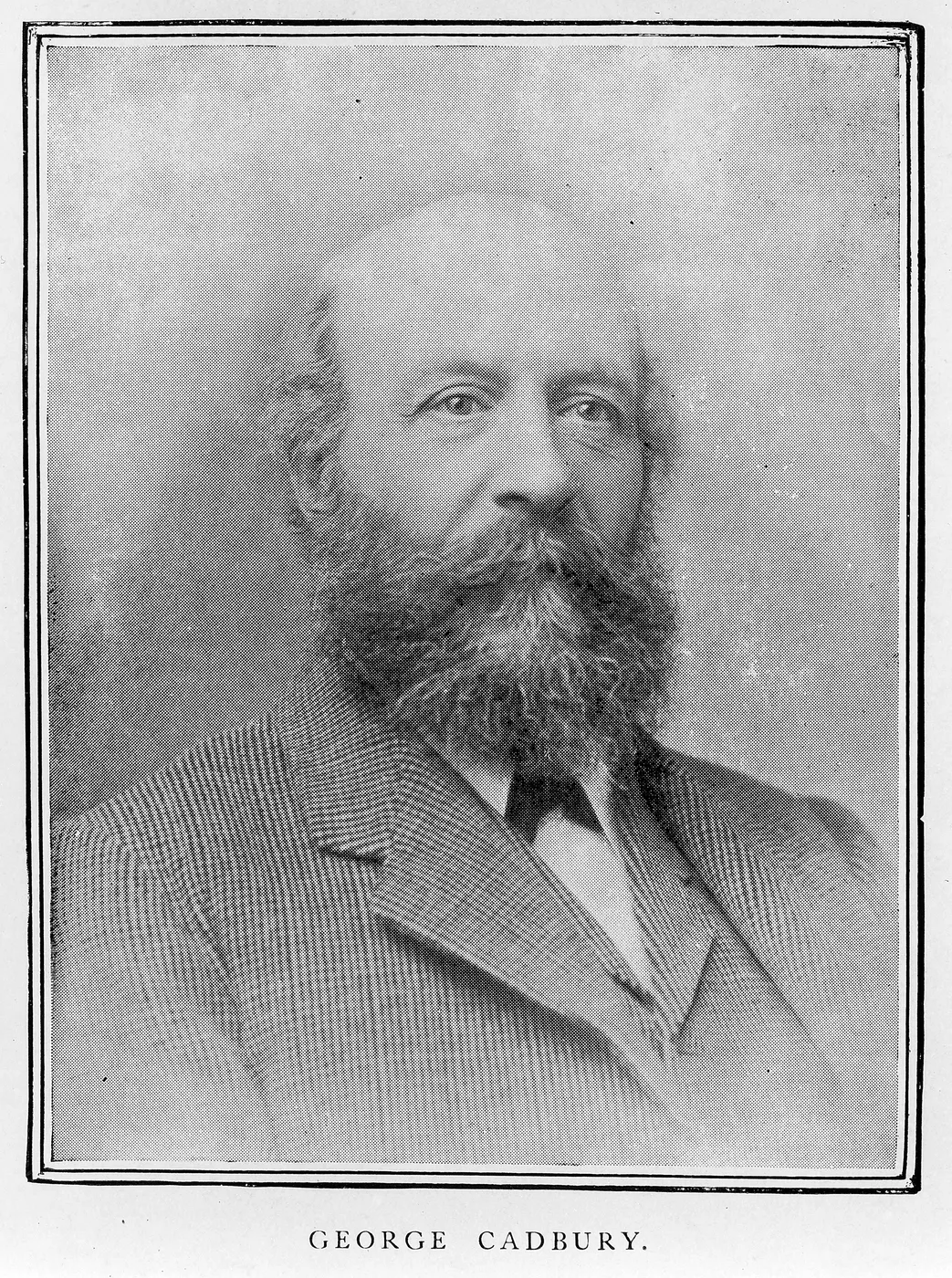
George Cadbury was born in Edgbaston on 19 September 1839, into the Quaker family of John and Candia Cadbury. His father’s grocery enterprise already existed, so George should not be described as the founder of the business in 1824. He grew up amid religious commitments to service and a commercial world in which trust, quality and family connections mattered.
Training took him to the Rowntree grocery in York, then run by Joseph Rowntree senior. He returned to Birmingham before completing the apprenticeship as the family firm encountered difficulties. In 1861 George and his elder brother Richard took control. Their partnership, rather than George alone, supplied the persistence and complementary skills needed to rebuild sales and production.
Cocoa, machinery and a larger market
The brothers struggled through their early years in charge. An important change came with a Dutch cocoa press, which removed much of the cocoa butter and helped them produce Cocoa Essence in 1866. Product quality and persuasive advertising worked together: the firm sold a recognisable, dependable cocoa product in a market concerned about adulteration.
Expansion brought a practical problem of space. The move to Bournville in 1879 offered transport connections, land for a larger works and a healthier setting than the crowded city centre. Manufacturing success depended on production workers and sales organisation as well as machinery. Later chocolate products belong to an evolving family firm, rather than being treated as inventions personally attributable to George.
Building Bournville beyond the factory gates
The factory move and the model village were separate stages. The brothers initially provided a small group of workers’ houses. A further land purchase in 1893 enabled a larger housing experiment; architect William Alexander Harvey dates the model-village building programme from 1895. George wanted gardens, open space and sound houses to demonstrate an alternative to cramped urban development.
After Richard’s death in 1899, George founded Bournville Village Trust in 1900 to secure the estate’s future. Homes were available to people employed elsewhere, and rents contributed to maintenance and further development. This was neither free housing nor a complete solution for Birmingham’s poorest residents. The design and management also expressed the founder’s preferences about healthy recreation and domestic life.
Education, family and public commitments
Adult education was a sustained part of Cadbury’s life. Teaching in Birmingham’s adult-school movement brought him into contact with working people outside the factory. His support for Quaker learning also helped create Woodbrooke in 1903 with John Wilhelm Rowntree. These activities joined religious education, personal relationships and practical reform rather than simply distributing money to distant causes.
His first wife, Mary Tylor, died in 1887. In 1888 he married Elizabeth Mary Taylor, who pursued extensive reform work of her own and later led Bournville Village Trust. George supported Liberal politics and became associated with the Daily News. His family, religious networks and collaborators helped sustain an influence much broader than his position in chocolate manufacturing.
Cocoa purchasing and coerced African labour
The company’s social reputation faced a serious test over cocoa from São Tomé and Príncipe. Evidence considered by its board in 1901 suggested that plantation workers were treated as property. George’s nephew William Adlington Cadbury took the leading investigative role. Joseph Burtt’s enquiry and journalist Henry Nevinson’s reporting exposed coercion behind a nominal system of labour contracts.
Cadbury continued purchasing while pursuing investigation and diplomatic pressure, finally joining a boycott in March 1909. The delay is central to the controversy; the eventual boycott does not erase years of trade with an abusive system. George and William were distinct people with different responsibilities. A business could improve conditions in Birmingham while remaining commercially entangled with colonial exploitation overseas.
An enduring institution and an uneven legacy
George Cadbury died at his home in Bournville on 24 October 1922. Elizabeth continued the housing trust’s work, showing why its separate institutional structure mattered. The estate survived its founder and the original family partnership, developing beyond the first model village into a larger community with changing needs.
His significance lies in connecting commercial wealth to organised experiments in housing and education. That achievement deserves attention without making the community a perfect village or the firm an uncomplicated ethical example. Skilled design, everyday labour, family collaboration and colonial supply chains all belong in the account. Cadbury’s life illustrates both the possibilities and the limits of reform directed by wealthy employers.
Quick answers
Frequently asked questions about George Cadbury
- Did George Cadbury found the original Cadbury business?
- No. His father John opened the original business in 1824. George and Richard took control in 1861 and greatly expanded it.
- Did Bournville begin in 1879 or 1893?
- The factory moved in 1879 with early workers’ housing. The 1893 land purchase enabled the larger model village; Harvey dates its building programme from 1895. The trust followed in 1900.
- Were Bournville homes only for Cadbury workers?
- No. The model village accommodated households with other employers as well. Harvey’s account reports rents and a mixed employed population, not free housing confined to factory staff.
- Was George the Cadbury who investigated São Tomé?
- His nephew William Adlington Cadbury led much of the company’s investigation and diplomacy. George was a senior figure in the firm, but their actions should not be merged into a single person’s biography.
Keep exploring
Lives connected to this story
- John Cadbury
George’s father, who founded the original business before his sons expanded it.
- William Morris
Another Victorian business owner who connected the conditions of work with social ideals.
- Robert Owen
An earlier factory community combining reform with employer authority.
Sources and further reading
Explore the evidence
These references support the biography and offer further reading. Official records, first-person accounts and independent reporting provide different perspectives; image records document attribution and licensing.
- 1. Birmingham Civic SocietyGeorge Cadbury: biographical plaque account
- 2. Quakers in the WorldGeorge Cadbury: business, family and adult education
Indexed article text, including family and adult-school passages, was read; direct opening returned 403. The first marriage year and number of children are omitted where institutional summaries conflict.
- 3. The Rowntree SocietyCadbury, Fry and Rowntree: family and trade connections
- 4. CadburyCompany timeline: Cocoa Essence, products and expansion
Company dates were checked against civic and institutional accounts. The separate company story’s claim that George assisted manufacturing in 1831 is impossible for someone born in 1839 and is not repeated.
- 5. Bournville Village TrustBournville’s story: factory and model village
- 6. Bournville Village TrustFoundation of Bournville Village Trust
- 7. William Alexander Harvey / Project GutenbergThe Model Village and Its Cottages: Bournville (1906), selected founding and housing passages
Selected 1906 introduction and printed pp.9–15 were read, not every cottage plan. Harvey was the estate architect and an advocate. His 1895 building date is distinguished from the Trust’s 1893 purchase/planning date; conflicting counts of the initial cottages are omitted.
- 8. WoodbrookeAbout Woodbrooke and its 1903 founders
- 9. Selly Manor MuseumCadbury Brothers and the issue of contract labour
- 10. University of Birmingham, Cadbury Research LibraryBlack History Resource Guide: Burtt and Cadbury papers, page 2
Page 2 catalogue descriptions of MS857 and CADBURY were read. The underlying Burtt letters, journal and company minutes were not independently examined.
- 11. Maria Teresa da Silva Lopes / University of YorkBuilding brand reputation through third party endorsement: Fair Trade in British Chocolate (2016), selected passages
Selected investigation and boycott passages were read. Celebratory language implying an immediate withdrawal is qualified by the documented 1901–1909 sequence.
- 12. Business History / Northumbria University repositoryHow do firms manage ethically-contested organisational paradoxes? Selected Cadbury case-study passages
Retrieved Cadbury case-study passages concerning the 1901 board evidence were read; this is not a claim to reading the whole accepted manuscript.
- 13. Wellcome Library / Wikimedia CommonsGeorge Cadbury, M0013563: image record, licence and file history
- 14. Creative CommonsAttribution 4.0 International licence