In this biography
Quick facts
- Born
- 19 January 1813
- Died
- 15 March 1898
- Birthplace
- Charlton, near Hitchin, Hertfordshire, England
- Country
- United Kingdom
- Nationality
- English
- Known for
- The air-blown Bessemer steelmaking process
- Early source of capital
- Bronze-powder and gold-paint manufacture
- Public steelmaking proposal
- August 1856, Cheltenham
- Main process
- Air blown through molten pig iron
- Own Sheffield works
- Operating by 1859
- Honours
- Knighthood and Royal Society fellowship, 1879
Why this life matters
His achievement lay in developing and commercialising a rapid steelmaking process, rather than inventing steel itself or solving every problem of iron chemistry.
Timeline
Key moments
Born at Charlton
His father Anthony’s workshop provided early experience.
Designs and secret manufacture
Embossing and bronze-powder production supported his inventive work.
Steel experiments and patents
Artillery problems led to experiments with molten iron and an air blast.
Public announcement
His Cheltenham paper attracted licence buyers before the process was reliable.
Sheffield manufacture
His own works demonstrated a developing commercial process.
Death
Bessemer died on 15 March after a long and varied inventive career.
A workshop education
Henry Bessemer was born at Charlton, Hertfordshire, on 19 January 1813. His father Anthony worked in engineering, engraving and type founding. Henry’s early education included substantial time in the workshop, where modelling, metalworking and the making of accurate impressions could be explored directly.
He moved to London around 1830 and earned money through ornamental castings, embossing and related work. These activities developed a practical understanding of machines and materials. His later move into metallurgy grew from a varied commercial workshop career rather than a formal training as an ironmaster.
Sources for this section: [1]
Secrecy, profit and the means to experiment
A process for making bronze powder and imitation gold paint became an important source of income. Bessemer developed machinery and organised production so that a small, trusted group could preserve the manufacturing secret. This business helped finance experiments in less immediately profitable fields.
The choice of secrecy had a cost for users and other inventors. In later reflection, Bessemer acknowledged that keeping the process private prolonged high prices and prevented outsiders from improving the machinery. His career illustrates different ways of controlling technical knowledge, from a guarded factory to published patent claims.
Artillery and the air-blown process
Experiments with projectiles during the Crimean War drew Bessemer’s attention to the weakness of available gun metal. From 1854 he investigated the manufacture of stronger iron and steel. A succession of patents developed methods for forcing air through molten pig iron.
Oxygen reacted with elements in the metal, producing heat while reducing its carbon content. At Cheltenham in August 1856 he announced a striking proposal for producing malleable iron and steel. The announcement attracted ironmakers and licence fees before dependable operation had been established across different raw materials.
Failure, suitable iron and a Sheffield works
Early users obtained disappointing results. The first process did not reliably deal with phosphorus and sulphur, and a successful trial using one iron did not prove that another iron would behave the same way. Continued experiments and the selection of suitable low-phosphorus pig iron were essential.
Bessemer established his own Sheffield steelworks, operating by 1859, to demonstrate and sell the product. Göran Fredrik Göransson’s Swedish work also advanced practical use. Commercial steelmaking emerged through equipment, raw-material choice, operating experience and customers willing to adopt the metal, rather than through the lecture alone.
Other metallurgists and contested credit
Robert Mushet’s experiments and patents concerning iron, carbon and manganese became central to the controversy. Adding manganese-bearing material could restore controlled carbon and help remove oxygen after blowing. This was a different problem from removing phosphorus, which required a later basic-process development.
Bessemer disputed that Mushet’s claims entitled him to royalties, but later paid him an annual allowance. William Kelly and Joseph Gilbert Martien also asserted priority over aspects of air treatment. The documentary arguments do not support reducing a complex industrial development to either a solitary genius or a simple theft.
Honours, unsuccessful projects and legacy
Bessemer’s interests ranged beyond steel, including sugar machinery and a ship intended to reduce seasickness through a suspended saloon. The ship project failed commercially. Patents and ingenuity did not make every venture successful.
He was knighted and elected a Fellow of the Royal Society in 1879, and died on 15 March 1898. Bulk steel supported railways, structures, machinery and armaments. His importance rests on one major industrial transformation within an uneven career, with credit shared across metallurgical knowledge, manufacturing practice and subsequent improvements.
Quick answers
Frequently asked questions about Henry Bessemer
- Did Henry Bessemer invent steel?
- No. Steel had been made for centuries. He developed and commercialised a rapid air-blown process that helped make it available in much larger quantities.
- Was the process fully successful when announced in 1856?
- No. Early licence holders encountered serious failures. Suitable pig iron, better operating methods and further development were needed before dependable commercial use.
- Did Mushet’s manganese treatment remove phosphorus?
- No. Its role concerned carbon control and deoxidation. The later basic process associated with Sidney Gilchrist Thomas and Percy Gilchrist addressed phosphorus through a different lining and slag chemistry.
Keep exploring
Lives connected to this story
- Joseph Whitworth
Precision manufacturing and another nineteenth-century engineering entrepreneur.
- William George Armstrong
The overlapping markets for steel, machinery and armaments.
Sources and further reading
Explore the evidence
These references support the biography and offer further reading. Official records, first-person accounts and independent reporting provide different perspectives; image records document attribution and licensing.
- 1. Dictionary of National Biography (1901 supplement) / WikisourceBessemer, Henry: historical biography
Read workshop, early ventures, steel patents, Sheffield, saloon ship and honours passages. The entry is strongly celebratory and has a 1866/1856 typo in its Cheltenham discussion.
- 2. Science MuseumOnward Ever: Sir Henry Bessemer (2013)
The biography was read for broad career context. Its 24 August lecture date and reversed Thomas/Gilchrist name are not adopted; only the month August 1856 is stated because consulted accounts disagree on the day.
- 3. Philip W. Bishop, Smithsonian Institution / Project GutenbergThe Beginnings of Cheap Steel (1959): selected technical and priority discussions
Read the introductory technical explanation, pre-1850s context, Bessemer experiments, early licensing, Göransson, and Mushet/1859–1866 controversy passages of Bishop’s Smithsonian study through Gutenberg. The Smithsonian repository download returned 403. The study itself offers an interpretation of partisan technical-press evidence.
- 4. Dictionary of National Biography / WikisourceThomas, Sidney Gilchrist: basic lining and phosphorus removal
Read the basic-lining theory, Percy Gilchrist collaboration and 1877–1879 development passages to distinguish phosphorus removal from manganese recarburisation/deoxidation.
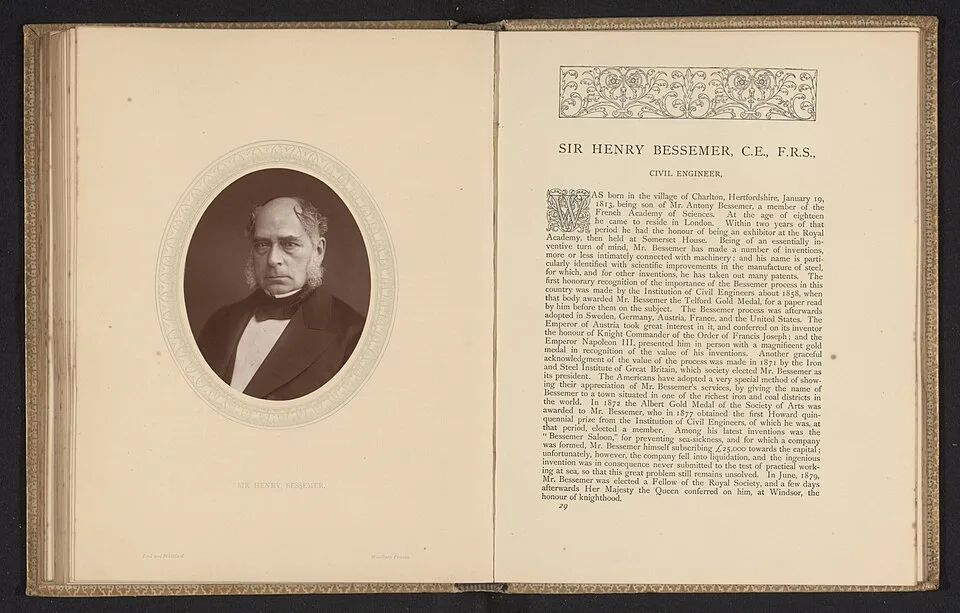
- 5. Rijksmuseum / Wikimedia CommonsLock & Whitfield: Sir Henry Bessemer album spread, CC0 and revision record
- 6. Creative CommonsCC0 1.0 Universal