In this biography
Quick facts
- Born
- 27 August 1877
- Died
- 12 July 1910
- Birthplace
- Mayfair, London, England, United Kingdom
- Country
- United Kingdom
- Nationality
- British
- Known for
- Creating the commercial partnership with Henry Royce and pioneering early motoring and aviation
- Founder meeting
- 4 May 1904, Midland Hotel, Manchester
- Company formation
- Rolls-Royce Ltd, 1906
- Aviator certificate
- Royal Aero Club No.2, 1910
- Channel flight
- Non-stop return crossing, 2 June 1910
Why this life matters
Rolls connected a developing engineering product with customers, competition and publicity. His short career reveals the overlap between elite leisure, technical experimentation and the early businesses of motoring and flight.
Timeline
Key moments
Born in London
Born on 27 August into the Rolls family, whose home was The Hendre in Monmouthshire.
Engineering and motoring
Studies at Trinity College, Cambridge, and develops practical experience with early motor cars.
The motor dealership
C.S. Rolls & Co. develops a London market for high-quality cars, with Claude Johnson joining the business.
Meets Henry Royce
Henry Edmunds arranges their meeting in Manchester on 4 May.
Company and competition
Rolls-Royce Ltd is formed; Rolls and riding mechanic Eric Platford win the Tourist Trophy.
Aviation achievement and death
Makes a non-stop double Channel crossing on 2 June; dies at Bournemouth on 12 July.
A London birth and a Welsh family home
Charles Stewart Rolls was born on 27 August 1877 in London. His registered birthplace was in Hill Street near Berkeley Square, while the family’s ancestral home, The Hendre, stood in Monmouthshire. The two locations explain why accounts associate him with both London and Wales. He was the son of Lord and Lady Llangattock and grew up with resources and connections unavailable to most aspiring engineers.
That privilege supported technical interests rather than excluding them. He experimented with electrical equipment and later studied Mechanical and Applied Science at Trinity College, Cambridge. Cars were still unusual and demanding machines. Ownership involved maintenance, repairs and an understanding of components; his enthusiasm was therefore practical as well as social. His subsequent commercial role cannot be reduced to supplying an aristocratic surname.
Motoring expertise became a business
Rolls gained experience with imported European cars and entered motor races and trials. These events tested machines and made skilled drivers visible to prospective buyers. His London dealership, C.S. Rolls & Co., developed from that world. It sold quality cars to people who could afford an expensive and still unfamiliar form of transport.
Claude Johnson joined the business and became an important partner. The two brought different strengths: Rolls understood machines and had access to influential customers, while Johnson excelled at organization and promotion. Their dealer experience also exposed a gap in the market. They wanted a British-made car capable of matching the quality of the Continental products they already knew, a specific commercial requirement rather than a general wish to start a famous brand.
Edmunds connected the dealer with the engineer
Henry Edmunds provided the crucial introduction. He knew both Rolls and Henry Royce and had driven one of Royce’s early 10-horsepower cars in a reliability event. Edmunds saw that the Manchester engineer’s product might suit the London dealer’s requirements. He arranged the first meeting at the Midland Hotel in Manchester on 4 May 1904.
Royce brought an existing engineering business and a car he had designed and built; Rolls brought a route to customers and the promise to sell its output. The arrangement developed into cars bearing both names. Rolls-Royce Ltd was formally established in 1906. Keeping the introduction, the early manufacturing-and-sales arrangement and incorporation separate gives a clearer account of how a partnership became an institution.
Public proof mattered as much as a sales promise
Racing and reliability trials supported the young marque’s reputation. Eric Platford served as Rolls’s riding mechanic in the 1905 Tourist Trophy, and they won the following year. Such results depended on preparation, mechanical attention and teamwork as well as the driver whose name appeared in reports. Rolls’s hands-on experience helped connect the selling of a car with knowledge of what it could do.
The 40/50-horsepower model then provided another route to recognition. Johnson’s promotion and the famous Silver Ghost trials made smoothness and reliability commercially persuasive. Rolls was part of this enterprise, but the specific 1907 demonstration car, its development and its testing belong to a wider team. An account centred only on the two founders misses the mechanics, drivers, engineers and coachbuilders who made the reputation possible.
Flight opened a second field of experiment
Rolls also became an experienced balloonist and an early supporter of powered aviation. These activities shared motoring’s mixture of engineering challenge, competition and public spectacle. His interests connected him with other pioneers and with the Aero Club, which became the Royal Aero Club in 1910. He received British aviator certificate number two that March.
On 2 June 1910 he made a non-stop double crossing of the English Channel in a Wright biplane, flying from Dover to France and back. This was a return-flight achievement, not the first flight across the Channel. Distinguishing the record avoids erasing earlier aviators and makes clear what was difficult about Rolls’s own feat: sustaining the journey in both directions without landing in France.
A short life and a company that continued
On 12 July 1910 Rolls died when his aircraft crashed during a flying competition at Bournemouth. He was thirty-two. The RAF Museum’s chronology identifies him as the first United Kingdom pilot killed in an air crash. His death belongs to the hazardous early development of powered flight, when technical experimentation could expose pilots to consequences that were not yet fully understood.
Rolls and Royce had worked together for only six years. The company continued under Royce, Johnson and others, later developing aero engines as well as cars. Rolls therefore did not live to direct the wartime engine business or the marque’s later history. His contribution remains distinct: he linked engineering judgement, commercial networks and adventurous public demonstration during the formative years of two new transport technologies.
Quick answers
Frequently asked questions about Charles Rolls
- Was Charles Rolls Welsh or English?
- He was born in London and closely associated with his family home at The Hendre in Monmouthshire, Wales. British describes his wider national context without confusing birthplace and family ties.
- Did Rolls-Royce begin in 1904 or 1906?
- Rolls and Royce met and began their business relationship in 1904. Rolls-Royce Ltd was formally established in 1906.
- Was he the first to fly across the English Channel?
- No. His distinction on 2 June 1910 was a non-stop double crossing, returning from France to Dover without landing on the French side.
Keep exploring
Lives connected to this story
- Henry Royce
Follow the manufacturing and engineering career that met Rolls’s dealership in 1904.
- Isambard Kingdom Brunel
Compare an earlier transport engineer working through commercial enterprises, technical risk and skilled collaborators.
Sources and further reading
Explore the evidence
These references support the biography and offer further reading. Official records, first-person accounts and independent reporting provide different perspectives; image records document attribution and licensing.
- 1. Rolls-Royce Motor CarsMakers of the Marque: Charles Stewart Rolls
Corporate heritage account used for dated biography and dealer context, with promotional superlatives omitted. The RAF Museum independently corroborates the principal 1910 aviation events.
- 2. Rolls-Royce Motor CarsMakers of the Marque: Henry Royce
- 3. Rolls-Royce Motor CarsShaping the World for 120 Years: engineering and early collaborators
- 4. Rolls-RoyceOur History: 1906 company formation and aero-engine milestones
- 5. Rolls-Royce Motor CarsHeritage: From 1904 to Today and Beyond
- 6. Rolls-Royce Motor CarsMakers of the Marque: Henry Edmunds
- 7. Rolls-Royce Motor CarsMakers of the Marque: Claude Goodman Johnson
- 8. Rolls-Royce Motor CarsMakers of the Marque: Eric Platford
- 9. Science and Industry MuseumIconic Duos: Rolls and Royce in Manchester
- 10. Rolls-Royce Motor CarsModels of the Marque: the 40/50 H.P. and Silver Ghost
- 11. National Motor MuseumRolls-Royce Silver Ghost: model history and the separate 1909 museum car
- 12. RAF MuseumBritish Civil Aviation in 1910
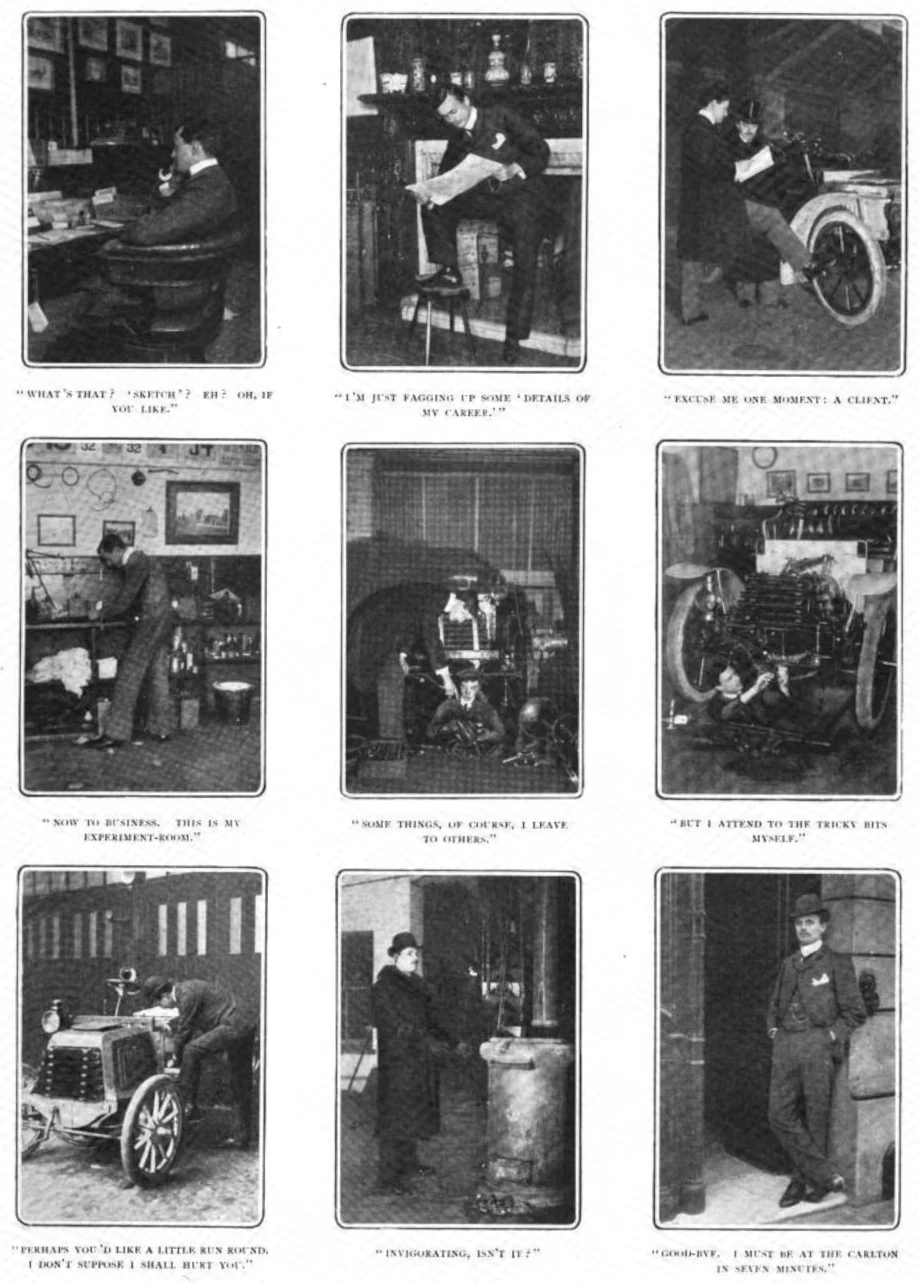
- 13. The Sketch / Wikimedia CommonsPhotographic interview of Charles Stewart Rolls, 7 January 1903: supplied scan and public-domain record
The supplied 1903 nine-panel interview and record were inspected. No photographer is named there; Commons provides UK anonymous-publication and US-expiry bases. No claim is made to have searched every issue of The Sketch or identified the photographer.