
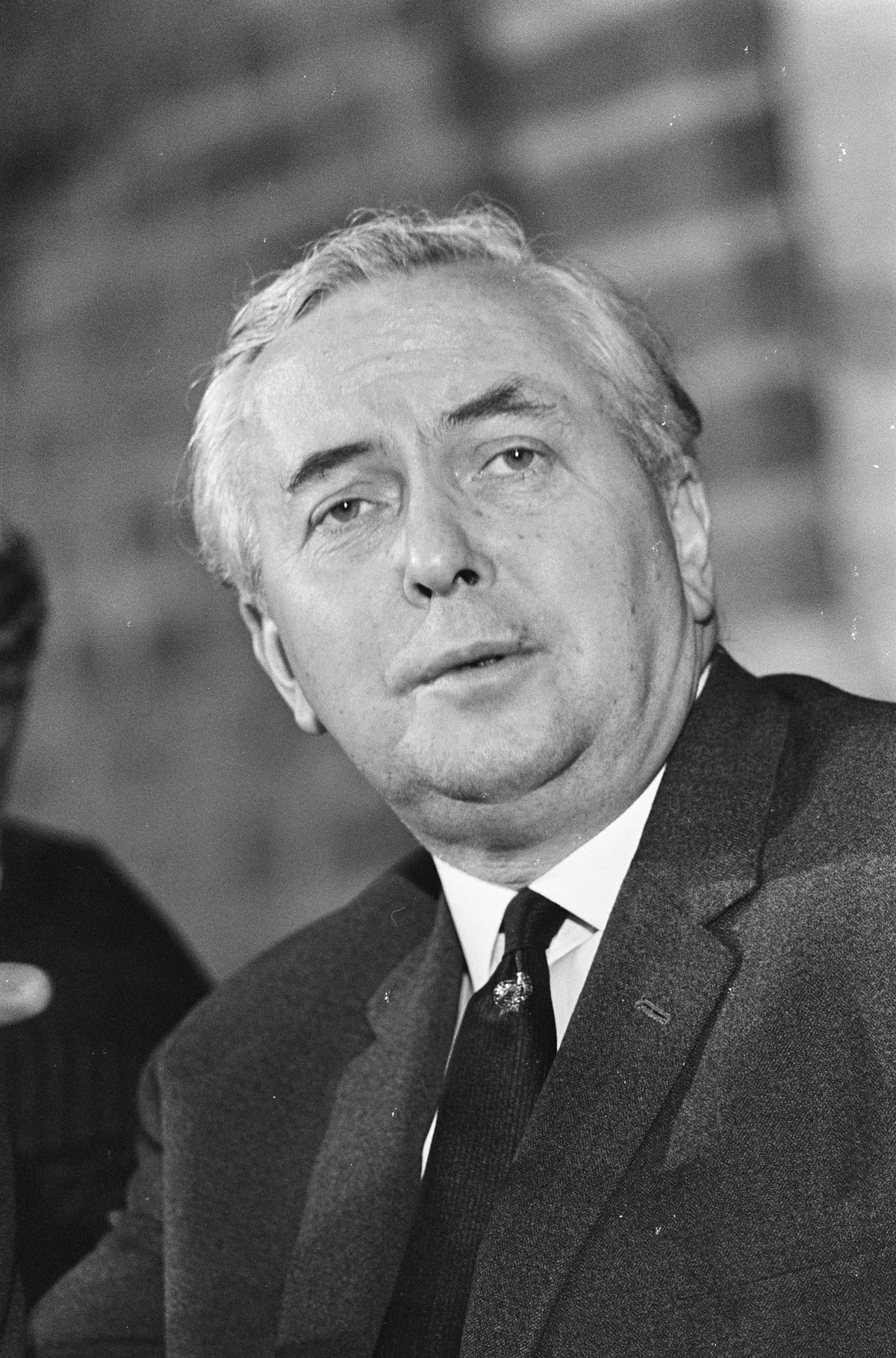
In this biography
Quick facts
- Born
- 11 March 1916
- Died
- 23 May 1995
- Birthplace
- Huddersfield, Yorkshire, England
- Country
- United Kingdom
- Nationality
- British
- Known for
- Two periods as prime minister, technological modernisation, the Open University and the 1975 EEC referendum
- Prime minister
- 1964–1970 and 1974–1976
- Labour leader
- Elected in 1963
- Elections followed by his governments
- 1964, 1966, February 1974 and October 1974
- Open University milestones
- Royal Charter in 1969; teaching began in 1971
Why this life matters
Wilson’s governments helped establish the Open University and extended legal protections against discrimination. His record also illustrates the constraints on reform: currency pressures, limited parliamentary majorities and party divisions shaped what his administrations could deliver.
Timeline
Key moments
Yorkshire childhood and Oxford study
Born in Huddersfield and graduated from Oxford with a first in 1937.
Entered Parliament and Cabinet
Elected for Ormskirk in 1945; became President of the Board of Trade under Attlee in 1947.
Became Labour leader
Succeeded Hugh Gaitskell and connected economic renewal with science and technology.
Won two successive elections
Entered Downing Street with a narrow majority, then secured a much larger one in 1966.
Sterling was devalued
The official dollar exchange rate fell from $2.80 to $2.40 per pound in November.
Education reform and election defeat
The Open University received its charter in 1969; Labour lost the 1970 election before teaching began.
Returned to government and held a referendum
A minority administration after February 1974 gained a narrow October majority; voters supported continued EEC membership in June 1975.
Retirement and death
Announced his resignation in March 1976, was succeeded by James Callaghan and died in London in May 1995.
Education and economic work opened a route into politics
James Harold Wilson was born in Huddersfield on 11 March 1916. His education took him to Jesus College, Oxford, where he graduated with a first in 1937, before becoming a research fellow at University College. The academic route mattered to a politician who later presented specialised knowledge as a resource for national renewal.
He entered the Commons for Ormskirk in 1945 and later represented Huyton. Attlee appointed him President of the Board of Trade in 1947, bringing a young politician into the post-war Cabinet. His early ministerial experience thus concerned trade and the practical management of the economy, rather than beginning with the educational project for which he would later be especially remembered.
Modernisation became an argument about national direction
After serving in senior opposition posts, Wilson won the Labour leadership following Hugh Gaitskell’s death in 1963. His party conference speech that October connected Britain’s future with scientific and technological change. It offered a way to speak about growth, skills and opportunity while building support across a party containing competing economic and ideological traditions.
Labour’s narrow victory in October 1964 brought him to Downing Street; the 1966 election gave him much more parliamentary room. Modernisation acquired a public face in projects such as the Post Office Tower, which he opened in 1965. Such visible symbols helped communicate ambition, but they did not by themselves establish that industrial productivity or national finances had been transformed.
Sterling exposed the limits of economic ambition
The promise of renewal confronted repeated pressure on sterling and Britain’s balance of payments. In November 1967 the government lowered the pound’s official rate from $2.80 to $2.40, a devaluation of roughly 14 per cent. The decision followed years spent defending the previous rate and became a damaging test of the government’s economic credibility.
Wilson’s attempt to reassure households distinguished the currency’s domestic denomination from its value abroad. Yet higher import costs could still affect prices at home. Exporters gained a potential advantage, while the adjustment required other measures and did not remove structural weaknesses overnight. His premiership shows how a persuasive political programme could be constrained by the international monetary system and economic performance.
Sources for this section: [4]
The Open University turned a political proposal into an institution
Wilson promoted a University of the Air in 1963, envisaging a route to higher education using broadcasting. After Labour took office, Jennie Lee sustained the project through ministerial decisions, scrutiny and planning. Walter Perry, selected as vice-chancellor in 1968, then helped turn its principles into the organisation needed to teach and assess students.
The Royal Charter was approved on 23 April 1969. A formal presentation ceremony followed in July, and the first students began in 1971, after Wilson had lost office. Those separate milestones reveal why the university cannot be reduced to a single speech or opening day. Political sponsorship, academic design and practical preparation each had to endure beyond the immediate electoral cycle.
A second premiership managed divisions rather than removing them
Wilson’s first government maintained the American alliance while keeping British troops out of the Vietnam War. Economic pressures also helped drive a reduction in Britain’s commitments east of Suez. Defeat by Edward Heath in 1970 ended the administration, but Wilson retained the Labour leadership and returned after the inconclusive February 1974 election. A second election that October produced a narrow Labour majority.
Europe was a defining problem of the renewed administration. Renegotiation of EEC membership terms was followed by the referendum of 5 June 1975, when about two-thirds of participating voters supported remaining. The result managed an immediate political dispute without ending disagreement. Wilson announced his intention to resign in March 1976 and was succeeded by James Callaghan. He died in London on 23 May 1995.
Quick answers
Frequently asked questions about Harold Wilson
- How many times was Harold Wilson prime minister?
- He served in two separate periods, 1964–1970 and 1974–1976. He formed governments after four general elections as Labour leader, including February 1974 when Labour had no Commons majority.
- Did Harold Wilson create the Open University alone?
- No. He supplied crucial political sponsorship, while Jennie Lee drove the project through government and Walter Perry led the development of the teaching institution.
- What happened to the pound in 1967?
- The government changed the official exchange rate from $2.80 to $2.40 per pound. This made sterling cheaper abroad but also increased the domestic cost of imported goods.
- Was the Open University teaching students in 1969?
- No. It received its Royal Charter in April 1969; teaching began in 1971. The July 1969 ceremony was a separate presentation of the charter.
Keep exploring
Lives connected to this story
- David Lloyd George
Compare an earlier prime minister whose social reforms and coalition management also reshaped the responsibilities of government.
- Clement Attlee
Read about the post-war prime minister who appointed Wilson to the Cabinet in 1947.
Sources and further reading
Explore the evidence
These references support the biography and offer further reading. Official records, first-person accounts and independent reporting provide different perspectives; image records document attribution and licensing.
- 1. UK Prime Minister’s OfficeHarold Wilson: political career and two premierships
- 2. Jesus College, OxfordJC:P118: family papers on Harold Wilson, biographical introduction
Read the catalogue’s biographical introduction, not the underlying family papers. Its simple PPE entry wording differs from the government’s account of an initial history year; the biography states only the corroborated graduation.
- 3. History of GovernmentHarold Wilson opens the Post Office Tower: technology and the 1963 speech
- 4. House of Commons LibraryPound in your pocket devaluation: 50 years on
Read the historical explanation and November 1967 figures. The article’s 2017 exchange-rate comparisons are not presented as current data.
- 5. House of Commons LibraryThe 1974–75 renegotiation of EEC membership and referendum
Read the briefing landing-page account of renegotiation and referendum, not every page of its linked report.
- 6. House of Commons LibraryMembers 1979–2010, RP10/33: Wilson entry, printed page 187
Wilson’s entry gives death on 23 May 1995, unlike 24 May in the 2009 predecessor. The later compilation agrees with the government biography. Only the relevant entry and the predecessor’s edition notice were consulted.
- 7. House of Commons LibraryMembers since 1979, RP09/31: earlier Wilson entry, printed page 174
- 8. UK Parliament, Historic HansardLord Wilson tributes, 24 May 1995: announcement and parliamentary recollections
The opening of the 24 May Commons tribute says that the news was heard that morning; it does not establish that death occurred on 24 May. No death certificate or complete personal archive is claimed as inspected.
- 9. UK Parliament, Parliamentary ArchivesRace Relations Act 1965: provisions and limitations
- 10. UK Parliament, Parliamentary ArchivesEqual Pay Act 1970: passage and commencement
- 11. Open University Digital ArchiveThe OU Story: Wilson’s 1963 proposal
- 12. Open University Digital ArchiveThe OU Story: Jennie Lee’s role
- 13. Open University Digital ArchiveThe OU Story: planning and Walter Perry’s appointment
- 14. Open University Digital ArchiveThe OU Story: April charter and July ceremony
The archive distinguishes charter approval on 23 April from formal presentation on 23 July 1969. Exhibition descriptions were read; linked videos and complete archive collections are not claimed as viewed.
- 15. Open University in ScotlandOur story: founders, charter and first students
- 16. Nationaal Archief / Wikimedia CommonsHarold Wilson at The Hague, 27 February 1967: original 920-1165 and CC0
Exact original-file API metadata and wikitext identify Koch/Anefo, 27 February 1967, file 920-1165 and CC-zero. The commonly reproduced cropped derivative has a different licence label and was not used.
- 17. Creative CommonsCC0 1.0 public domain dedication

Social reform depended on ministers, campaigners and Parliament
The 1965 Race Relations Act prohibited racial discrimination in public places but left major gaps concerning employment and housing. The 1968 measure extended protection into those areas. These were stages in a continuing legislative process, not evidence that racism had disappeared. The distinction between establishing a right and making it effective is central to assessing the period.
The Equal Pay Act received royal assent in May 1970 and came into force in December 1975. Parliamentary support also enabled changes in abortion, divorce, censorship and the treatment of male homosexuality. Their scope varied, and several came through backbench legislation. Attributing the entire programme personally to Wilson would conceal the work of ministers, MPs and campaigners and the limits retained within particular laws.
Sources for this section: [9] · [10] · [1]