In this biography
Quick facts
- Born
- 15 November 1897
- Died
- 6 July 1960
- Birthplace
- Tredegar, Monmouthshire, Wales
- Country
- United Kingdom
- Nationality
- Welsh
- Known for
- Leadership in establishing the NHS, post-war housing policy, the 1951 resignation and the Labour left
- Commons constituency
- Ebbw Vale, 1929–1960
- Health minister
- 1945–1951, with housing responsibilities
- Resignation statement
- 23 April 1951, after becoming Minister of Labour
- Labour deputy leader
- Elected in 1959
Why this life matters
Bevan helped make access to healthcare a collective public responsibility. His career also exposes the difficult relationship between socialist principles and government choices over housing, taxation and defence, and between outspoken opposition and the compromises required to administer a national service.
Timeline
Key moments
A mining community and union education
Born in Tredegar, worked underground and gained a union scholarship to the Central Labour College in 1919.
Local office and election to Parliament
Served in local government before winning Ebbw Vale in 1929.
An outspoken parliamentary critic
Spoke on unemployment, coal and national policy; criticised both pre-war governments and Churchill’s wartime administration.
Health and housing responsibilities
Attlee appointed him Minister of Health; legislation and negotiations preceded the NHS launch on 5 July 1948.
A new office and resignation
Moved to the Ministry of Labour and then resigned over spending priorities, rearmament and proposed health charges.
Writing and party conflict
Published In Place of Fear in 1952, contested the leadership in 1955 and became party treasurer in 1956.
Became Labour deputy leader
His later career included foreign-policy responsibilities and election as deputy leader.
Death and parliamentary tributes
Died at Asheridge Farm, Buckinghamshire; MPs paid tribute the following day.
Tredegar gave him experience of work and insecurity
Aneurin Bevan was born in Tredegar on 15 November 1897 into a large mining family. He left school, worked underground and read widely through the local Workmen’s Library. Union activity supplied both an education and a route to public responsibility. A scholarship took him to the Central Labour College in London in 1919.
Returning to South Wales, he experienced unemployment and became involved in local government. The National Library’s account connects his socialist politics with mining life rather than presenting them as an abstract theory acquired at Westminster. Work, bargaining and insecurity helped form a politician concerned with the unequal distribution of power as well as income. Those experiences remained a reference point even after he became a national figure.
Parliamentary opposition sharpened his political voice
Bevan won Ebbw Vale for Labour in 1929 and represented it until his death. Unemployment and the coal industry gave his parliamentary interventions an immediate constituency basis. He also argued over national strategy and the direction of the Labour Party. Support for a united-front campaign brought temporary expulsion in 1939, followed by reinstatement later that year.
During the Second World War he criticised Churchill’s government while remaining committed to defeating fascism. His force as a speaker could make him an awkward colleague as well as an effective opponent. The parliamentary tributes in 1960 remembered the severity of his attacks alongside intellectual range and humour. Such recollections show how contemporaries experienced his style, without making every judgement offered in a memorial tribute an objective measurement.
The NHS required ministerial compromise as well as principle
Attlee made Bevan Minister of Health after Labour’s 1945 election victory. Proposals for comprehensive healthcare already existed; his task involved deciding the structure and negotiating its operation. The 1946 Act established the framework for England and Wales, while the NHS opened on 5 July 1948 after difficult discussions with doctors and other institutions.
National public ownership of hospitals and access based on need were major changes. Yet general practitioners retained an independent contractual position, illustrating the compromises through which the programme became workable. Scotland and Northern Ireland had separate arrangements. The service’s creation therefore involved cabinet support, parliamentary legislation, professional cooperation and staff across several systems, with Bevan supplying essential departmental leadership rather than inventing or running everything alone.
Housing was a substantial and contested responsibility
Health was not his only responsibility. Bevan also dealt with housing in a country facing wartime destruction and acute shortages. Local-authority building, repairs, subsidies and temporary accommodation formed part of the response. The need to produce homes quickly competed with arguments about their size, quality and the communities they would create.
The National Library of Wales highlights criticism of his insistence on larger, better-quality homes when faster numerical expansion was politically attractive. This is a useful qualification to a career often told entirely through the NHS. His housing record raised a recurring question of post-war reform: whether the state should maximise immediate provision or protect standards intended to endure. Material shortages and construction capacity constrained either ambition.
Resignation made spending priorities an open party conflict
Bevan moved to the Ministry of Labour in January 1951. In April he resigned during the dispute over Hugh Gaitskell’s Budget, the rearmament programme and charges for dentures and spectacles. His Commons statement on 23 April argued that defence commitments were straining economic resources and that social services should not bear the resulting burden.
This was not simply an argument over the price of one health-service item. Bevan disputed the allocation of resources and the distribution of taxation between social groups. Harold Wilson’s statement the next day likewise challenged the practicability of the armaments programme. The resignations made differences within Attlee’s Cabinet public and contributed to the subsequent identification of a Labour left around Bevan. They did not themselves abolish the NHS or remove him from Parliament.
A socialist writer also became a senior party leader
In Place of Fear, published in 1952, gave a wider expression to Bevan’s democratic socialism. He remained influential among Labour activists and MPs, although he lost the 1955 leadership contest to Gaitskell. Becoming party treasurer in 1956 and later taking foreign-policy responsibilities showed a career continuing through the institutions of the party he frequently challenged.
He was elected deputy leader in 1959 and died on 6 July 1960 at Asheridge Farm, Buckinghamshire. His marriage to fellow Labour politician Jennie Lee had joined two substantial public careers. Tributes the following day crossed party boundaries. Bevan’s lasting importance includes the NHS, but also a sustained argument about how democratic authority, economic resources and public services could reduce insecurity without surrendering political freedom.
Quick answers
Frequently asked questions about Aneurin Bevan
- Was Aneurin Bevan Welsh?
- Yes. He was born and raised in Tredegar, Wales, and is described as a Welsh politician. His UK parliamentary career does not erase that national identity.
- Did Bevan create the NHS on his own?
- No. He led the health legislation and negotiations within Attlee’s Labour government, building on earlier proposals and working with Parliament, officials and health professionals.
- Why did Bevan resign in 1951?
- He opposed the direction of the Budget, including rearmament priorities and charges for dentures and spectacles, and argued that the burden was unfairly distributed.
- Did his resignation concern prescription charges introduced in 1951?
- The immediate charging proposals concerned dentures and spectacles. Actual prescription charging began under the succeeding government in 1952.
Keep exploring
Lives connected to this story
- Clement Attlee
Explore the prime minister and wider Cabinet programme within which Bevan developed health and housing policy.
- Harold Wilson
Follow the career of the fellow minister who resigned in 1951 and later led Labour back to government.
Sources and further reading
Explore the evidence
These references support the biography and offer further reading. Official records, first-person accounts and independent reporting provide different perspectives; image records document attribution and licensing.
- 1. Dictionary of Welsh Biography / John Graham JonesAneurin Bevan: life and political career
Read the complete biographical entry and cross-checked the health account against focused institutional histories. Its compressed insurance-based description is not used to define NHS entitlement, and no claim is made to have read the books in its bibliography.
- 2. National Library of WalesWelsh politicians: Aneurin Bevan and housing policy
Used the Bevan passage for housing priorities and political context. Its claim that he was Britain’s youngest MP in 1929 is not repeated.
- 3. UK History of Government / Michelle ClementThe founding of the NHS: 75 years on
- 4. Nuffield Trust / Geoffrey Rivett1948–1957: establishing the NHS, early finance and charges
- 5. UK Parliament, HansardAneurin Bevan’s resignation statement, 23 April 1951
Read the resignation statement as Bevan’s own explanation, checked against the Chancellor’s Budget passage and Wilson’s separate statement. Speeches establish arguments, not the correctness of all their economic forecasts.
- 6. UK Parliament, HansardHarold Wilson’s resignation statement, 24 April 1951
- 7. UK Parliament, Historic HansardHugh Gaitskell’s Budget: NHS ceiling and charges, 10 April 1951
- 8. UK Parliament, Historic HansardTributes to Aneurin Bevan, 7 July 1960
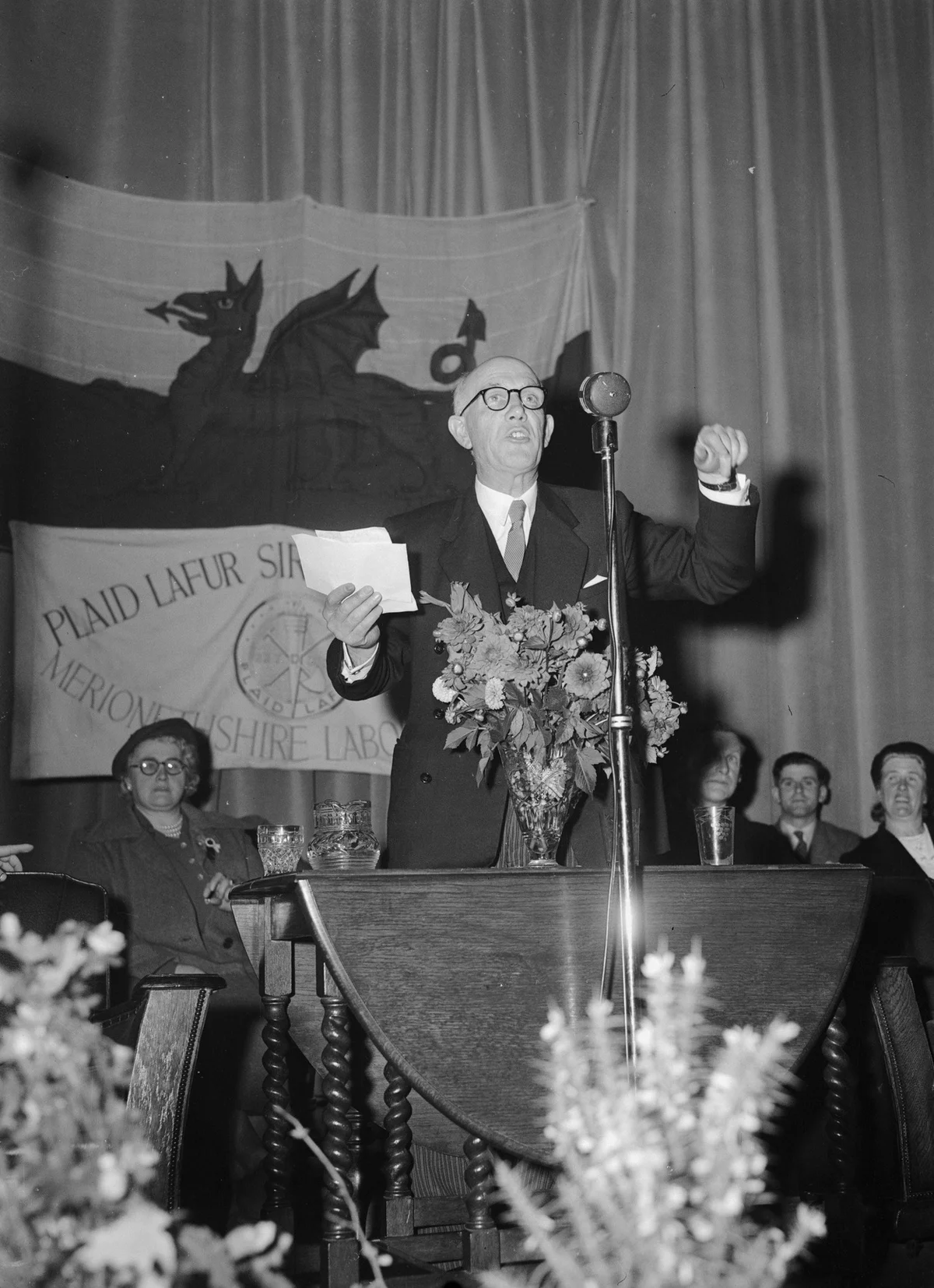
- 9. National Library of Wales / Wikimedia CommonsBevan in Corwen, 3 October 1952: exact photograph and licence
Exact Geoff Charles item, date, sitter and CC BY-SA licence checked; full frame inspected. The catalogue title mentions Jennie Lee, but this caption does not independently identify every seated person.
- 10. Creative CommonsAttribution-ShareAlike 4.0 International licence