In this biography
Quick facts
- Born
- 17 January 1863
- Died
- 26 March 1945
- Birthplace
- Chorlton-on-Medlock, Manchester, England
- Country
- United Kingdom
- Nationality
- Welsh
- Known for
- The People’s Budget, National Insurance and leading a coalition government during the First World War
- Prime minister
- 1916–1922, leading a coalition
- Chancellor of the Exchequer
- 1908–1915
- Constituency
- Caernarvon Boroughs, first elected in 1890
- National Insurance
- Health and unemployment insurance legislation, 1911
Why this life matters
His Treasury reforms helped establish a larger state role in social protection. His wartime administration strengthened central government, while the peace settlement, coercion in Ireland, honours controversy and dependence on Conservative support complicate his reputation as a reformer and war leader.
Timeline
Key moments
Manchester birth and Welsh upbringing
Born in Manchester, raised at Llanystumdwy after his father’s death and completed his legal examinations in 1884.
Entered Parliament
Elected Liberal MP for Caernarvon Boroughs after establishing a solicitor’s practice in Cricieth.
Entered Cabinet and then the Treasury
Became President of the Board of Trade in 1905 and Chancellor of the Exchequer in 1908.
Budget and insurance reforms
The People’s Budget became law in April 1910; National Insurance legislation followed in 1911.
Moved into wartime production and leadership
Served as Minister of Munitions, then Secretary for War, and replaced Asquith as prime minister in December 1916.
Coalition victory and contested settlements
Won the post-war election with coalition allies, participated in the Paris Peace Conference and negotiated the Anglo-Irish Treaty.
Lost Conservative support
Resigned on 19 October after Conservatives decided to end the coalition.
Final months in Wales
Received an earldom in January and died at Tŷ Newydd, Llanystumdwy, on 26 March.
A Manchester birthplace and a Welsh political identity
David Lloyd George was born in Manchester on 17 January 1863. After his father died, his mother took the family to Llanystumdwy in Caernarfonshire, where her brother Richard Lloyd helped raise him. His Welsh upbringing and first language were central to his identity. Describing him as Welsh does not require moving his birthplace across the border.
Legal training supplied a route into public life. He completed his examinations in 1884 and established a solicitor’s practice in Cricieth. Advocacy on behalf of Nonconformists helped build his reputation. Elected for Caernarvon Boroughs in 1890, he pressed questions of church disestablishment, land and Welsh self-government. These causes connected inequalities of wealth with inequalities of religious and political power.
Radical opposition became administrative responsibility
His opposition to the South African War made him nationally conspicuous and exposed him to intense hostility. Yet the campaigning speaker also developed a capacity for negotiation. As President of the Board of Trade from December 1905, he dealt with commercial legislation and industrial disputes, including railway negotiations in 1907. The Cabinet appointment preceded the Liberal election victory of 1906.
Asquith’s accession to the premiership brought Lloyd George to the Exchequer in 1908. He carried forward the pensions legislation already introduced by Asquith, then developed his own programme for financing social reform. Remembering the pension as one man’s invention obscures the successive decisions and ministerial responsibilities through which it reached the statute book.
The Treasury became a battleground over social protection
The 1909 People’s Budget made taxation a public argument about who should finance pensions and other demands on government. Land taxes attracted particular resistance. The Lords’ rejection precipitated an election and a constitutional confrontation, but the Finance Act received royal assent on 29 April 1910. Its passage therefore preceded the Parliament Act of 1911.
National Insurance in 1911 created compulsory schemes addressing sickness and unemployment. These were significant foundations for later welfare provision, with their own contributions and eligibility rules. They were not the universal post-war settlement. The reforms nevertheless made insecurity arising from illness, age and unemployment a larger responsibility of national government rather than leaving relief entirely to families, charity or local institutions.
Wartime leadership emerged from a rupture with Asquith
Lloyd George supported Britain’s war effort in 1914, became Minister of Munitions in 1915 and Secretary for War in 1916. Arguments about production, conscription and strategic direction widened his differences with Asquith. The December 1916 transition followed political manoeuvring and Asquith’s resignation, rather than a general election. Conservative support was crucial to the new coalition.
His smaller War Cabinet concentrated strategic decision-making. Its first meeting on 9 December 1916 was formally minuted by Maurice Hankey and colleagues, whose secretariat became the nucleus of the Cabinet Office. This institutional change mattered beyond Lloyd George’s personal energy: decisions could be recorded and transmitted across departments. Military victory still depended on allied forces, civilian labour and many other leaders.
Victory did not settle the problems of peace
The coalition’s 1918 election success gave him a powerful parliamentary position while continuing dependence on Conservative allies. At the 1919 Paris Peace Conference he helped shape the settlement with Germany, balancing British interests against competing allied demands. His reputation as the leader who had won the war could not guarantee agreement over the peace or prosperity at home.
Ireland exposed the coercive side of his government. The recruitment of the Black and Tans accompanied a violent struggle before negotiations produced the Anglo-Irish Treaty in December 1921. A negotiated agreement did not erase the preceding violence or resolve the divisions among those who accepted and rejected it. His record combines bargaining skill with responsibility for the means used before a settlement.
The coalition’s collapse left a long, disputed afterlife
Unemployment, international difficulties and the honours-for-sale scandal weakened his authority. In October 1922 Conservative MPs decided to fight independently, removing the basis of his coalition. He resigned on 19 October and never again held ministerial office. A leader capable of assembling unusual alliances had failed to create a durable political organisation to sustain them.
He remained active through policy initiatives, memoirs and parliamentary debate. His 1936 visit to Hitler’s Germany and favourable comments damaged his reputation; later criticism of appeasement does not cancel that episode. He received an earldom in January 1945 and died at Llanystumdwy on 26 March. His career leaves substantial reforms alongside divisive choices about party, empire, war and political power.
Quick answers
Frequently asked questions about David Lloyd George
- Was David Lloyd George born in Wales?
- No. He was born in Chorlton-on-Medlock, Manchester, and raised in Llanystumdwy. His Welsh identity and first language are distinct from his birthplace.
- When was Lloyd George prime minister?
- From December 1916 until October 1922. He replaced Asquith during the war and remained in office through a post-war coalition.
- Did the People’s Budget pass after the Parliament Act?
- No. It received royal assent on 29 April 1910. The Parliament Act followed in 1911 as the constitutional confrontation continued.
- Why did his government fall in 1922?
- Conservative withdrawal ended the coalition’s parliamentary basis, after policy difficulties and controversies including the sale of honours had weakened support.
Keep exploring
Lives connected to this story
- Harold Wilson
Compare a later prime minister’s attempts to turn social reform and technical modernisation into durable institutions.
- William Ewart Gladstone
Explore the earlier Liberal tradition and Irish constitutional disputes that preceded Lloyd George’s career.
Sources and further reading
Explore the evidence
These references support the biography and offer further reading. Official records, first-person accounts and independent reporting provide different perspectives; image records document attribution and licensing.
- 1. UK Prime Minister’s OfficeDavid Lloyd George: birth, death and premiership
Birth and death checked against Welsh institutional sources. Its compressed claims putting Budget passage after 1911, the Board of Trade appointment in 1906 and the earldom in 1944 are not adopted.
- 2. Dictionary of Welsh Biography / National Library of WalesDavid Lloyd George: career and family chronology
Career passages were read and cross-checked with focused institutional histories. This is a biographical entry, not a claim that its listed books or the underlying Lloyd George papers were read.
- 3. National Library of WalesDavid Lloyd George exhibition: offices and parliamentary career
- 4. National Library of WalesThe People’s Budget and the Welfare State
- 5. Matthew Johnson / History of GovernmentAsquith, Lloyd George and the December 1916 premiership struggle
- 6. Andrew Blick / History of Government9 December 1916: the War Cabinet and Cabinet Office
- 7. National Library of WalesDavid Lloyd George the Prime Minister: coalition and fall
- 8. National Library of WalesIreland: coercion and the 1921 treaty
Used for coercion and treaty negotiation. The exhibition’s broad claim that Ireland disappeared from British politics is not repeated.
- 9. National Library of WalesVersailles: Lloyd George at the peace conference
- 10. National Library of WalesVisiting Hitler and the Second World War
- 11. UK Parliament, Parliamentary ArchivesFinance Act 1910: royal assent on 29 April
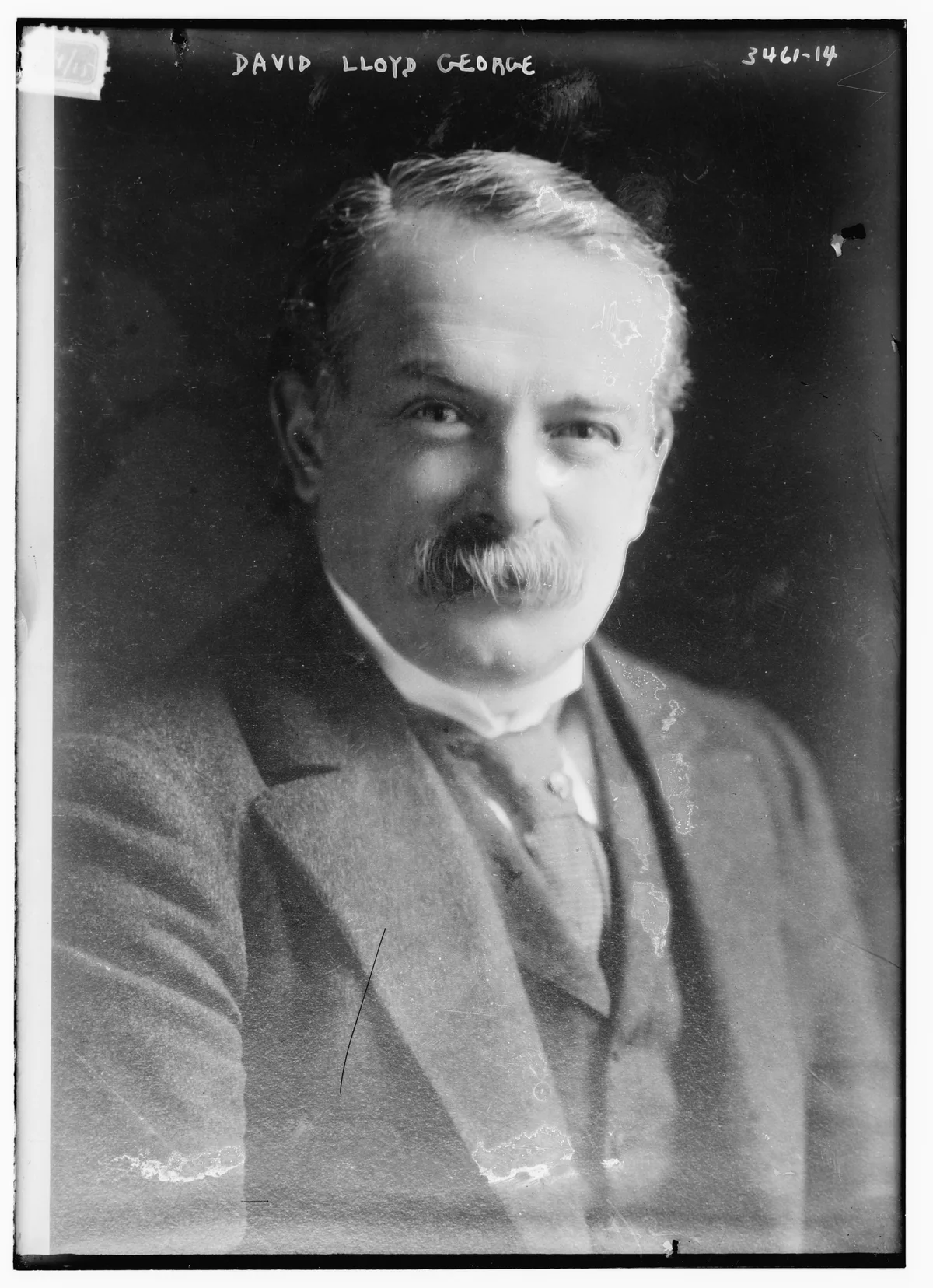
- 12. Library of Congress / Wikimedia CommonsDavid Lloyd George, LCCN2014698950: complete photograph and rights
Exact original-file metadata identifies the sitter, circa 1910–1915 range and public-domain status. The complete scan was visually inspected; no precise sitting date or individual photographer is invented.
- 13. Creative CommonsPublic Domain Mark 1.0