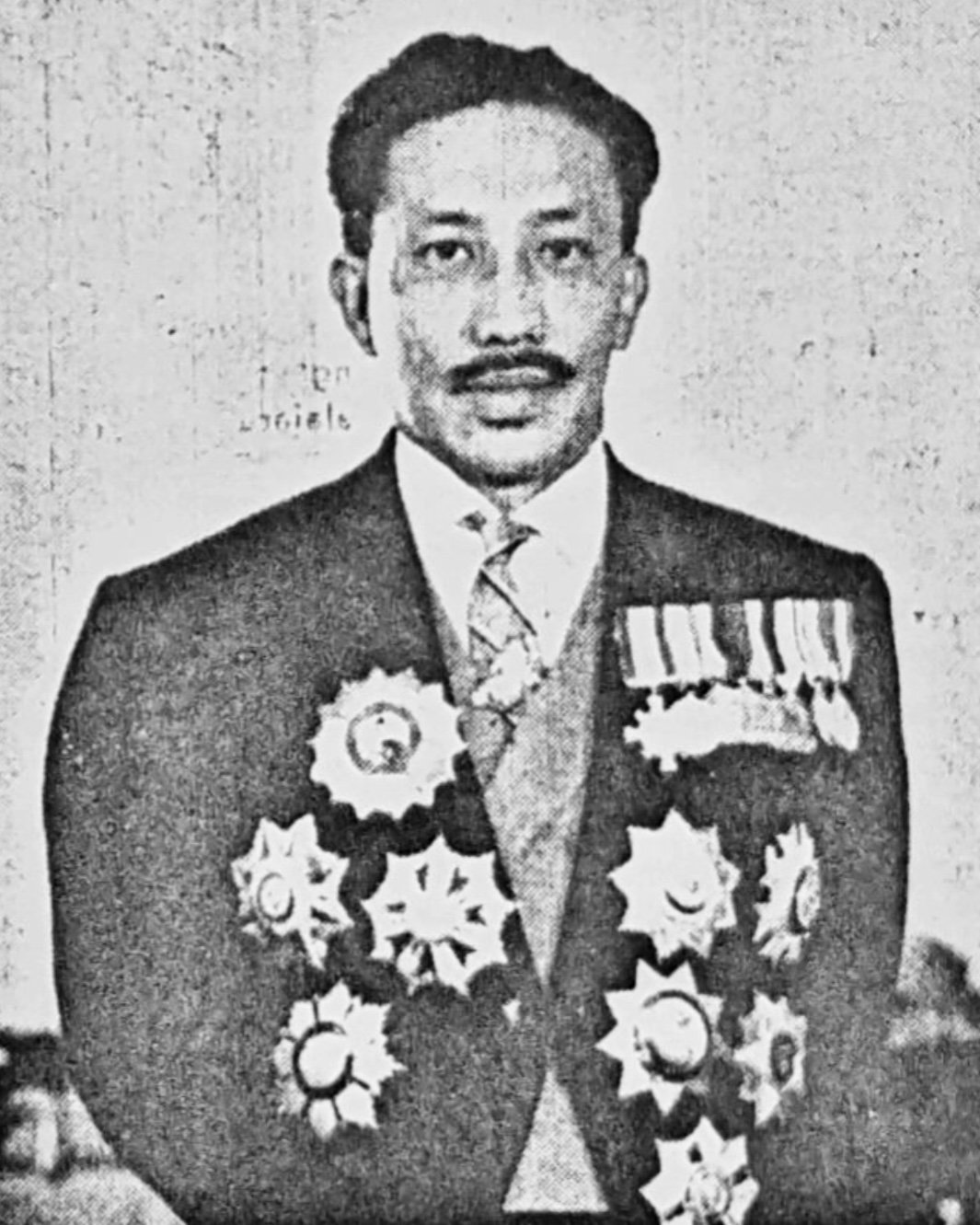
In this biography
Quick facts
- Born
- 28 August 1928
- Died
- 30 May 2002
- Birthplace
- Labuan or Brunei Town · accounts differ
- Country
- Brunei
- Nationality
- Bruneian
- Known for
- Opposing the Malaysia plan and heading the political movement associated with the 1962 Brunei revolt
- Full name
- Sheikh Ahmad M. Azahari bin Sheikh Mahmud
- Party
- Partai Rakyat Brunei · founded 1956
- Political proposal
- Federation of northern Borneo territories
- Later life
- Exile in Indonesia
Why this life matters
Azahari represents the strongest organised challenge to royal government in modern Brunei and connects domestic politics to decolonisation across northern Borneo, Manila and Jakarta.
Timeline
Key moments
Born during the colonial period
Sources disagree whether his birthplace was Labuan or Brunei Town.
Founded the Brunei People’s Party
Built a mass nationalist organisation seeking independence and representative government.
Won the district council elections
The party won 54 of 55 seats and all 16 indirectly elected places in the Legislative Council while opposing Brunei’s entry into Malaysia.
Revolt began
Armed supporters attacked government positions while Azahari was outside Brunei.
Exile in Indonesia
Lived largely in Indonesia after the revolt’s defeat and died in Bogor.
A nationalist shaped by the decolonising region
Sheikh Ahmad M. Azahari bin Sheikh Mahmud was born in 1928, but published accounts disagree over whether his birthplace was Labuan or Brunei Town. His political formation crossed colonial borders: he spent formative years in Indonesia during the revolutionary era and returned to Brunei with an anticolonial vocabulary that linked local reform to the wider Malay-Indonesian world.
Azahari founded the Partai Rakyat Brunei, or Brunei People’s Party, in 1956. It became the protectorate’s principal mass political organisation, pressing for representative government and independence. Its programme also proposed joining Brunei, Sarawak and North Borneo in a united northern Borneo state rather than placing the three territories separately inside the planned Federation of Malaysia.
The proposed state was not presented simply as annexation by Indonesia. Azahari’s model placed the Sultan of Brunei at the head of a constitutional Bornean federation and gave him a prospective role as prime minister. It combined royal legitimacy, popular government and regional nationalism, though support across Sarawak and North Borneo was uneven.
An electoral landslide without control of government
In the August 1962 district council elections, the PRB won 54 of 55 seats and thereby all 16 indirectly elected positions allocated to district representatives in the 33-member Legislative Council. The result demonstrated broad organised support, but it did not produce a cabinet: appointed and ex officio members still outnumbered the elected bloc, and executive authority remained with the Sultan.
The party sought to use the new council to oppose Malaysia, request independence and advance its northern Borneo proposal. The motions were disallowed before the scheduled December sitting. A contemporaneous Australian diplomatic cable judged that the PRB had been well placed to gain eventual political power through normal processes, while stressing that its own explanation of the revolt’s causes was tentative and speculative.
The revolt while Azahari was in Manila
Armed units of the Tentera Nasional Kalimantan Utara, associated with the PRB, began attacks in Brunei and nearby territories on 8 December 1962. British and Gurkha forces rapidly restored government control. Azahari was not commanding operations on the ground: he was in Manila, where he proclaimed the alternative North Kalimantan state and sought diplomatic support.
Manila was important because President Diosdado Macapagal’s government was developing the Philippine claim to North Borneo, now Sabah, while questioning the Malaysia plan. Modern scholarship records that Azahari met Vice-President and Foreign Secretary Emmanuel Pelaez after arriving in late October 1962. His project therefore became entangled with competing British, Malayan, Philippine and Indonesian strategies.
Contemporaneous records do not give one uncontested account of external backing. A February 1963 United States intelligence estimate asserted that Indonesia had provided political, financial and limited military support. An Australian cable written during the revolt said there was then no evidence of material Indonesian aid, although contacts and reports of training existed. The difference should be preserved rather than collapsed into certainty: the documents were produced at different moments and both reflected government assessments.
Exile and a divided historical legacy
Defeat ended the PRB’s legal route to power. Party members were detained or driven abroad, the Legislative Council was dissolved and emergency government reshaped political life. Azahari moved from Manila to Indonesia and spent most of the rest of his life there, continuing to argue for his political programme long after regional diplomacy had moved on.
The revolt formed part of the setting in which Brunei stayed outside Malaysia, but it was not the only cause. Negotiations also foundered over oil revenue, taxation, Brunei’s financial contribution and royal precedence. Separating those issues avoids turning one dramatic week into a complete explanation of the Sultanate’s path to independence.
Azahari died in Bogor on 30 May 2002. To supporters, he represented electoral legitimacy, anticolonial independence and an alternative constitutional future; to the state that defeated the uprising, his movement threatened public order and monarchical government. His historical importance lies in that unresolved divide and in the brief moment when mass electoral politics offered Brunei a markedly different route through decolonisation.
Quick answers
Frequently asked questions about A. M. Azahari
- Who was A. M. Azahari?
- He founded the Brunei People’s Party in 1956 and advocated independence, representative government and a union of Brunei, Sarawak and North Borneo.
- Did the PRB’s 1962 election victory make him prime minister?
- No. Its 54 of 55 district seats yielded all 16 indirectly elected Legislative Council places, not control of the 33-member council or the executive.
- Was Azahari in Brunei when the revolt began?
- No. He was in Manila when armed supporters began the revolt on 8 December 1962. He sought support and proclaimed an alternative state from outside Brunei.
- Do contemporary documents agree about Indonesian backing?
- No. The Australian cable of 11 December 1962 reported no evidence of material aid then; a February 1963 U.S. estimate asserted political, financial and limited military support. These are differently dated government assessments, not a single settled finding.
Keep exploring
Lives connected to this story
- Emmanuel Pelaez
Follow the Philippine foreign secretary whose Manila diplomacy intersected with Azahari’s proposal.
- Diosdado Macapagal
Read the Philippine president’s North Borneo claim and regional policy.
- Omar Ali Saifuddien III
Compare the Sultan’s constitutional authority with the PRB’s elected support.
Sources and further reading
Explore the evidence
These references support the biography and offer further reading. Official records, first-person accounts and independent reporting provide different perspectives; image records document attribution and licensing.
- 1. Office of the Historian, U.S. Department of StateHistorical document on the Brunei revolt and Malaysia
This February 1963 intelligence estimate offers a later government assessment of outside support. It is not a judicial finding and must not erase the earlier cable’s uncertainty.
- 2. Australian Department of Foreign Affairs and TradeCablegram on the Brunei revolt, 11 December 1962
The 11 December 1962 cable explicitly calls its political explanation tentative and speculative. Its “no evidence” statement concerns information available then, not proof that no support ever existed.
- 3. Modern Asian Studies · Cambridge University PressA region in dispute: Manila and the origins of Konfrontasi
- 4. University of Hull Research RepositoryBrunei’s political development and the formation of Malaysia
The thesis supplies constitutional and electoral context. A district-seat landslide is not equivalent to an executive appointment; the disputed birthplace remains qualified.
- 5. Australian National University Open ResearchBrunei and the formation of Malaysia — research paper
- 6. School of Advanced Study, University of LondonBritish documents on the end of empire — Malaysia
- 7. Prime Minister’s Office SingaporeSultan Sir Haji Omar Ali Saifuddien Memorial Lecture
- 8. Sarawak Museum JournalThe centenary of the British Residency in Brunei
- 9. Wikimedia Commons1959 portrait and public-domain record