
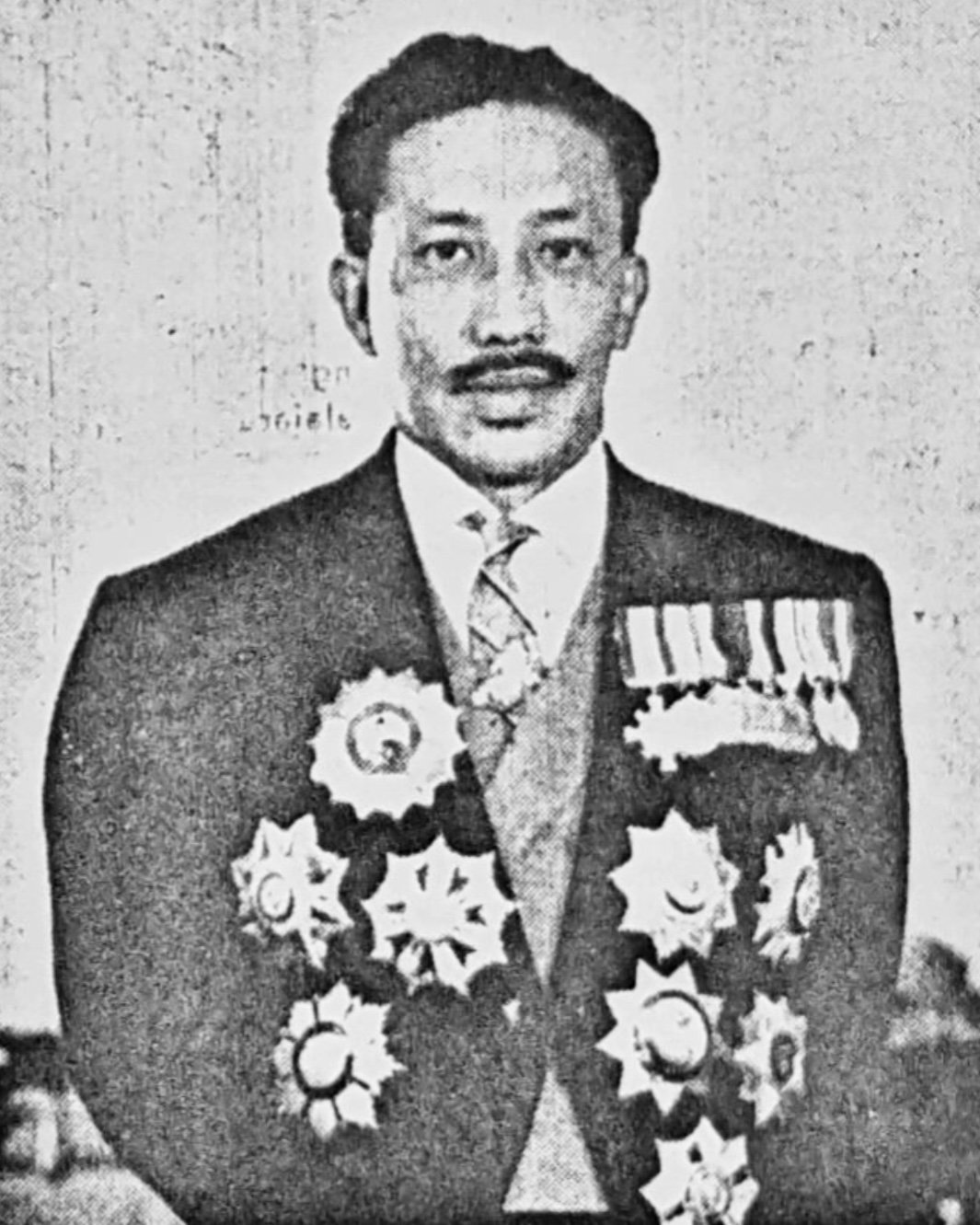
In this biography
Quick facts
- Born
- 23 September 1914
- Died
- 7 September 1986
- Birthplace
- Brunei Town, Brunei
- Country
- Brunei
- Nationality
- Bruneian
- Known for
- The 1959 Constitution, postwar development and preparing Brunei for independence
- Reign
- 1950–1967
- Dynastic position
- 28th Sultan of Brunei
- Constitutional milestone
- Written constitution · 1959
- Later title
- Seri Begawan Sultan
Why this life matters
Omar Ali Saifuddien III linked Brunei’s traditional monarchy to modern ministries, infrastructure and constitutional government, then remained influential after his 1967 abdication.
Timeline
Key moments
Born in Brunei Town
Born into the royal house on 23 September.
Became the 28th Sultan
Succeeded Sultan Ahmad Tajuddin and began a seventeen-year reign.
First national development plan
Directed oil revenue into roads, public services, education and infrastructure.
Promulgated the Constitution
The written constitution established internal self-government, replaced the British Resident with a High Commissioner and created new governing institutions.
Abdicated
Voluntarily transferred the throne to his eldest son, Hassanal Bolkiah.
Served independent Brunei
Became the first minister of defence when full independence transferred responsibility for defence to Brunei.
From royal administrator to the 28th Sultan
Omar Ali Saifuddien was born in Kampong Sultan Lama on 23 September 1914, a son of Sultan Muhammad Jamalul Alam II. He studied at the Malay College Kuala Kangsar and worked in Brunei’s administrative and legal departments before succeeding his brother, Ahmad Tajuddin, in June 1950. That experience gave the new sultan direct knowledge of the British Residency system he would later renegotiate.
His accession came as Brunei recovered from wartime destruction and petroleum income made a much larger public programme possible. The first five-year development plan, covering 1953 to 1958, channelled oil revenue into roads, electricity, telecommunications, schools, hospitals, clinics and government capacity. Later official histories called him the Architect of Modern Brunei because state institutions and everyday infrastructure expanded together during his reign.
The 1959 Constitution and internal self-government
The transformation was constitutional as well as physical. Negotiations with Britain produced the written Constitution proclaimed on 29 September 1959. It ended the British Resident system, replaced the Resident with a High Commissioner and established offices including chief minister, attorney general, state financial officer and state secretary, alongside the Privy Council, Council of Ministers and Legislative Council.
Internal self-government did not mean a transfer to parliamentary rule. The Constitution identified the Sultan as the supreme executive authority, while Britain retained responsibility for defence and external affairs. This distinction matters: the settlement modernised administration and reduced direct British control, but it preserved royal authority at the centre of government.
The first development plan and the Constitution therefore formed one state-building project. New schools and overseas scholarships were intended to prepare Bruneians for public service, while health care, transport and communications gave a small, dispersed population more direct contact with national institutions.
The 1962 revolt and the Malaysia decision
The new order soon faced a mass opposition movement. The Brunei People’s Party dominated the August 1962 district council elections, opposed entry into the proposed Federation of Malaysia and advocated a separate northern Borneo federation. Its inability to convert electoral support into control of government intensified a constitutional confrontation. Armed units associated with the party began the Brunei revolt on 8 December 1962; British forces defeated it and emergency government followed.
Omar Ali Saifuddien had earlier accepted the Malaysia proposal in principle, subject to acceptable terms. Brunei did not sign the July 1963 Malaysia Agreement. Accounts of the negotiations identify several unresolved questions, including oil revenue, federal taxation, Brunei’s financial contribution and the Sultan’s precedence. The revolt changed the political setting, but it should not be treated as the sole explanation for Brunei remaining outside the federation.
Abdication, independence and the Seri Begawan legacy
He voluntarily abdicated in October 1967, and his eldest son was proclaimed Sultan Hassanal Bolkiah on 5 October. Taking the title Seri Begawan Sultan, Omar Ali Saifuddien remained an influential adviser while the younger monarch learned the administration and negotiations with Britain continued.
A 1971 amendment ended Britain’s advisory role in Brunei’s internal affairs, although defence and foreign affairs remained British responsibilities. The Treaty of Friendship and Co-operation signed in 1979 set the path to full sovereignty on 1 January 1984. When the independent government created a Ministry of Defence, the former sultan became its first minister.
Omar Ali Saifuddien died on 7 September 1986. His legacy combines material development, constitutional state-building and the preservation of a separate Bruneian monarchy. The same record also established a centralised political system in which elected opposition did not become the government—a tension essential to understanding both his achievements and modern Brunei.
Quick answers
Frequently asked questions about Omar Ali Saifuddien III
- Who was Omar Ali Saifuddien III?
- Omar Ali Saifuddien III was the 28th Sultan of Brunei and architect of the modern state. Omar Ali Saifuddien III linked Brunei’s traditional monarchy to modern ministries, infrastructure and constitutional government, then remained influential after his 1967 abdication.
- What is Omar Ali Saifuddien III best known for?
- Omar Ali Saifuddien III is best known for the 1959 Constitution, postwar development and preparing Brunei for independence.
- When and where was Omar Ali Saifuddien III born?
- Omar Ali Saifuddien III was born on 23 September 1914 in Brunei Town, Brunei.
- When did Omar Ali Saifuddien III die?
- Omar Ali Saifuddien III died on 7 September 1986.
Sources and further reading
Explore the evidence
These references support the biography and offer further reading. Official records, first-person accounts and independent reporting provide different perspectives; image records document attribution and licensing.
- 1. Information Department of Brunei DarussalamBrunei in Brief 2017 — historical background
- 2. Attorney General’s Chambers of Brunei DarussalamConstitution of Brunei Darussalam — revised edition 2022
- 3. Information Department of Brunei DarussalamBrunei Darussalam annual report — constitutional development
- 4. Ministry of Defence, Brunei DarussalamHistory of the Ministry of Defence
- 5. Information Department of Brunei DarussalamOmar Ali Saifuddien Mosque and the Architect of Modern Brunei
- 6. Prime Minister’s Office SingaporeSultan Sir Haji Omar Ali Saifuddien Memorial Lecture
- 7. Wikimedia Commons1963 portrait and public-domain record


