In this biography
Quick facts
- Born
- 19 September 1851
- Died
- 7 May 1925
- Birthplace
- Bolton, Lancashire, England, United Kingdom
- Country
- United Kingdom
- Nationality
- British
- Known for
- Building the Sunlight soap business and the Port Sunlight workers’ village, alongside a colonial palm-oil enterprise
- Sunlight trademark
- Registered in 1884
- Lever Brothers
- Founded with James Lever in 1885
- Port Sunlight
- Construction inaugurated in 1888; production and first tenants in 1889
- Later company history
- Unilever formed in 1930, after his death
Why this life matters
Lever’s career connects branded consumer goods, industrial welfare, public art and colonial supply. It shows why a founder’s philanthropy and the treatment of workers across an international business must be examined together.
Timeline
Key moments
Born in Bolton
Born on 19 September into a wholesale-grocery family.
Partner in the family firm
Becomes a partner in Lever & Co. after working in the business as a young man.
Soap brand and partnership
Sunlight is registered in 1884; William and James form Lever Brothers in 1885.
Port Sunlight begins
Factory construction begins in 1888; soap production and the first village tenancies follow in 1889.
Congo palm oil
An agreement with the Belgian government establishes Huileries du Congo Belge within the Lever business.
Public art gallery opens
The Lady Lever Art Gallery opens on 16 December; Lever is also created a viscount that year.
Death
Dies on 7 May, five years before Lever Brothers and Margarine Unie combine as Unilever.
A grocery background before the soap business
William Hesketh Lever was born in Bolton on 19 September 1851. His father’s wholesale grocery firm supplied his first commercial education. Bolton’s museum records his entry at fifteen, beginning with tasks including wrapping soap before becoming a commercial traveller. In 1872 he became a partner. The later manufacturer therefore began with practical experience of selling and distributing goods that other people made.
He married Elizabeth Hulme in 1874. Her surname later joined his own in the title Leverhulme, adopted when he became a baron in 1917; a viscountcy followed in 1922. These honours can make the beginning of his life sound aristocratic. His working setting was instead a family trading business, with its established customers, credit and routes to market.
Sunlight made a familiar product recognizable
The Sunlight trademark was registered in 1884. Individually wrapped bars gave soap a recognizable identity that could be requested by name, promoted and distributed beyond a single shop. William and his brother James founded Lever Brothers in 1885. It is useful to distinguish this partnership from the earlier family grocery firm and from the much later corporation named Unilever.
Increasing demand required more than advertising. The small Warrington operation needed room to expand, and transport mattered to the choice of a new site. Road, railway and water connections made the Wirral location commercially attractive. Lever’s achievement lay in coordinating product, manufacturing capacity and marketing; he neither invented soap nor made the work of chemists, factory employees and distributors unnecessary.
Port Sunlight joined a factory to a community
Construction at Port Sunlight was inaugurated on 3 March 1888, with Elizabeth cutting the first sod. Soap production began there in June 1889 and the first tenants arrived that September. William Owen and other architects helped turn a growing industrial site into a village. Its varied buildings and open spaces were developed over time, rather than delivered as one finished settlement in 1888.
The houses offered families more space and domestic facilities than many workers could obtain in crowded industrial districts. Schools, recreation and a hospital extended the project beyond accommodation. Lever called this arrangement prosperity-sharing: benefits were provided through housing and services rather than simply distributed as cash. The expectation that good conditions would strengthen loyalty was part of the business model.
Welfare also raised questions about power
Originally, village housing was available to employees and people closely connected with the firm. That link matters when assessing the experiment. An employer could improve daily life while remaining a powerful influence over the community in which employees lived. Attractive architecture alone cannot tell us how much independent choice a tenant possessed or whether every resident welcomed the same social arrangements.
Port Sunlight should consequently be read as an institution with competing purposes. It addressed overcrowding and access to green space, while serving recruitment, stability and the company’s reputation. Residents, designers and maintenance workers also made the settlement function. Treating the village only as a monument to its founder obscures their contribution and avoids the harder question of who decided how the benefits of industrial wealth should be shared.
Colonial palm oil challenges the benevolent image
Palm oil linked the soap business to colonial Africa. In 1911 Lever agreed with the Belgian government to establish Huileries du Congo Belge, or HCB. Port Sunlight Village Trust’s research describes coercive recruitment involving company managers, colonial authorities and chiefs. The resulting forced labour directly contradicts a story in which care for workers was applied evenly across the enterprise.
A University of Liverpool report examines both the abuses and the limits of corporate records. Silence in management correspondence is not proof that violence did not occur. Equally, the report’s financial analysis cautions against assigning a simple, constant profit figure to the Congo operation. These findings support a serious account of exploitation without inventing a plantation inspection or attributing every local action to a surviving personal order from Lever.
Public collections and a company that outlived him
Lever bought Hall i’ th’ Wood and presented it to Bolton in 1902 as a museum commemorating Samuel Crompton. His collecting also produced the Lady Lever Art Gallery, which opened at Port Sunlight on 16 December 1922 after wartime delays. Paintings, furniture and ceramics became accessible through a public institution. That cultural legacy is substantial, though it cannot settle questions about the business’s supply chain.
He died on 7 May 1925. Lever Brothers continued, merging with Margarine Unie in 1930 to form Unilever. Calling him the founder of that 1930 organization collapses separate moments and ignores the people who negotiated the later combination. His historical significance is clearer when the commercial founder, employer, colonial investor and collector remain visible together, with neither philanthropy nor criticism substituting for the rest of the record.
Quick answers
Frequently asked questions about William Hesketh Lever
- Did William Lever found Unilever?
- He co-founded Lever Brothers with his brother James in 1885. Unilever was formed by a later merger in 1930, five years after his death.
- Was Port Sunlight built in 1888?
- Construction began in 1888. Soap production and the first tenancies followed in 1889, and the village continued to develop over decades.
- Why is his philanthropy controversial?
- Housing and public art in Britain coexisted with forced labour in the Congo operations of Lever Brothers subsidiary HCB. Institutional and university research examine that unequal treatment.
Keep exploring
Lives connected to this story
- Thomas Lipton
Compare a branded food business whose supply chain also depended on colonial production and labour.
- John Cadbury
Distinguish another consumer-business founder from the later family, company and model-village history.
- Isambard Kingdom Brunel
Explore the engineering practice and collective investment behind another large Victorian enterprise.
Sources and further reading
Explore the evidence
These references support the biography and offer further reading. Official records, first-person accounts and independent reporting provide different perspectives; image records document attribution and licensing.
- 1. Bolton Libraries and MuseumsLord Leverhulme: grocery background, marriage and Hall i’ th’ Wood
- 2. Port Sunlight Village TrustHistory and heritage: business model and dated chronology
Village Trust chronology distinguishes the 1888 start, 1889 production and tenancies, 1925 death and 1930 merger. Its account explicitly identifies the commercial purpose of prosperity-sharing.
- 3. Store norske leksikonWilliam Hesketh Lever: biographical dates and 1885 partnership
University-owned Norwegian reference work supplies exact birth/death dates and corroborates the 1885 partnership; its brief peerage wording is checked against the more detailed Village Trust timeline.
- 4. MyLearning / Port Sunlight MuseumThe Story of Port Sunlight: Soap Success
- 5. MyLearning / Port Sunlight MuseumLiving and Working Conditions at End of 19th Century
- 6. MyLearning / Port Sunlight MuseumTown Planning
- 7. MyLearning / Port Sunlight MuseumModern Houses: accommodation and employee tenancies
- 8. Parks & GardensPort Sunlight: historic landscape register account
- 9. National Museums LiverpoolCentenary Celebrations for Lady Lever Art Gallery: 1914 foundation and 1922 opening
- 10. Port Sunlight Village TrustRacism, the Belgian Congo, and William Lever, second edition, June 2022
Read the Trust’s 2022 booklet on HCB, coercion and racial hierarchy. Its statement that 1923 was a year before Lever’s death is an error; death was in 1925. No precise early-profit claim is adopted.
- 11. University of Liverpool / Royal African SocietyCho, Cross and Tierney: Report on Lever Brothers’ Plantations in the Solomon Islands and Belgian Congo c.1900–1930s, selected passages
Read selected executive-summary, financial and Congo labour passages, including printed pp.53 and 86; not the complete 214-page report or underlying archives. The report complicates the older booklet’s simplified profitability chronology.
- 12. Revealing Histories / Bolton Museums and Archive ServiceTobacco box: philanthropy and Congo forced labour
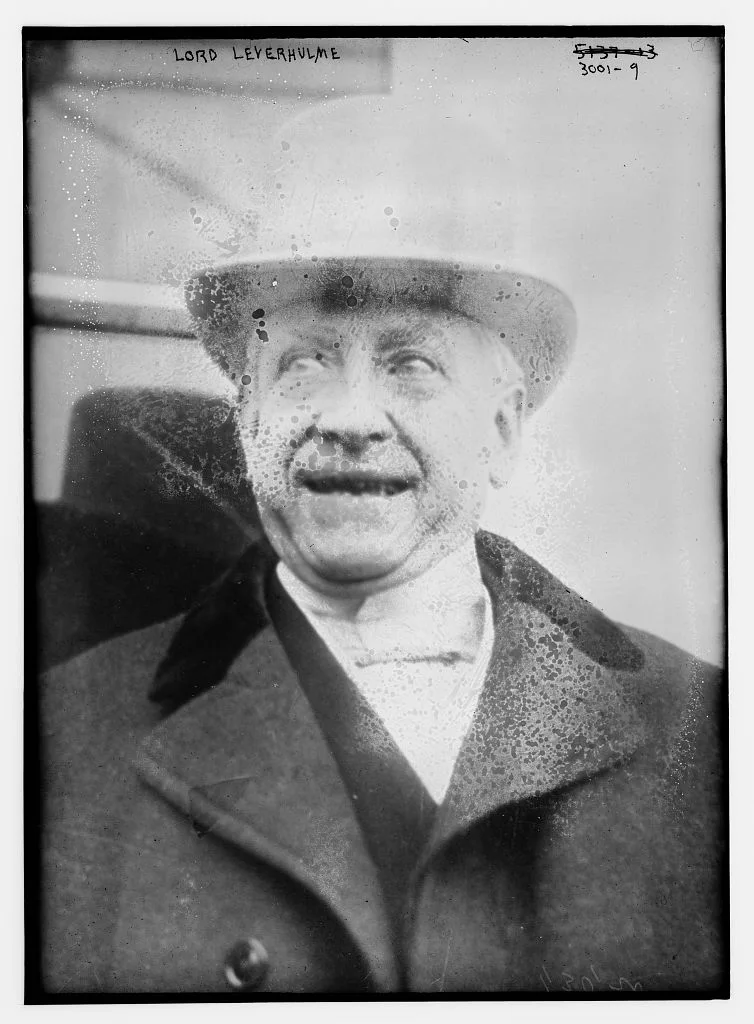
- 13. Wikimedia Commons / Library of CongressLord Leverhulme, LCCN 2014695537: exact Bain image record
Exact Bain image identity and source link checked. Commons labels it 1910, while its handwritten title uses Leverhulme, adopted later; no precise sitting date is asserted. The direct 754 × 1024 Library JPEG is used, not the later large Commons derivative.
- 14. Library of CongressGeorge Grantham Bain Collection: Rights and Restrictions Information