In this biography
Quick facts
- Born
- 10 May 1848 or 1850
- Died
- 2 October 1931
- Birthplace
- Glasgow, Scotland, United Kingdom
- Country
- United Kingdom
- Nationality
- Scottish
- Known for
- Building a chain of provision shops and a tea business linking plantation ownership, branded packets and retail distribution
- First independent shop
- Stobcross Street, Glasgow, 1871 in Glasgow’s museum chronology
- Tea estates
- Acquired in Ceylon around 1890
- Company milestone
- Business incorporated in 1898
- Sport
- Five America’s Cup challenges, 1899–1930
Why this life matters
Lipton’s career connects multiple-shop retailing, control of supply, mass advertising and empire. It also shows how a founder’s public personality can obscure the workers and institutions behind a familiar consumer brand.
Timeline
Key moments
Born in Glasgow
His parents had migrated from County Fermanagh; published accounts disagree over his birth year.
Work in the United States
Works in agriculture and the New York grocery trade before returning to Glasgow.
Independent provision shop
Glasgow museum accounts date his Stobcross Street business to 1871.
A chain and a tea supply
Expands his grocery outlets and begins acquiring estates in colonial Ceylon around 1890.
Incorporation and knighthood
His businesses become a limited liability company; he is also knighted.
The Shamrock challenges
Challenges five times for the America’s Cup through Royal Ulster Yacht Club without winning.
Death and bequest
Dies on 2 October; leaves substantial charitable gifts and his personal collection to Glasgow.
Glasgow origins and an uncertain birth year
Thomas Johnstone Lipton was born in Glasgow to parents from County Fermanagh who had left Ireland after the famine. Their provision shop gave him an early connection to food trading. His familiar birth date needs a qualification: accounts agree on 10 May but use both 1848 and 1850. The Dictionary of Irish Biography explicitly treats the year as unresolved, so a confident modern age should not conceal the disagreement.
He worked in the United States during the 1860s, including agricultural employment and the New York grocery trade. The American experience exposed him to forceful selling and display. Returning to Scotland, he brought those methods into a commercial world he already knew through his family. His career grew from migration, practical work and existing trading connections, rather than from inventing grocery retailing.
A provision merchant learned to attract a crowd
Glasgow museum accounts date Lipton’s independent shop in Stobcross Street to 1871. Butter, ham, cheese, eggs and other basic provisions were central to the trade. A surviving voucher dated 16 March 1877 offers a pound’s worth of ham, butter or eggs for fifteen shillings. It makes his discount promotion concrete, beyond the later tea-and-yachting celebrity.
He developed a chain of shops and cultivated publicity with conspicuous displays and promotional events. The objective was commercial: make the name recognizable, bring shoppers through the door and encourage repeat purchases. Low prices needed reliable purchasing and distribution as well as attention. Advertising could stimulate demand, but customers still had to receive the provisions for which they paid.
Tea became a business of supply and branding
Tea offered a route beyond the identity of one grocery chain. Around 1890 Lipton acquired estates in Ceylon, now Sri Lanka, connecting production with the distribution network he had developed in Britain. The Ceylon Tea Museum describes his use of colourful packets and eventual sales through other retailers. The branded product could travel farther than the shops that first carried it.
This was an expansion of an established industry. James Taylor and many others had developed Ceylon tea before Lipton arrived. By 1890 tea already accounted for most of the island’s highland exports. Buying estates and controlling more stages of supply was commercially significant; it did not make Lipton the discoverer of tea, its first planter or the sole architect of its international market.
The plantation economy behind the packet
Ceylon was a British colony, and tea production depended on a large workforce, including Tamil migrants from southern India and their families. They plucked leaves and sustained the plantations on which merchant fortunes depended. A history confined to retail prices or a picturesque estate view leaves this work outside the frame.
The American Institute for Sri Lankan Studies explains how poverty, recruitment and debt constrained plantation workers’ choices, with women performing much of the plucking. That is evidence about the wider plantation system, not a complete inspection of every Lipton estate. It nevertheless changes the meaning of the success story: affordable tea in Britain and wealth for an owner did not demonstrate equitable conditions for the people producing it.
Yachting made the merchant a public personality
In 1898 Lipton’s businesses were incorporated and he received a knighthood. His first America’s Cup challenge followed in 1899. Through Royal Ulster Yacht Club he entered five campaigns with yachts named Shamrock, ending in 1930. He never won the Cup, but his persistence and public manner helped make him an international celebrity.
The campaigns also carried commercial value: American readers encountered the merchant and his tea together. Royal connections did not erase distinctions of class, and the Royal Yacht Squadron admitted him only late in life. His sporting reception shows how money, sociability and publicity could open doors while the status of a person who earned his fortune in trade remained contested.
A charitable legacy and an unusually visible archive
Lipton died on 2 October 1931 and was buried with his family in Glasgow’s Southern Necropolis. He left substantial wealth for charitable purposes in the city. His papers, photographs and memorabilia also went to Glasgow. The Mitchell Library preserves more than a hundred volumes of press cuttings and photographs, a collection especially rich in his social life and Cup campaigns.
That abundance needs interpretation. A businessman who invested heavily in publicity naturally left many records of his public image. The archive is a starting point for studying how a celebrity merchant was presented, alongside the less glamorous history of shops, suppliers and labour. His philanthropy belongs in the account without serving as proof that every earlier commercial relationship was fair.
Quick answers
Frequently asked questions about Thomas Lipton
- Was Thomas Lipton born in 1848 or 1850?
- Both years appear in published histories. The Royal Irish Academy’s Dictionary of Irish Biography says the year cannot be conclusively determined; this profile retains that uncertainty.
- Did Lipton introduce tea cultivation to Ceylon?
- No. He bought estates around 1890, after tea cultivation and exports had already developed. His contribution centred on ownership, distribution and marketing.
- Did Thomas Lipton win the America’s Cup?
- No. His five challenges through Royal Ulster Yacht Club, from 1899 to 1930, were unsuccessful.
Keep exploring
Lives connected to this story
- Mary Quant
Compare expansion through manufacturing contracts and licensing with Lipton’s ownership of more stages of supply.
- John Cadbury
Read another British food-business founder whose later brand history requires distinguishing generations and institutions.
Sources and further reading
Explore the evidence
These references support the biography and offer further reading. Official records, first-person accounts and independent reporting provide different perspectives; image records document attribution and licensing.
- 1. Royal Irish AcademyIan d’Alton, Lipton, Sir Thomas Johnstone: Dictionary of Irish Biography
Royal Irish Academy biography identifies unresolved birth-year evidence and supplies family, incorporation and death details. Its tea-estate date is 1889, while the museum and AISLS use 1890; the biography uses around 1890.
- 2. The Glasgow Story / Glasgow MuseumsSir Thomas J Lipton: retail chain, plantations and incorporation
- 3. The Glasgow Story / Glasgow MuseumsLipton Note: 1877 business document and 1871 shop chronology
- 4. History ScotlandTea magnate Thomas Lipton is born: competing birth years
- 5. Ceylon Tea MuseumHistory: Taylor, Lipton, plantations and packaged tea
Trade-museum history supplies packaging and retail expansion. Its early-return/shop chronology is internally awkward; the independent-shop date follows the Glasgow museum account. Promotional superlatives and claims of uniquely introducing packaging are not adopted.
- 6. Brand ScotlandScotland’s legacy in Sri Lanka: commercial context
- 7. American Institute for Sri Lankan StudiesWorld History of Tea: empire, production and Lipton
- 8. American Institute for Sri Lankan StudiesTea and Immigrant Labor
Teaching resource used for the wider plantation labour system. It is not presented as an estate-level audit of Lipton employment practices.
- 9. Modern Asian Studies / Humboldt University repositoryRoland Wenzlhuemer, Indian Labour Immigration and British Labour Policy in Nineteenth-Century Ceylon: abstract
- 10. Mitchell Library / Glasgow LifeSir Thomas Lipton collection introduction
Read the collection introduction, not the complete newspaper volumes or underlying business accounts.
- 11. Royal Ulster Yacht ClubSir Thomas Lipton: five America’s Cup challenges
- 12. America’s CupThe Lipton Era Begins: the 1898 challenge and 1899 contest
- 13. Smithsonian National Museum of American HistoryLipton: Warshaw Collection archival-material description
- 14. The Tropical Agriculturist / Tamil Digital LibraryOctober 1890: contemporary Lipton estate advertising, printed p.235
- 15. Library of CongressComplete Bain photograph ggbain.04328: source JPEG
- 16. Library of CongressBain Collection: Rights and Restrictions Information
- 17. Wikimedia CommonsThomas Lipton: exact Bain file identity and date cross-check
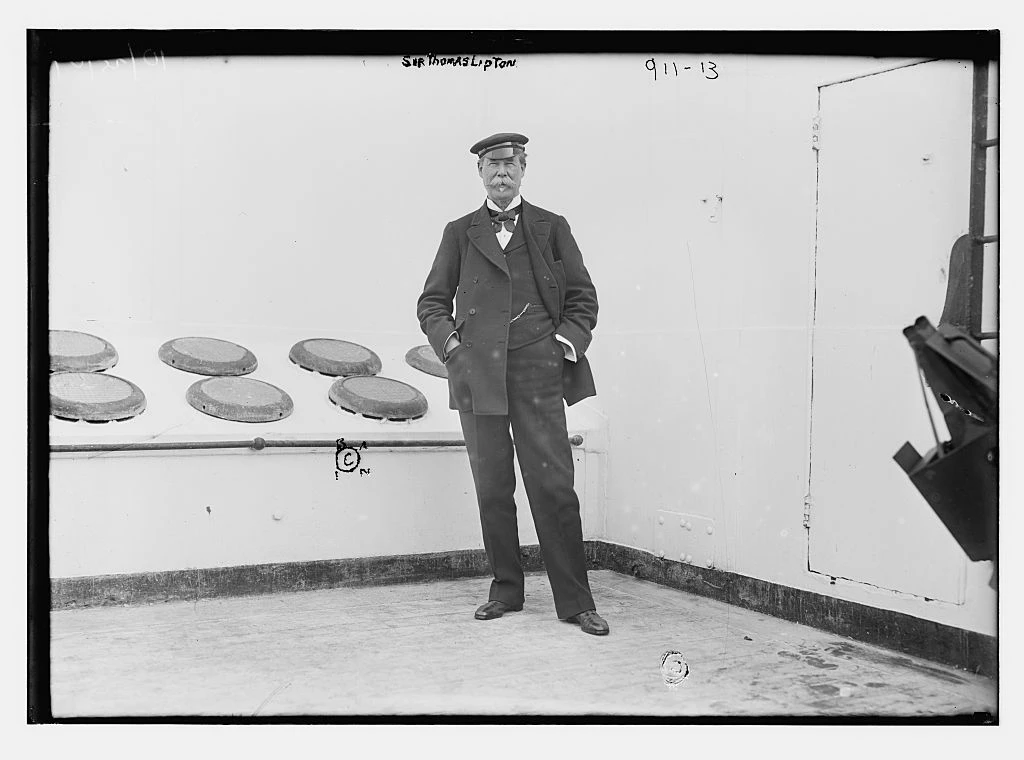
The exact Commons record identifies Bain digital ID ggbain.04328 and 25 October 1909. Its portrait derivative is cropped; the website uses the full source JPEG downloaded directly from the Library of Congress instead.