In this biography
Quick facts
- Born
- 26 November 1810
- Died
- 27 December 1900
- Birthplace
- Shieldfield, Newcastle upon Tyne, England
- Country
- United Kingdom
- Nationality
- English
- Known for
- Hydraulic cranes, Elswick Works, armaments and Cragside
- First profession
- Solicitor
- Crane patent
- 1846
- Elswick production
- Began in 1847
- Spouse
- Margaret Ramshaw, married 1835
- Peerage
- Baron Armstrong of Cragside, 1887
Why this life matters
Armstrong connected hydraulic power with large-scale manufacturing and international sales, making Elswick a major industrial centre with far-reaching military consequences.
Timeline
Key moments
Born in Newcastle
His father was a corn merchant and local politician.
Law and marriage
Armstrong became a legal partner and married Margaret Ramshaw.
Hydraulic demonstration and crane
A model demonstration preceded quayside installation and a lifting-machinery patent.
Elswick Works
The partners established manufacturing beside the Tyne.
Industrial expansion
Hydraulic machinery was joined by armaments, warships and experiments at Cragside.
Peerage and later life
Armstrong became a baron and died at Cragside in 1900.
A legal career alongside scientific curiosity
William George Armstrong was born in Shieldfield, Newcastle upon Tyne, on 26 November 1810. His father, also William Armstrong, was a corn merchant and local politician. The younger Armstrong followed the legal career his father encouraged, training as a solicitor and becoming a partner in Armorer Donkin’s firm in 1835.
That year he married Margaret Ramshaw. Scientific interests developed alongside professional work rather than replacing it immediately. Experiments in water power and electricity grew out of local observation and contact with Newcastle’s scientific community. Donkin later helped finance the move into engineering, showing how commercial and personal networks supported Armstrong’s change of occupation.
From a model crane to useful hydraulic power
Armstrong demonstrated a model hydraulic crane to Newcastle’s Literary and Philosophical Society in December 1845. In 1846 he obtained permission to apply the system on the quayside and patented lifting, lowering and hauling apparatus. Water supplied under pressure moved working parts that could raise and control a load, offering an alternative to hand-operated lifting.
The first successful crane depended on the town’s water supply and an existing port economy, not on an isolated invention. Later the weight-loaded hydraulic accumulator made pressure available without relying on a sufficiently high reservoir. Pumping water beneath a weighted piston stored energy for machinery to draw upon as needed. That development widened the practical reach of hydraulic installations.
Building Elswick through partners and labour
W. G. Armstrong & Company established its works at Elswick in 1847, with production beginning that October. The firm made cranes and other hydraulic equipment for docks, railways, mines and industrial customers. Donkin and fellow partners contributed capital; designers, foundry workers and machinists converted plans into reliable equipment that could survive daily service.
The works expanded substantially over the following decades. Newcastle University’s comparison of early and late maps shows factories and dense workers’ housing replacing a more open landscape. Industrial growth brought employment while transforming the Tyne and its communities. The company’s later name, Armstrong Whitworth, followed a merger in 1897 and should not be projected backwards onto the original 1847 enterprise.
Guns, government work and global sales
Armstrong entered armaments manufacturing during the 1850s, developing a rifled breech-loading field gun amid the demands of the Crimean War. Government orders and official recognition enhanced his standing. Work at Elswick moved beyond civilian machinery towards a combination of gun production, naval equipment and shipbuilding that served customers around the world.
Foreign arms sales provoked criticism because technical improvement also meant greater destructive capacity. Armstrong defended the trade, but its consequences cannot be separated from the wealth it generated. Newcastle University explicitly describes indiscriminate overseas selling after the government relationship changed; the National Trust likewise identifies armaments as a foundation of his fortune. Philanthropy and military commerce therefore belong in the same account.
Public gifts and the final industrial legacy
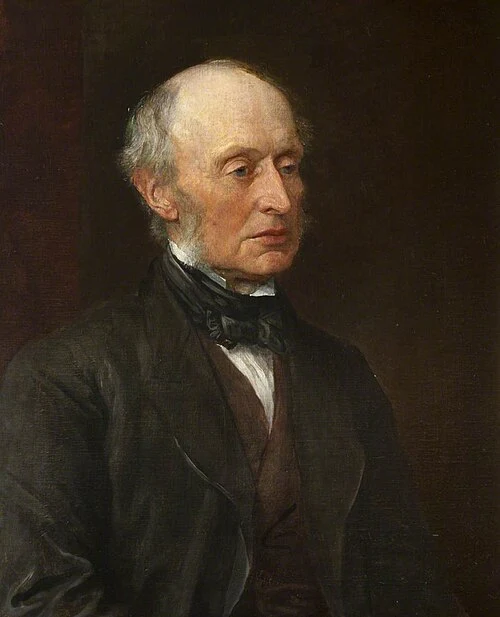
Armstrong supported Newcastle institutions and gave Jesmond Dene for public enjoyment. His assistance to the College of Physical Science contributed to the institutional ancestry of Newcastle University. He became Baron Armstrong of Cragside in 1887. Margaret died in 1893; William died at Cragside on 27 December 1900. They had no children, and a great-nephew inherited.
His career demonstrates how an engineering business could grow from a specific useful machine into a vast industrial concern. It also resists a single verdict. Hydraulic power, scientific curiosity and civic generosity coexist with arms exports and major changes to urban working life. The surviving house and gardens preserve only one part of the much larger world that paid for them.
Quick answers
Frequently asked questions about William George Armstrong
- Was Armstrong originally an engineer by profession?
- He trained and worked as a solicitor. Water-power experiments and the success of his cranes led him into engineering manufacture during the 1840s.
- What did the hydraulic accumulator do?
- Pumps forced water under a weighted piston, storing energy as pressure for machinery to use. It reduced dependence on a high natural reservoir or water tower.
- Did Armstrong invent electric lighting at Cragside?
- He developed the estate’s power systems and adopted new lighting, but worked with others. Joseph Swan’s incandescent lamps were installed in 1880; earlier arc lighting was different equipment.
- Why are arms sales central to his biography?
- Armaments and warships generated a substantial part of his wealth and international business. Their military effects and controversy are integral to the same career as his civilian inventions and public gifts.
Keep exploring
Lives connected to this story
- Joseph Whitworth
A fellow precision engineer and weapons manufacturer whose firm merged with Armstrong’s in 1897.
- James Watt
An earlier example of machinery developed through finance, partnerships and skilled manufacture.
Sources and further reading
Explore the evidence
These references support the biography and offer further reading. Official records, first-person accounts and independent reporting provide different perspectives; image records document attribution and licensing.
- 1. Newcastle University Special CollectionsLord Armstrong: bicentenary biography and archive exhibition
The 2010 biography, selected archive-exhibition sections on water supply, Elswick and maps, and the 1897 Swan-letter discussion were read. Displayed archive images and the complete manuscript collections were not independently analysed.
- 2. Dictionary of National Biography, 1901 supplement / WikisourceArmstrong, William George: selected early hydraulics passages
Selected 1845 lecture, January 1846 permission, July patent and early-works passages were read. Its detailed chronology is compared with modern institutional accounts rather than treated as a complete neutral history.
- 3. National TrustHistory of Cragside: William, Margaret, engineering and armaments
- 4. BAE Systems HeritageElswick: chronology of the engineering works
The successor company’s Elswick history supports chronology but is not independent assessment of arms sales. Newcastle University and the National Trust supply that context.
- 5. University of Melbourne, History of the TorpedoArmstrong, Sir William: industrial chronology
- 6. Association for Industrial ArchaeologyIndustrial Archaeology News 157: William Armstrong, page 4
The William Armstrong account on printed page 4 of issue 157 was read through indexed text, including its 1850–1851 accumulator date; the PDF filename and search title are inconsistent, so no publication year is inferred from them.
- 7. Tyne and Wear Historic Environment RecordIndustrial period: William Armstrong and regional industry
- 8. National Trust / Wikimedia CommonsWatts’s William Armstrong, 1230213: image and revision record
- 9. Creative CommonsPublic Domain Mark 1.0