In this biography
Quick facts
- Born
- 30 January 1736
- Died
- 25 August 1819
- Birthplace
- Greenock, Renfrewshire, Scotland
- Country
- United Kingdom
- Nationality
- Scottish
- Known for
- The separate condenser and the Boulton & Watt steam-engine business
- Birthplace
- Greenock, Scotland
- Early trade
- Mathematical instrument maker
- Key patent
- Separate condenser, 1769
- Business partner
- Matthew Boulton
- Retirement
- 1800
Why this life matters
Watt joined practical engineering to a system of patents, installation and customer support, helping steam power move beyond mine pumping into manufacturing.
Timeline
Key moments
Born in Greenock
Watt grew up in a port connected to Atlantic commerce.
Instrument-making career
Training in Glasgow and London led to work at the University of Glasgow.
Separate-condenser patent
Watt patented improvements that reduced wasteful heating and cooling of the engine cylinder.
Boulton partnership
Patent extension and a new partnership supported commercial development.
Rotative mechanisms
A further patent covered ways of producing continuous rotary motion.
Retirement and death
Watt retired in 1800, continued experimenting, and died at Heathfield in 1819.
From a trading port to the instrument workshop
James Watt was born in Greenock on the Clyde in 1736. His father’s work combined manufacture and maritime commerce, placing the family within a port economy rather than an isolated world of invention. Watt trained in Glasgow and London as a mathematical instrument maker. At the University of Glasgow he repaired and made scientific apparatus, acquiring practical experience alongside contact with academic science.
His work included restoring astronomical instruments and producing optical and other equipment. This background matters: precision, measurement and the behaviour of materials were central to his later engines. He did not begin as the proprietor of a large engineering factory, nor did steam power spring fully formed from a childhood encounter with a kettle.
Improving an engine that already existed
Repairing a model Newcomen engine drew Watt into the problem of wasted heat. In the older arrangement the cylinder repeatedly heated and cooled as steam entered and condensed. Watt’s solution separated these functions: steam could condense in a different chamber while the working cylinder stayed hot. He developed the idea during the 1760s and secured his important patent in 1769.
This was an improvement to an established technology, not the invention of the steam engine from nothing. A useful principle also required workable cylinders, seals, materials and installation. Early financial support came from John Roebuck; his bankruptcy threatened the project before Matthew Boulton became the crucial commercial partner.
Selling useful power, not simply a machine
Watt moved to Birmingham in 1774, and the Boulton & Watt partnership followed in 1775, when Parliament extended the protection of his earlier patent. Boulton brought manufacturing connections, finance and a market for improved power. Their enterprise combined design, specialist components, erection at customers’ premises and continuing technical supervision.
Clients did not necessarily receive a complete engine shipped from a single factory. Large structures were assembled on site, with local contractors and the firm’s engineers sharing work. Charges connected to fuel savings or use helped make the technology a commercial proposition. Watt’s business contribution lay partly in making a complicated invention dependable enough for other people to purchase and operate.
Rotary power, collaborators and patents
Pumping engines moved back and forth; manufacturers also needed shafts that rotated continuously. Watt’s 1781 patent covered alternative mechanisms for this purpose. Sun-and-planet gearing became the practical choice, avoiding a competitor’s crank patent. The Library of Birmingham credits the initial sun-and-planet invention to the firm’s engineer William Murdoch, an essential qualification to any account centred on Watt.
Later engines combined rotary transmission with double-acting cylinders, parallel-motion linkages and speed regulation. These were interrelated developments rather than one instantaneous breakthrough. Patent protection financed an expensive business but also restricted competitors and prompted litigation. Watt defended his rights energetically; the consequences for innovation cannot be reduced to an uncomplicated story of either heroic protection or total obstruction.
A wider inventive life and its human costs
Watt’s interests extended beyond engines. He developed a copying process for handwritten documents and established a copying-machine concern in 1780, applying technical ingenuity to the paperwork generated by commerce. His family life included marriage to Margaret Miller in 1764, her death in 1773, and a later marriage to Anne McGrigor. Several of his children died before him.
The wider setting included slavery, not only industrial progress. Stephen Mullen’s archival appraisal identifies Watt’s involvement in arranging the movement of an enslaved Black child named Frederick in 1762 through his family’s mercantile network. This documented episode should not be displaced by vague claims that every connection was merely indirect, or confused with the later career of Watt’s son of the same name.
Retirement, commemoration and significance
Watt retired in 1800 as the next generation assumed control of the business. He continued experimenting in his workshop and died at Heathfield, near Birmingham, on 25 August 1819. He was buried at Handsworth near Boulton. Monuments and the naming of the unit of power preserved his reputation as an emblem of industrial invention.
His lasting achievement was to connect scientific understanding with commercially usable engineering. That achievement belonged to a network of instrument makers, foundry workers, installers, customers and partners as well as Watt himself. More efficient engines widened the uses of coal-powered machinery; the resulting expansion of production, altered working lives and environmental damage are also part of the legacy.
Quick answers
Frequently asked questions about James Watt
- Did James Watt invent the steam engine?
- No. Newcomen engines already existed. Watt’s separate condenser and later improvements made steam power more efficient and adaptable, while Boulton & Watt helped commercialise it.
- Why are there two dates for Watt’s birthday?
- The Science Museum gives 30 January 1736 in the New Style calendar and its equivalent, 19 January, in the Old Style calendar. This profile uses 30 January and states the distinction.
- Was sun-and-planet gearing solely Watt’s invention?
- It was covered by Watt’s 1781 patent, but the Library of Birmingham credits the initial invention to William Murdoch. Patent ownership and technical authorship are not identical.
- What evidence connects Watt personally to slavery?
- Stephen Mullen’s appraisal discusses surviving 1762 correspondence concerning the trafficking of Frederick, an enslaved Black child, and identifies the engineer’s role. This is distinct from general links between industrial trade and slavery.
Keep exploring
Lives connected to this story
- Matthew Boulton
The manufacturing entrepreneur who helped finance and commercialise Watt’s engines.
- Richard Arkwright
A contrasting route to industrial power through water-driven cotton factories.
Sources and further reading
Explore the evidence
These references support the biography and offer further reading. Official records, first-person accounts and independent reporting provide different perspectives; image records document attribution and licensing.
- 1. Science Museum / Nick GuddeJames Watt, office equipment and high-street fashion: instruments, engines and business
Used for the explicit Old Style/New Style birthday equivalence, instrument work, installation model and copying concern. Simplified claims that a single engine “created” the factory are not adopted.
- 2. Science MuseumJames Watt and the separate condenser: the 1769 patent
- 3. Science MuseumJames Watt, RIP: later life, patents and commemoration
- 4. University of GlasgowUniversity Story: James Watt, instrument maker
- 5. Historic Environment ScotlandJames Watt: engineering, commercial applications and retirement
- 6. Westminster AbbeyJames Watt: family, death and memorial
- 7. Science Museum GroupBoulton, Watt & Company: partnership and foundry chronology
- 8. Science Museum GroupModel of Sun and Planet Gearing, 1782–1784: object 1876-1258
- 9. Science Museum GroupRotative Steam Engine by Boulton and Watt, 1788: the Lap engine
The 1788 surviving engine demonstrates a combination of improvements; its date is not used as the date of the 1781 patent. Non-commercially licensed museum photographs are not used.
- 10. Powerhouse / Debbie RudderBoulton and Watt rotative steam engine: the Whitbread engine
- 11. Library of BirminghamArchives of Soho: Steam engines and William Murdoch’s sun-and-planet contribution
The indexed institutional page text was read; direct opening returned 403. Its explicit Murdoch attribution qualifies ownership of Watt’s patent.
- 12. Birmingham Museums Trust / Stephen MullenAppraisal for the Golden Boys Statue, March 2021: selected methodology, summary and Watt passages
Selected methodology/summary and Watt passages, including printed pp.26–33 and the Frederick correspondence discussion on pp.31–32, were read; this profile does not claim an independent review of the original archive or all cited books.
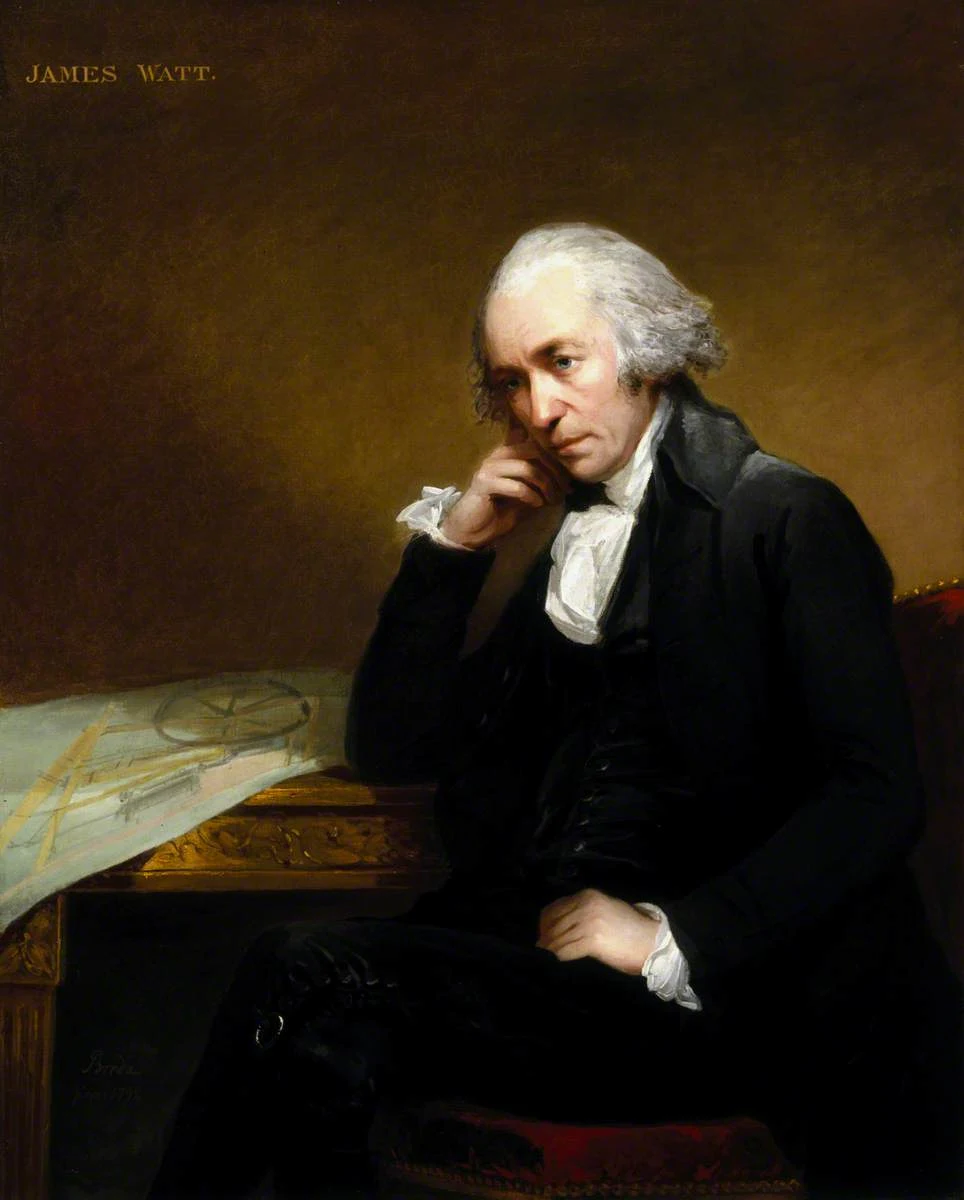
- 13. Wikimedia Commons / Science MuseumCarl Frederik von Breda’s 1792 portrait of James Watt: public-domain record
- 14. Creative CommonsPublic Domain Mark 1.0