
The short answer
The 1856 announcement offered a rapid route from molten pig iron to malleable metal. It did not immediately provide a dependable recipe for every ironworks. Understanding the process means separating its operating principle from raw-material limits, carbon control, patent claims and the factory experience needed to make a saleable product.
Chronology
A timeline of the turning points
Experiments and patents
Bessemer moved from artillery problems to the treatment of molten iron.
The Cheltenham announcement
His British Association paper drew attention and early licence buyers.
Failures and development
Trials exposed chemistry and operating limits; Göransson and Bessemer advanced practical production.
Commercial demonstration
Sheffield production and engineering visits made the process more credible.
Phosphorus addressed differently
Thomas and Gilchrist developed a durable basic lining and basic slag practice.
What the air blast actually did
Pig iron emerging from a blast furnace contained more carbon than was wanted in most steel. Bessemer’s method forced air through the molten metal in a converter. Oxygen reacted with silicon and carbon, releasing heat while changing the metal’s composition. The reaction could keep the charge hot enough to remain fluid during conversion.
The celebrated promise of manufacture without fuel referred to the conversion stage. It did not mean that mining, smelting the pig iron or the wider works needed no fuel. Nor was blowing air through iron the invention of steel itself: older cementation and crucible methods already produced steel, generally at higher cost and in smaller batches.
Why an apparently successful trial could fail elsewhere
The chemistry of the starting pig iron mattered. An air-blown charge could lose carbon yet retain damaging phosphorus and sulphur. Early licence holders who used unsuitable material could therefore obtain metal that looked promising but behaved badly during working or use.
Selecting appropriate low-phosphorus iron became a practical requirement of the early acid process. Bishop’s study describes the importance of Swedish iron and hematite pig from Workington in the Sheffield operation. The machine and the raw material formed a system: copying a converter without understanding the charge was insufficient.
Carbon control and Mushet’s contribution
Blowing too far could remove more carbon than the desired steel required. One method was to stop at an appropriate stage; another was to blow further and then add controlled carbon-bearing material. Manganese-bearing additions also helped remove oxygen from the metal, improving its behaviour.
Robert Mushet investigated and patented combinations involving iron, carbon and manganese. His claim to have made Bessemer’s invention practical became contentious, and other manganese treatments already existed. The underlying metallurgical function can be explained without declaring every patent-priority claim settled. Manganese treatment should especially not be described as the later solution to phosphorus.
Sources for this section: [3]
A lecture, a licence and an operating steelworks
The Cheltenham paper of August 1856 attracted ironmakers and brought licence income before widespread reliable operation. When trials failed, confidence fell. Bessemer continued experiments, while Göran Fredrik Göransson developed successful Swedish practice. Their work demonstrates the difference between an announced principle and an industrial routine.
By 1859 Bessemer’s own Sheffield works were producing steel. Factory investment, technical staff, repeat trials and sales gave the process a practical base. Licence disputes also reflected competing commercial interests. The early business history is therefore part of how the technology spread, rather than an optional story attached to a finished invention.
Why the later basic process was a separate step
In the 1870s Sidney Gilchrist Thomas and his cousin Percy Gilchrist tackled phosphorus through the chemistry of the converter lining and slag. A durable basic lining, with basic additions, allowed oxidised phosphorus to remain in the slag rather than returning to the metal. Large-scale demonstrations followed in 1879.
That development widened the range of ores that could be used. It was not present in a completed form at Bessemer’s 1856 announcement, and it did not make all steelmaking methods identical. The process’s history is a sequence of linked solutions to different problems: rapid conversion, composition control, suitable raw materials and the treatment of further impurities.
Continue the chronology
Related history guides
Biography context
Explore United Kingdom through connected lives
Henry Bessemer
The wider life in inventions, patents, secret manufacture and unsuccessful ventures.
Explore the biographiesManufacturing contextJoseph Whitworth
Measurement and production practices that helped manufacturers use reliable materials.
Explore the biographiesIndustrial demandWilliam George Armstrong
Machinery, weapons and the industrial markets for improved metals.
Explore the biographiesConnected biographies
People in the wider manufacturing story
1813–1898
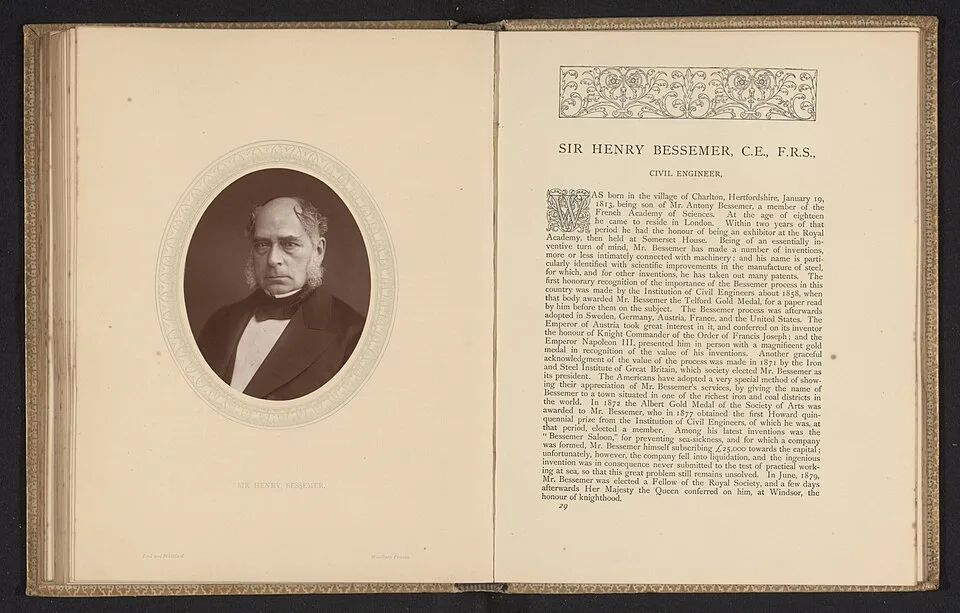
Henry Bessemer
Inventor, steel manufacturer and patent entrepreneurHenry Bessemer developed an air-blown method for converting molten pig iron and helped make bulk steel commercially practical. His 1856 announcement preceded serious failures, further experiments and a Sheffield business; his success also involved disputes over patents and other metallurgists’ contributions.Read biography
1803–1887
Joseph Whitworth
Machine-tool manufacturer, engineer and philanthropistJoseph Whitworth built a Manchester engineering business around accurate surfaces, measurement and machine tools. His screw-thread system made repair and interchangeability easier, while firearms, steelmaking and education formed other important parts of a career dependent on workshop skill.Read biography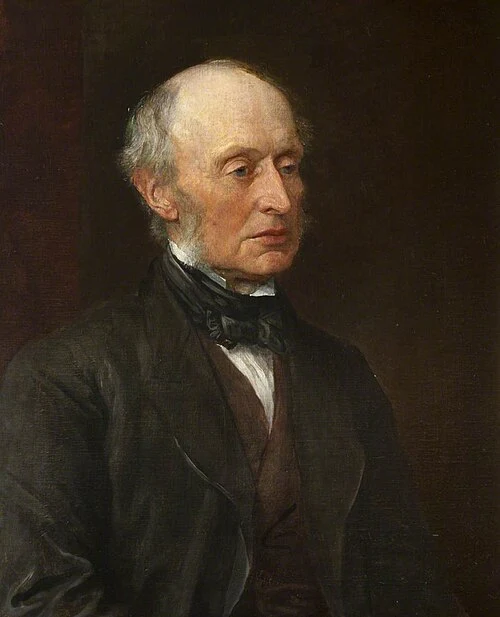
1810–1900
William George Armstrong
Engineer, hydraulic-machinery manufacturer and industrialistWilliam George Armstrong moved from law into hydraulic engineering, then built an international manufacturing business on Tyneside. Cranes, accumulators, guns and warships generated wealth that supported scientific experiments and public gifts, while tying his legacy to the global arms trade.Read biographyQuick answers
Common questions
- How could cold air make the iron hotter?
- Oxygen reacted with elements in the molten iron and released heat. The air carried oxygen into the charge; the chemical reaction supplied the heat of conversion.
- Why did different ironworks obtain different results?
- Their pig iron could contain different impurities, and early equipment and operating methods varied. The acid process could not remove phosphorus adequately, so raw-material selection was crucial.
- Did Mushet and Thomas solve the same problem?
- No. Mushet’s manganese-bearing treatments concerned carbon adjustment and deoxidation. Thomas and Percy Gilchrist’s later basic-process work concerned retaining phosphorus in the slag.
- Was the 1856 announcement already a complete commercial success?
- No. It preceded failed trials and years of further development. Bessemer’s Sheffield works and Göransson’s Swedish operation helped demonstrate practical use later.
Primary and institutional sources
How this history was checked
Bishop’s Smithsonian study was read through its Gutenberg transcription for the opening technical explanation, early patents/licensing, Göransson and selected Mushet controversy passages; the repository PDF returned 403. The DNB supplies historical chronology and the Thomas entry supplies basic-lining chemistry and collaboration. These are selected historical readings, not a new analysis of original patents or operating records. Consulted accounts disagree on the August 1856 lecture day, so only the month is given. The guide explains historical principles rather than a present-day steelmaking specification. This article was reviewed on 23 October 2026.
- Dictionary of National Biography (1901 supplement) / WikisourceBessemer, Henry: historical biography
- Science MuseumOnward Ever: Sir Henry Bessemer (2013)
- Philip W. Bishop, Smithsonian Institution / Project GutenbergThe Beginnings of Cheap Steel (1959): selected technical and priority discussions
- Dictionary of National Biography / WikisourceThomas, Sidney Gilchrist: basic lining and phosphorus removal
- Rijksmuseum / Wikimedia CommonsLock & Whitfield: Sir Henry Bessemer album spread, CC0 and revision record
- Creative CommonsCC0 1.0 Universal