In this biography
Quick facts
- Born
- 23 November 1926
- Died
- 28 September 2017
- Birthplace
- Kampot Province, Cambodia
- Country
- Cambodia
- Nationality
- Cambodian
- Known for
- Shaping New Khmer Architecture and leading the National Sports Complex design team
- Movement
- New Khmer Architecture
- Landmark
- National Sports Complex (team-led design)
- Education
- École des Beaux-Arts, Paris
- First Obayashi Prize
- 2000
Why this life matters
Vann Molyvann made architecture central to Cambodia’s post-independence civic programme, adapting modern engineering to Khmer forms, shade, air movement and water. His later work connects the preservation of Angkor with the protection of Cambodia’s modern built heritage.
Timeline
Key moments
Won a scholarship to France
Studied law before transferring to architecture in Paris.
Returned to independent Cambodia
Took senior state-building and urban-planning roles under Norodom Sihanouk.
Chaktomuk Hall hosted a major conference
Its fan-shaped hall hosted the Sixth Conference of the World Fellowship of Buddhists.
National Sports Complex completed
A Molyvann-led international team completed the arena, indoor stadium and swimming complex.
The coup ended his Sangkum-era work
Relocated to Switzerland after the overthrow of Sihanouk and later worked internationally.
Returned to reconstruction work
Returned to Cambodian cultural and planning office and helped develop Angkor protection.
Received the first Obayashi Prize
The foundation recognised his architecture, planning and heritage work.
His built work became an archive project
The Vann Molyvann Project began documenting buildings and preparing measured drawings.
A state architect after independence
Vann Molyvann was born in Kampot province in 1926 and received a scholarship to study in France in 1946. The Vann Molyvann Project records his training at Paris’s École des Beaux-Arts and his return to Cambodia in 1956, three years after independence. Norodom Sihanouk appointed him as a state architect. The Obayashi Foundation, which later honoured him, lists both chief-architect and urban-planning responsibilities after his return. His career was therefore larger than the design of a few celebrated buildings: it formed part of a state programme for public institutions and a growing capital.
The same foundation dates his appointment as secretary of state for public works and telecommunications to 1962, president of the Royal University of Fine Arts to 1965, and minister for national education and fine arts to 1967. These offices put architecture, infrastructure and education in one career. The archive project also records his role in planning Phnom Penh’s expansion and the development of Sihanoukville. Those responsibilities explain why the description “architect and urban planner” is more accurate than treating him only as a designer of monuments.
Buildings shaped by place and climate
Chaktomuk Conference Hall shows his approach in a compact form. The Vann Molyvann Project describes eight gabled roofs opening across a quarter-circle plan beside the river, drawing on nearby palace roof forms while using a modern concrete structure. The hall first hosted the Sixth Conference of the World Fellowship of Buddhists in 1961. Its shape was not simply a historic quotation: the fanned seating, broad veranda and open views answered a public building’s practical needs. The hall remains a clear example of how familiar Khmer forms and modern engineering were brought together.
The National Sports Complex required a larger team and site. The project archive credits a Vann Molyvann-led group of international architects and engineers, with construction beginning in 1962 and completion in 1964. Its earthworks created the arena and water channels; the indoor stadium used roof supports, drains, shaded seating and openings for light and air. The complex later hosted the 1966 GANEFO Games, not the 1963 Southeast Asian Games for which construction had initially been anticipated. Calling it “the Olympic Stadium” is common, but it never hosted an Olympic Games. The archive’s account makes the design collective and its climate response visible rather than crediting every engineering decision to one person.
Return, heritage and the surviving record
After the 1970 coup displaced Sihanouk’s government, Molyvann moved to Switzerland and worked internationally, including with the United Nations human-settlements programme. The archive project dates his return to Cambodia to 1991 and records his later cultural and planning office and involvement in establishing the APSARA Authority for Angkor. The Obayashi Foundation describes him as APSARA’s president and executive director at the time he received its first prize in 2000. His post-exile work thus involved conservation and urban policy as well as architecture.
Preservation of his own modern buildings became another task. The Vann Molyvann Project began in 2009 to survey surviving works, create measured drawings and support their protection amid loss and alteration. M+ Museum records a group of 27 archive items prepared by that project between 2010 and 2015, including drawings of the Chaktomuk-era programme, National Sports Complex and later university work. These are documentation made after the buildings, not a claim that all original 1960s plans survive. That distinction matters when reconstructing how Cambodia’s post-independence public architecture was actually built. Molyvann died in Siem Reap on 28 September 2017; the buildings and the records of them remain a way to study the ambitions and limits of that period.
Sources for this section: [1] · [5] · [2] · [6] · [7] · [10]
Quick answers
Frequently asked questions about Vann Molyvann
- What is Vann Molyvann known for?
- He was a leading architect and urban planner associated with Cambodia’s New Khmer Architecture, combining modern construction with local forms and climate-responsive design.
- Which buildings did Vann Molyvann design?
- Notable work includes Chaktomuk Conference Hall and the National Sports Complex, designed under his leadership with an international team.
- When was Phnom Penh’s National Sports Complex completed?
- In 1964, after construction began in 1962. The anticipated 1963 games did not take place; the complex hosted the 1966 GANEFO Games.
- What award did Vann Molyvann receive in 2000?
- The first Obayashi Prize, recognising his architecture, planning and heritage work.
Keep exploring
Lives connected to this story
- Sopheap Pich
Compare a contemporary sculptor’s separate approach to materials, open form and Cambodian cultural surroundings.
- Norodom Sihanouk
Read about the head of state who commissioned Cambodia’s post-independence civic programme.
- Ros Serey Sothea
Explore a contemporary voice from the wider cultural world of pre-1975 Cambodia.
- Rithy Panh
See how another Cambodian cultural figure has worked to preserve and interpret the country’s past.
Sources and further reading
Explore the evidence
These references support the biography and offer further reading. Official records, first-person accounts and independent reporting provide different perspectives; image records document attribution and licensing.
- 1. Vann Molyvann ProjectBiography of Vann Molyvann
The project’s older biography still uses present-tense wording about Molyvann. Death on 28 September 2017 is confirmed by contemporary reporting and is not inferred from that undated prose.
- 2. Obayashi FoundationFirst Obayashi Prize profile
- 3. Vann Molyvann ProjectChaktomuk Conference Hall project history
- 4. Vann Molyvann ProjectNational Sports Complex project history
The project credits a Molyvann-led international team rather than sole authorship; its seating and site figures describe the historic design, not verified current capacity.
- 5. Vann Molyvann ProjectProject documentation and preservation mission
- 6. M+ MuseumVann Molyvann drawings archive
M+ catalogues later measured documentation prepared in 2010–2015; those archive dates should not be confused with the 1960s construction dates or with original surviving design drawings.
- 7. Phnom Penh PostContemporaneous report of Vann Molyvann’s death
- 8. The GuardianVann Molyvann obituary
The obituary gives the exact 23 November 1926 birth date and explains that the National Sports Complex was commonly called the Olympic Stadium although it never hosted the Olympics. The specialist project sources establish its design and construction chronology.
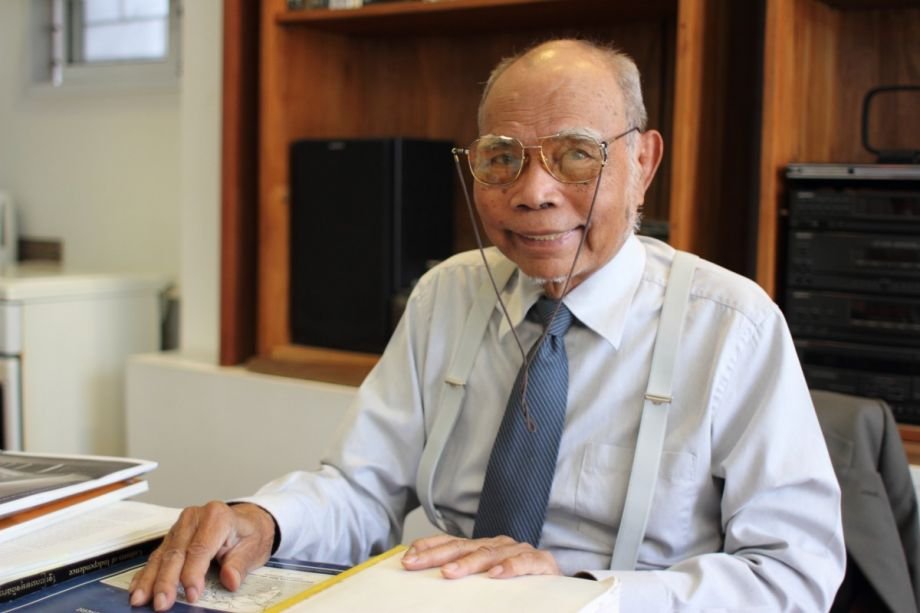
- 9. Wikimedia CommonsPortrait and CC BY-SA 4.0 record
The Commons file identifies Vann Molyvann and a CC BY-SA 4.0 own-work licence from uploader Achariyeak. Its 2022 date is the upload date, not evidence of when the pre-2017 photograph was taken.
- 10. The Vann Molyvann ProjectMeet Vann Molyvann: 1926–2017 and his architecture and planning career
This specialist biography identifies Molyvann as 1926–2017; the other biography retains present-tense wording. Exact birth and death dates remain separately sourced; this page does not establish those days.