
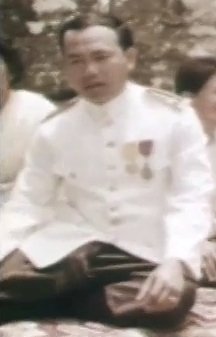
In this biography
Quick facts
- Born
- c. 1933
- Died
- Exact date unknown
- Birthplace
- Stung Treng, Cambodia
- Country
- Cambodia
- Nationality
- Cambodian
- Known for
- Defining Cambodia’s pre-1975 popular-music golden age
- Known as
- King of Khmer Music
- Recorded work
- Ballads, dance songs, rock and duets
- Frequent collaborator
- Ros Serey Sothea
- Death chronology
- Disappeared after 1975; exact date unknown
Why this life matters
Sinn Sisamouth’s voice is inseparable from Cambodia’s 1950s–1970s cultural modernity and from the artists lost under the Khmer Rouge whose recordings survived them.
Timeline
Key moments
A major voice in Khmer popular music
Recorded ballads, dance songs, rock and collaborations.
Duets with Ros Serey Sothea
Surviving releases identify both singers on shared recordings.
Disappearance under Khmer Rouge rule
His exact death date and circumstances remain unestablished here.
Reissues and documentary remembrance
Family-supported compilations and films carry recordings to new listeners.
A singer and composer beyond a single genre
Sinn Sisamouth was a Cambodian singer and songwriter whose recordings helped define popular Khmer music before 1975. Often called the King of Khmer Music, he worked across romantic ballads, dance songs and electric rock. The variety matters: the international label “Cambodian rock” describes only part of a repertoire that also depended on a crooner’s phrasing and melodic control.
Surviving recordings place Khmer singing alongside guitars, keyboards and rhythms circulating through global popular music. The result was not simply a copy of an overseas style. His career belongs to a Cambodian musical culture in which local voices and language reshaped those sounds, leaving songs that can be heard as performances rather than only as relics of a lost era.
Sources for this section: [1]
Songs that make the range audible
The official soundtrack materials for Don’t Think I’ve Forgotten credit Sisamouth as performer and composer of Under the Sound of Rain, Dance a Go Go and the title song. Those selections offer concrete starting points for hearing different moods. The rain song evokes intimacy and recollection, while the dance recording turns toward sociability and movement.
The soundtrack’s credits are useful for distinguishing performance from composition. A song appearing in a documentary is not necessarily written by its featured singer, and an English title is a translation rather than a replacement for its Khmer identity. Names and spellings vary across releases, so matching performer, composition credit and recording is more reliable than treating every differently transliterated title as another work.
Sources for this section: [4]
Duets with Ros Serey Sothea
Ros Serey Sothea was an important collaborator, not a supporting voice interchangeable with other singers. The documentary soundtrack credits both performers on Thevary My Love. Lion Productions’ later catalogue also identifies several duets, including Still Loving You and Unwritten Songs, alongside Sisamouth’s solo recordings.
These credits preserve a musical relationship without establishing a private romance. Listening to the exchanges between two voices also reveals a different kind of performance from a solo ballad. The surviving catalogue is selective, shaped by what could be recovered and released; it should not be mistaken for a complete session history or a settled total of everything either artist recorded.
Disappearance and the limits of a death story
The Khmer Rouge’s seizure of power in 1975 destroyed the public musical world to which Sisamouth belonged. He disappeared during that period, as did other prominent singers. The surviving sources used here do not establish a precise day, place or sequence of his death. Accounts of a final performance before execution should not be presented as verified scenes.
Bophana’s programme description of Pov Sok’s documentary Sinn Sisamouth explicitly notes speculation about his fate after 1975. That distinction is important in remembering a person whose life is often compressed into a dramatic ending. Uncertainty about the final circumstances does not diminish the documented recordings, or justify supplying an exact date that the available evidence cannot securely support.
Family archives, reissues and a continuing audience
Lion Productions describes its Groove Club releases as family-supported reissues drawn from rare surviving recordings. The later volume includes interviews with his widow, Khav Thong Nhot, and granddaughter Sin Sethsochhata. Such materials bring family testimony into the archive, alongside the audible work itself; neither a compilation nor an interview can reconstruct every missing year.
Barang Films’ Elvis of Cambodia follows the singer’s legacy through people carrying his music across generations and communities abroad. That title is a documentary framing, not evidence that his music can be explained through Elvis Presley alone. Sisamouth’s continuing importance lies in songs that still connect listeners to language, affection and cultural memory, as well as to the history of their survival.
Quick answers
Frequently asked questions about Sinn Sisamouth
- Was Sinn Sisamouth only a rock singer?
- No. His surviving repertoire includes ballads, dance songs, rock and duets; Cambodian rock describes only part of his work.
- Which recordings provide a starting point?
- The documentary soundtrack credits him on Under the Sound of Rain, Dance a Go Go and Don’t Think I’ve Forgotten. Thevary My Love is credited to him and Ros Serey Sothea.
- Is Sinn Sisamouth’s exact death date known?
- The sources used here do not establish it. He disappeared during the Khmer Rouge period after 1975; a precise 1976 death date or final-performance story is not asserted.
- How has his music been preserved?
- Surviving records, family collections, reissues and documentary projects preserve parts of it. Lion’s Groove Club editions include family-supplied material, but are not a complete discography.
Keep exploring
Lives connected to this story
- Preap Sovath
Follow Cambodian popular music into a later generation through Preap Sovath’s recording, cinema and television career.
- Ros Serey Sothea
Explore the distinct career of the singer heard with him on many duets.
- Norodom Sihanouk
Place pre-1975 cultural life within Cambodia’s wider political history.
- Rithy Panh
Compare another Cambodian approach to preserving testimony and cultural memory.
Sources and further reading
Explore the evidence
These references support the biography and offer further reading. Official records, first-person accounts and independent reporting provide different perspectives; image records document attribution and licensing.
- 1. Lion ProductionsSinn Sisamouth archive and reissue notes
The reissue label supplies track credits and describes its collaboration with the family. Promotional superlatives are not independent rankings, and the catalogue is not a complete lifetime discography.
- 2. Barang FilmsElvis of Cambodia documentary project
The producer’s description is used for the later documentary’s scope, not as proof of an exact birth date, death date or an anecdote about his final moments.
- 3. Wikimedia CommonsPortrait and public-domain record
- 4. Don’t Think I’ve Forgotten: Cambodia’s Lost Rock and RollOfficial soundtrack: song and performer credits; translated titles
Only titles, credits and broad song subjects are summarised; lyrics are not reproduced. English title spellings can differ between releases.
- 5. Bophana Audiovisual Resource CenterMarch–April 2016 programme: Pov Sok’s Sinn Sisamouth documentary
The indexed programme entry identifies a documentary and describes speculation about his fate. The film itself and the full programme were not inspected; the entry does not verify an execution date.

