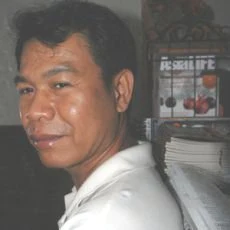
In this biography
Quick facts
- Born
- 1971
- Birthplace
- Battambang, Cambodia
- Country
- Cambodia
- Nationality
- Not independently established
- Known for
- Open-weave sculpture in rattan and bamboo, informed by anatomy, plants and place
- Born
- 1971, Battambang
- US settlement
- 1984, following years in Thai refugee camps
- BFA
- Painting, University of Massachusetts Amherst, 1995
- MFA
- Painting, School of the Art Institute of Chicago, 1999
- Return to Cambodia
- 2002; turn toward sculpture in 2004
- Studio base
- Phnom Penh
Why this life matters
His practice shows how familiar materials can support contemporary sculpture without reducing every work to an illustration of Cambodia’s violent history.
Timeline
Key moments
Birth
Born in Battambang; no exact birthday is established.
Flight to Thailand
His family fled Cambodia and spent years in refugee camps.
United States
Settled in the US at thirteen, according to his autobiographical account.
Painting degrees
BFA at UMass Amherst in 1995; MFA at SAIC in 1999.
Return and change of medium
Returned in 2002 and began moving toward sculpture in 2004.
Morning Glory
Made the large plant-related construction documented by the Guggenheim.
Met exhibition
Ten works were exhibited from 23 February to 7 July.
Mia exhibition
In the Presence Of ran from 25 October 2025 to 1 February 2026.
Displacement and education as a painter
Sopheap Pich was born in Battambang in 1971. His family fled Cambodia for Thailand in 1979 and spent years in refugee camps. In his autobiographical account, he dates settlement in the United States to 1984, when he was thirteen. Those experiences preceded his professional training as an artist.
He earned a BFA in Painting at the University of Massachusetts Amherst in 1995 and an MFA in Painting at the School of the Art Institute of Chicago in 1999. The two institutions and degree years are distinct. Although he later became known for sculpture, his formal art education was rooted in painting.
Returning to Cambodia and changing medium
Pich returned to Cambodia in 2002 and dates his move toward sculpture to 2004. His artist statement describes finding painting insufficient for what he wanted to make. Rattan, bamboo and metal wire became central to a practice based on slow manual construction, experimentation and close attention to the properties of materials.
He works in Phnom Penh, drawing on surroundings and memories without assigning every sculpture a single historical message. His own account resists the assumption that all his work must depict Khmer Rouge trauma. Childhood history is important context, but it does not replace the individual work’s form, process or more open-ended associations.
Rattan, bamboo and open structures
Rattan and bamboo connect Pich’s sculpture with Cambodian baskets, fish traps and other everyday objects. The strands can become structures suggesting anatomy, vegetation or abstraction. Mia’s process account describes washing, boiling, bending and weaving bamboo before binding components with wire. Large constructions can remain visually open rather than presenting a solid, closed surface.
Morning Glory, made in 2011, uses rattan, bamboo, wire, plywood and steel. The Guggenheim’s teaching resource connects its plant form with an edible vegetable and Pich’s recollection of food during deprivation. The work brings material and memory together, while its scale and construction also invite attention to space and the experience of looking through a sculpture.
Museum exhibitions and continuing practice
The Metropolitan Museum presented ten works in Cambodian Rattan: The Sculptures of Sopheap Pich from 23 February to 7 July 2013. MASS MoCA’s group exhibition Invisible Cities, running from May 2012 to February 2013, included Compound, a 2011 construction in bamboo, rattan, plywood and wire. These are documented exhibitions, not personal prizes.
Mia’s In the Presence Of ran from 25 October 2025 to 1 February 2026 and included Buddha 3, Caged Heart, Upstream 2 and Rang Phnom Flower. Together, these records show how his work has been encountered in different museum settings. His practice remains grounded in making and in the possibilities of ordinary materials, rather than a claim to be the first or only artist representing Cambodia.
Quick answers
Frequently asked questions about Sopheap Pich
- Where was Sopheap Pich born?
- Battambang, Cambodia, in 1971. The checked artist records do not establish an exact birthday.
- What materials does he use?
- Principally rattan and bamboo, often assembled with wire and other structural materials.
- Where did he earn his MFA?
- The School of the Art Institute of Chicago, in Painting, in 1999.
- When did he return to Cambodia?
- His autobiographical statement dates his return to 2002 and the move toward sculpture to 2004.
Keep exploring
Lives connected to this story
- Chhim Sothy
Compare another Cambodian artist’s painting, materials and observation of contemporary society.
- Vann Molyvann
Compare a Cambodian architect’s distinct engagement with materials, spatial experience and cultural surroundings.
- Davy Chou
Explore another contemporary creative career connected with Cambodia and cross-border cultural experience.
Sources and further reading
Explore the evidence
These references support the biography and offer further reading. Official records, first-person accounts and independent reporting provide different perspectives; image records document attribution and licensing.
- 1. Sopheap Pich · autobiographical statement1984 US settlement, 2002 return and 2004 sculpture transition
Use the artist’s 2002 return date. His statement cautions against reducing all works to Khmer Rouge experience.
- 2. Sopheap Pich · curriculum vitaeBirth year, BFA, MFA and working base
The verified qualifications are BFA 1995 and MFA 1999, both in Painting. No exact birthday or legal citizenship is inferred; the Cambodia archive reflects origin and artistic context.
- 3. Guggenheim · teaching resourceChildhood history, materials and Morning Glory
- 4. Minneapolis Institute of Art · process accountPreparing bamboo and constructing sculpture
- 5. Metropolitan Museum · exhibition archiveTen works and exact 2013 exhibition dates
The ten-work museum exhibition is a historical exhibition, not an award or a claim to permanent display.
- 6. MASS MoCA · Invisible CitiesGroup exhibition and Compound
- 7. Minneapolis Institute of Art · exhibition archive2025–2026 dates and named works
The October 2025–February 2026 exhibition has ended; it is not described as currently running.
- 8. Wikimedia Commons · Trace MeekMASS MoCA photograph, reviewed CC BY 2.0
Trace Meek’s Flickr photograph passed CC BY 2.0 review on 18 April 2016. Its April 2012 capture precedes the later Invisible Cities opening; it is not represented as an opening-day photograph.