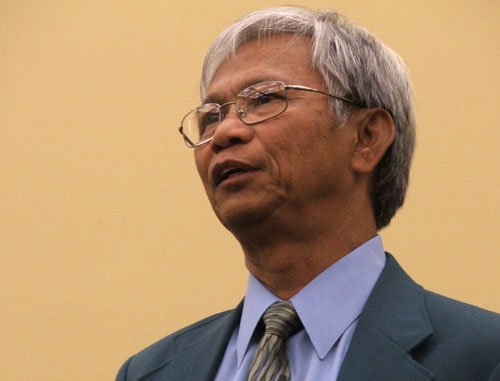
In this biography
Quick facts
- Born
- 1946
- Died
- 5 September 2011
- Birthplace
- Battambang Province, Cambodia
- Country
- Cambodia
- Nationality
- Cambodian
- Known for
- Painting scenes of S-21 imprisonment and testifying in the Duch trial
- Detention site
- S-21 / Tuol Sleng, Phnom Penh
- Memoir
- A Cambodian Prison Portrait (1998)
- Court testimony
- ECCC Case 001, 29 June 2009
- Artistic legacy
- Prison paintings, survivor memory and intergenerational workshops
Why this life matters
Vann Nath turned survival into evidence: his paintings and testimony gave later generations a direct visual and legal account of life inside S-21.
Timeline
Key moments
Born in the Battambang region
The birth year is retained without imposing a disputed exact day.
Arrest and S-21 detention
Arrested in late 1977 and transferred to S-21 in early 1978; later assigned to paint leader portraits.
Survival and return
Left with workshop detainees as the prison was abandoned, then returned to the site later that year.
Published his memoir
White Lotus published A Cambodian Prison Portrait: One Year in the Khmer Rouge’s S-21.
Memory workshop
Worked with Soko Phay-Vakalis and younger artists on transmitting survivor memory.
Testified in Case 001
Gave evidence about detention, forced artistic work and Duch’s authority.
Died
The court’s October 2011 report commemorated his life and artistic testimony.
An artist detained at S-21
Vann Nath was a Cambodian painter from the Battambang region who survived S-21, the Khmer Rouge security prison in Phnom Penh. Born in 1946, he was arrested in late 1977 and brought to S-21 in early 1978. His later testimony described prisoners held in crowded rooms, shackled in rows and given severely inadequate food.
His account is not a general history told from outside the prison. It records how an artist experienced confinement and how useful skills could alter a prisoner’s immediate chances without ending captivity. His survival was exceptional, but a formula such as “only seven survivors” can obscure the different groups, dates and definitions counted in accounts of S-21.
Sources for this section: [1]
Why painting helped keep him alive
After roughly a month, Vann Nath was selected with other artists to make portraits of Khmer Rouge leaders. The court’s witness summary connects this assignment with a February 1978 prisoner-list instruction to retain him for use. He received better food and worked without the same restraints, but remained a detainee subject to the prison’s authority.
The distinction matters to his biography: producing portraits of Pol Pot was coerced work, not evidence that the artist freely supported the regime. When the Khmer Rouge abandoned Phnom Penh in January 1979, he left with a group from the workshop. His later return to the former prison gave him a different purpose for the same skill: communicating what imprisonment had meant.
Tuol Sleng paintings and A Cambodian Prison Portrait
When the former prison became a genocide museum, Vann Nath painted scenes of detention and abuse for visitors. These works made conditions visible that administrative records alone could not explain. His memoir, A Cambodian Prison Portrait: One Year in the Khmer Rouge’s S-21, was published by White Lotus in Bangkok in 1998, bringing written recollection and painting into the same public testimony.
Not every painted scene should be labelled an event he personally witnessed. The ECCC distinguishes his direct experiences from images based on accounts supplied by other survivors, including Bou Meng and Oeng Pech. The paintings are historical evidence with identifiable sources and purposes, not photographs or a claim that one person saw everything that occurred in the prison.
His evidence at Duch’s trial in 2009
Vann Nath testified on 29 June 2009 in Case 001 against Kaing Guek Eav, known as Duch. He described the prison chief’s authority, the conditions of detention and the workshop. His paintings were displayed during the proceedings, connecting the courtroom account with the visual work through which many people had already encountered S-21.
The court did not simply accept every recollection as an established finding. Its summary notes, for example, that it did not rely on his allegation that Duch personally kicked Bou Meng. That qualification does not erase his witness role. It shows the difference between testimony offered, evidence assessed and facts a court ultimately relies upon when deciding a criminal case.
Memory workshops and a legacy beyond one witness
His later artistic practice also included collaboration with younger generations. The court’s October 2011 report describes the memory workshop begun with scholar Soko Phay-Vakalis in 2008 and the exhibitions that followed. An exhibition essay discusses both the effort to restore victims’ dignity and the different approaches available to artists who inherited, rather than directly experienced, the violence.
Vann Nath died on 5 September 2011 after prolonged illness. The same court report recorded plans to discuss his work in a further Bophana Centre workshop. His legacy therefore extends beyond being kept alive to paint a ruler’s portrait: it includes a memoir, museum interpretation, judicial testimony and an artistic conversation about how later generations can remember without pretending to possess a survivor’s own experience.
Quick answers
Frequently asked questions about Vann Nath
- Why did Vann Nath survive S-21?
- He was retained for forced artistic work, including portraits of Khmer Rouge leaders. This changed his treatment but did not make him a free worker or a voluntary propagandist.
- What is Vann Nath’s book?
- A Cambodian Prison Portrait: One Year in the Khmer Rouge’s S-21, published by White Lotus in 1998.
- Did he personally witness everything in his paintings?
- No. The court distinguishes images of his own experiences from scenes based on other survivors’ accounts.
- When did Vann Nath testify and die?
- He testified in ECCC Case 001 on 29 June 2009. He died on 5 September 2011.
Keep exploring
Lives connected to this story
- Rithy Panh
Explore another approach to Cambodian memory through film and the Bophana archive.
- Haing S. Ngor
Compare a different survivor’s memoir, public advocacy and acting career.
- Loung Ung
Read a childhood-survival narrative with a different perspective and route into public memory.
Sources and further reading
Explore the evidence
These references support the biography and offer further reading. Official records, first-person accounts and independent reporting provide different perspectives; image records document attribution and licensing.
- 1. Extraordinary Chambers in the Courts of CambodiaVann Nath witness profile and testimony
The court summary separates personal observation, testimony based on others and allegations on which the Trial Chamber did not rely. The biography preserves these distinctions.
- 2. Extraordinary Chambers in the Courts of CambodiaCourt Report tribute to Vann Nath
The October 2011 report supports the death date and memory-workshop history. Its age-at-death statement is not used to manufacture an exact birth date.
- 3. Wikimedia CommonsPortrait and CC BY 2.0 record
- 4. White Lotus BooksA Cambodian Prison Portrait: 1998 publisher record
The publisher confirms the 1998 book and museum work. Its simplified entry-year wording is not preferred over the court chronology for the early-1978 S-21 transfer.
- 5. ECCC evidence archiveA Cambodian Prison Portrait: memoir extracts, exhibit E3/386
The indexed court exhibit is offered as further reading; its full PDF was not retrievable. Prison chronology is checked against the court’s witness summary, not an asserted full-book reading.
- 6. CIREMM / Art AbsolumentVann Nath, une peinture de l’effroi: paintings and intergenerational memory