
The short answer
Opened on 30 January 1826, the Menai Suspension Bridge carried the Holyhead road across a difficult tidal strait. Its long span kept the main channel clear for shipping. Telford directed the project, but the working bridge depended on tested ironwork, resident engineering, construction labour and later changes to its vulnerable deck.
Chronology
A timeline of the turning points
A route and a design problem
Government sought improvements to the Holyhead route and a reliable Menai crossing.
Construction starts
Masonry works and preparations for the iron suspension system began.
Bridge opens
The road crossing replaced a dangerous ferry link.
Storm damage and strengthening
Damage to the roadway prompted changes under resident engineer William Provis.
The crossing had to serve both road and sea
The bridge formed part of the strategically important route from London to Holyhead and onward by sea to Ireland. A ferry across the Menai Strait introduced delay and danger. Yet the strait was also a navigation channel. A bridge could not be judged solely by how easily carriages crossed it; ships still needed to pass beneath.
High banks, strong tidal currents and required clearance shaped the engineering choice. A suspension design could cross the main channel without placing ordinary supporting piers in its middle. Its roughly 176-metre principal span was exceptionally ambitious for its period. The design answered the geography and competing uses of the site rather than pursuing length as an isolated record.
How the chains, towers and anchorages carried traffic
The road deck hung from an iron suspension system passing over masonry towers and secured into anchorages. A load on the roadway was transmitted through the hangers into the chains; the towers and anchorages resisted the resulting forces. The bridge therefore worked as a connected structural system, with each part depending on the others.
Its chains used wrought-iron bars pinned together rather than the bundles of fine steel wire familiar from many later suspension bridges. Ironmaster William Hazledine manufactured and tested the bars. Quality control was essential because repeated links and connections carried forces across the span. A striking silhouette could only become a dependable crossing through the less visible discipline of materials and joints.
Design authority did not remove collaboration
Telford directed the undertaking, but William Provis served as resident engineer. Specialist contractors, masons and ironworkers built it, and public authorities financed and scrutinised the scheme. Experiments on iron and suspended bars informed the design. Mathematical advice and practical testing together helped engineers address a scale of structure for which established rules were limited.
The project is consequently a poor example of solitary invention. Telford’s practical judgement mattered because it organised contributions into a workable design and construction process. Attributing the crossing to him need not erase Provis, Hazledine or the workforce. The structure’s achievement lay in coordinating manufacture, site operations, engineering decisions and institutional support over several years.
Opening exposed a different problem: the wind
The bridge opened on 30 January 1826, but a road deck suspended on flexible chains could move under wind. Early storms exposed weaknesses in its light construction. This is a different problem from simply asking whether the chains could hold the static weight of carriages. A bridge must also behave acceptably when forces change and its parts move.
Serious storm damage in 1839 affected roadway supports and beams. The account preserved in Billington and Deodatis’s discussion distinguishes this damage from the exaggerated claim that the entire bridge collapsed. Provis’s subsequent strengthening added weight and longitudinal stiffness. The work in 1840 illustrates how observation in service could reveal requirements not fully resolved before opening.
Why the surviving bridge is a continuing work
Further deck changes and twentieth-century reconstruction adapted the crossing for later traffic. Cadw’s listed-building report records major reconstruction in 1938–1940. The bridge seen today therefore preserves a historic form and route through substantial engineering intervention. It should not be described as every original component surviving untouched from 1826.
Menai’s influence came from proving the practical potential of a large suspension road crossing, while its difficulties helped expose the importance of deck behaviour. Its history joins innovation with repair. That combination makes it more informative than a simple success story: testing, operation and maintenance continued the engineering after the celebratory first crossing had ended.
Continue the chronology
Related history guides
Biography context
Explore United Kingdom through connected lives
Connected biographies
The engineer in the wider transport story
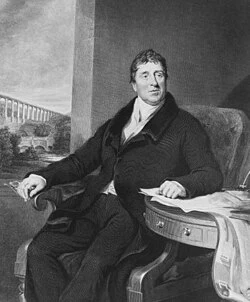
1757–1834
Thomas Telford
Civil engineer, surveyor and infrastructure organiserThomas Telford rose from stonemasonry to direct major roads, canals and bridges across Britain. His work joined design, surveying, public finance and construction management, relying on resident engineers, contractors and labourers as well as his own practical judgement.Read biographyQuick answers
Common questions
- Was Menai the first suspension bridge ever built?
- No. It was an exceptionally large and influential suspension road bridge for its time. Earlier suspension bridges existed.
- Did it carry the first railway across the strait?
- No. Menai was a road bridge. The separate Britannia Bridge opened for railway traffic in 1850.
- Did the whole bridge collapse in 1839?
- No. Severe wind damage affected the roadway, followed by repairs and strengthening. Describing the entire structure as having collapsed exaggerates the event.
Primary and institutional sources
How this history was checked
Cadw’s listed-building report, ICE and ASCE support the opening, site constraints and structural account. Selected indexed Royal Society commentary passages concern Provis and experiments; direct PMC opening presented a browser challenge. Selected Billington/Deodatis passages describe 1839 damage and 1840 strengthening. No original calculation book, complete contractor archive or present-condition engineering assessment was examined. Small differences in published span measurements are expressed as approximately 176 metres. This article was reviewed on 23 October 2026.
- William Llewelyn Davies / Dictionary of Welsh BiographyTelford, Thomas: Welsh and border works (1959)
- Institution of Civil EngineersMenai crossings: construction and structural systems
- American Society of Civil EngineersMenai Suspension Bridge: historic engineering landmark
- Royal Society / PubMed CentralAn amateur’s contribution to the design of Telford’s Menai Suspension Bridge (2015), indexed design discussion
- David P. Billington and George Deodatis / Princeton UniversityMenai suspension bridge: selected storm-damage and strengthening passages
- CadwMenai Suspension Bridge: listed-building report 18572
- RCAHMS / Wikimedia CommonsRaddon after Lane: Thomas Telford, 1838, image and revision record
- National Portrait GalleryWilliam Raddon: artist authority entry in collection results
- National Portrait GallerySamuel Lane, 1780–1859: artist authority record
- Creative CommonsPublic Domain Mark 1.0