In this biography
Quick facts
- Born
- 1 October 1956
- Birthplace
- Eastbourne, Sussex, England
- Country
- United Kingdom
- Nationality
- British
- Known for
- Home Office policy, the Modern Slavery Act, Article 50 notification and the unsuccessful attempt to secure approval for her Brexit agreement
- Prime minister
- 13 July 2016–24 July 2019
- Home secretary
- 12 May 2010–13 July 2016
- Maidenhead MP
- 1997–2024
- House of Lords
- Baroness May of Maidenhead, from August 2024
Why this life matters
May’s career illuminates the different demands of departmental leadership, party management and parliamentary consent. The Windrush scandal is central to examining her immigration legacy, while the failure of her withdrawal agreement shows that negotiating an international text did not guarantee a domestic majority.
Timeline
Key moments
Education and a financial-sector career
Born in Eastbourne, studied geography at Oxford and worked at the Bank of England and APACS.
Elected for Maidenhead
Entered the Commons after local government service in Merton.
Chaired the Conservative Party
Held the party chairmanship during its years in opposition.
Led the Home Office
Served as home secretary, with responsibilities spanning policing, immigration and modern slavery.
Entered Downing Street
Became prime minister following David Cameron’s resignation after the EU referendum.
Notified the EU under Article 50
Sent the formal withdrawal notification after Parliament authorised it.
Lost the Conservative majority
The snap election left the Conservatives without an overall majority; a confidence-and-supply agreement with the DUP was announced on 26 June.
Agreement and parliamentary rejection
Negotiated a withdrawal agreement but lost two votes on the full package and a third on the agreement alone.
Left the premiership, then the Commons
Her government legislated for net zero in June 2019; she left Downing Street in July and remained an MP until 2024.
A career in finance and local politics came first
Theresa May was born in Eastbourne on 1 October 1956 and studied geography at St Hugh’s College, Oxford. Work at the Bank of England and the Association for Payment Clearing Services preceded her national political career. She also served as a councillor in Merton. These were distinct forms of administrative and local experience before she became widely associated with immigration and Brexit.
Elected MP for Maidenhead in 1997, she entered the Commons as the Conservatives began a long period in opposition. Her route to senior office involved years of parliamentary work rather than a direct arrival in government. Maidenhead remained her constituency throughout her Commons career, ending at the dissolution before the 2024 election.
Opposition responsibilities extended beyond one policy area
May held shadow responsibilities covering education, transport, the family, work and pensions, as well as serving as Shadow Leader of the House. She chaired the Conservative Party from 2002 to 2003. The range matters because her later public image can obscure the breadth of her apprenticeship in an opposition trying to regain a governing majority.
Her appointment as Home Secretary in May 2010 placed her in a department where security, policing, migration and civil liberties repeatedly intersected. She also served as Minister for Women and Equalities until 2012. The combination brought responsibilities for enforcement alongside questions of discrimination and access to opportunity.
Policing and modern slavery formed part of her Home Office record
The government’s historical account records the establishment of the College of Policing and National Crime Agency during May’s Home Office tenure. It also identifies her role in the Modern Slavery Act. These initiatives placed institutional organisation and the response to exploitation alongside the department’s more publicly disputed immigration work.
Modern slavery remained an interest after she left Downing Street, according to her office’s biography. Her office’s account identifies the causes she emphasises; it does not independently establish the effectiveness of legislation or victims’ access to support.
Windrush exposed the consequences of immigration enforcement
May’s immigration record includes the expansion of measures associated with the “hostile environment”. The Windrush scandal exposed the treatment of people with a right to live in the UK who could not satisfy the documentary demands placed upon them. Loss of work or services and detention were consequences for individuals, not simply a dispute over terminology.
Wendy Williams’s review, published in 2020, examined institutional failures across successive governments. The Home Secretary’s parliamentary response accepted serious failings concerning race and the history of the Windrush generation. This broader history does not remove May’s responsibility for policies developed during her tenure. Equally, attributing every stage of the scandal to one minister would obscure the accumulated administrative and political decisions the review investigated.
The referendum brought her to a different leadership problem
May became prime minister on 13 July 2016 after the EU referendum and David Cameron’s resignation. Her government had to translate the decision to leave into legislation and negotiations. On 29 March 2017 she notified the European Council under Article 50, following the Supreme Court’s ruling that parliamentary authorisation was necessary and the passage of the notification Act.
Notification began a treaty process; it did not itself establish the final terms of departure. The distinction would become central to her premiership. Her letter set out ambitions for future cooperation and recognised the Irish border and peace settlement as major responsibilities. Agreeing those aims in general language was easier than reconciling their detailed implications for trade, sovereignty and Northern Ireland.
A negotiated agreement failed to secure parliamentary consent
The snap election on 8 June 2017 had weakened her parliamentary position. The Conservatives remained the largest party but lost their overall majority. May formed a minority government supported by a confidence-and-supply agreement with the Democratic Unionist Party, announced on 26 June. The arrangement supported specified votes, including confidence and supply, while leaving her dependent on bargaining across a divided Commons.
May’s administration reached a withdrawal agreement and political declaration in November 2018. The Irish backstop was intended to prevent a hard border if other arrangements were not ready. Opponents disagreed over the resulting obligations and the possibility of remaining in them without a unilateral exit. The negotiating compromise consequently encountered resistance from different political directions.
The Commons rejected the package on 15 January and 12 March 2019. A narrower motion on 29 March sought approval of the Withdrawal Agreement alone, excluding the Political Declaration, and also failed. These were three defeats with an important difference in scope. The revised agreement negotiated under Boris Johnson later in 2019 changed the Ireland/Northern Ireland arrangements; it was not simply May’s rejected text gaining a different signature.
Sources for this section: [3] · [11] · [12] · [13] · [14] · [15]
Environmental legislation and parliamentary work outlasted her premiership
In June 2019 the government changed the UK’s statutory climate target to net-zero greenhouse-gas emissions by 2050. This was a legal commitment for future governments and policy, not an announcement that emissions had already reached zero. It belongs in the record of her premiership alongside the political crisis over withdrawal.
May left Downing Street on 24 July 2019, continued as a backbench MP and stood down from the Commons in 2024. Parliament records her membership of the Lords from 21 August 2024 as Baroness May of Maidenhead. Her later role therefore followed, rather than extended, her premiership. The full career contains departmental reforms and sustained causes as well as the unresolved parliamentary conflict that ended her government.
Quick answers
Frequently asked questions about Theresa May
- When was Theresa May prime minister?
- From 13 July 2016 to 24 July 2019, after six years as home secretary.
- Did Theresa May take the UK out of the EU in March 2017?
- No. Her 29 March 2017 letter notified the intention to withdraw and began the Article 50 process. Notification and departure were separate events.
- Was May’s agreement rejected three times in identical votes?
- No. The first two votes concerned the Withdrawal Agreement and Political Declaration. The 29 March 2019 motion concerned the Withdrawal Agreement alone.
- What did May do after her premiership?
- She remained MP for Maidenhead until 2024 and then entered the House of Lords as Baroness May of Maidenhead. Her stated interests include combating modern slavery and environmental policy.
Keep exploring
Lives connected to this story
- Tony Blair
Read about the 1998 Northern Ireland settlement whose institutions and border implications shaped the Brexit negotiations.
- Harold Wilson
Compare the different circumstances of the 1975 European membership referendum and the party divisions surrounding it.
Sources and further reading
Explore the evidence
These references support the biography and offer further reading. Official records, first-person accounts and independent reporting provide different perspectives; image records document attribution and licensing.
- 1. UK Prime Minister’s OfficeTheresa May: life and premiership
Used for birth, education and the administration’s policy chronology. Its favourable economic and programme assessments are not treated as independent evaluation.
- 2. UK ParliamentParliamentary career of Baroness May of Maidenhead
Exact parliamentary office and membership dates checked, including the distinction between party leadership, premiership, Commons service and Lords membership.
- 3. House of Commons LibraryThe 2017–19 Government at Westminster: minority government and the DUP agreement
- 4. Office of Theresa MayBiography: career and work after Downing Street
- 5. House of Lords LibraryWindrush scandal and compensation scheme: review findings
- 6. Home OfficeStatement on the Windrush Lessons Learned Review, 19 March 2020
Read the parliamentary response to the review alongside the Lords Library’s account. No claim is made to have examined every individual Windrush case or the full Home Office archive.
- 7. Department for Business, Energy and Industrial StrategyUK net-zero emissions legislation, 27 June 2019
- 8. UK Prime Minister’s OfficeTheresa May’s Article 50 letter, 29 March 2017: HTML transcript
- 9. The National Archives / legislation.gov.ukEuropean Union (Notification of Withdrawal) Act 2017, section 1, as enacted
- 10. UK Supreme CourtMiller, [2017] UKSC 5: press summary, 24 January 2017
- 11. House of Commons LibraryEU assurances to the UK on Brexit, 16 January 2019
- 12. European CouncilArticle 50 conclusions: the backstop, 13 December 2018
- 13. UK ParliamentSecond meaningful vote: rejection on 12 March 2019
- 14. UK ParliamentWithdrawal Agreement-only motion: rejection on 29 March 2019
- 15. House of Commons LibraryThe October 2019 EU–UK Withdrawal Agreement: comparison with May’s text
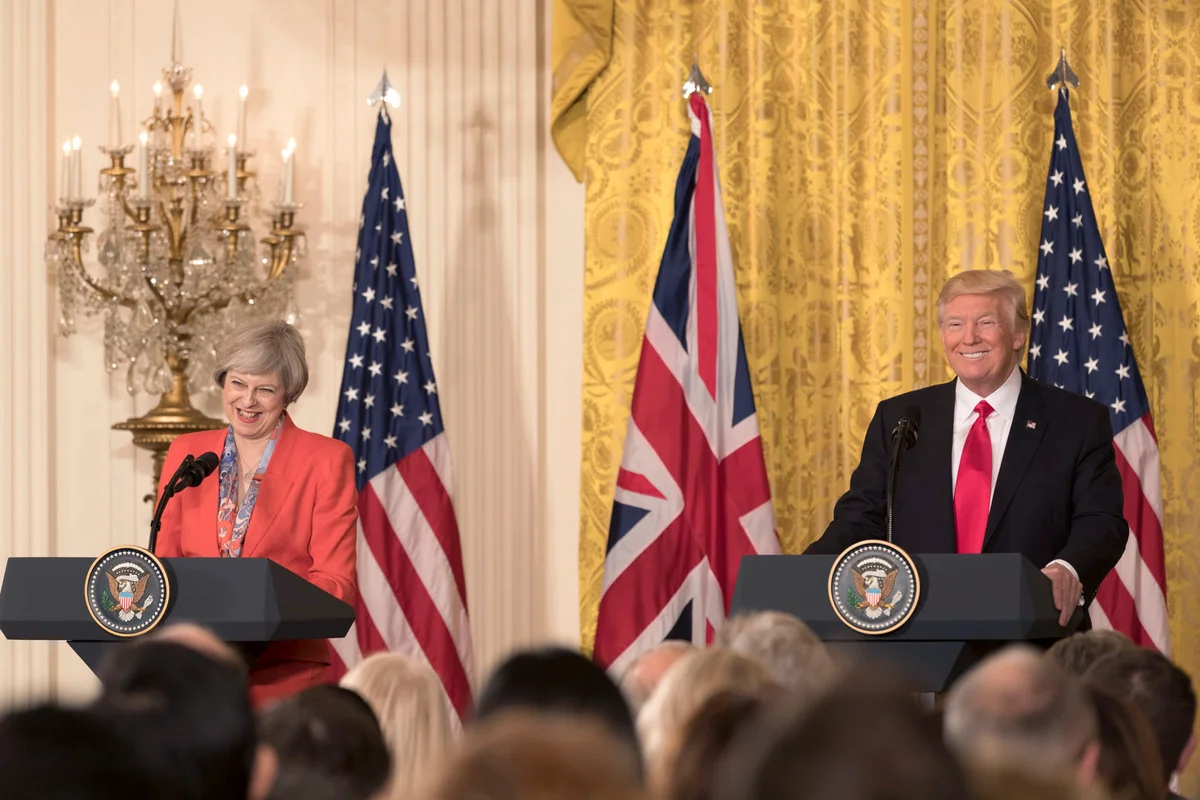
- 16. The White House / Wikimedia CommonsMay and Trump press conference: exact photograph and public-domain record
Exact official White House item, credited photographer and Commons Flickr public-domain review checked. Its embedded courtesy/endorsement notice is recorded in the research evidence; the public-domain basis is official federal duties, not a claim of endorsement.
- 17. Creative CommonsPublic Domain Mark 1.0