In this biography
Quick facts
- Born
- 29 March 1943
- Birthplace
- Carshalton, Surrey, England
- Country
- United Kingdom
- Nationality
- British
- Known for
- The 1992 election victory, Maastricht negotiations, Black Wednesday and the Northern Ireland peace process
- Prime minister
- 28 November 1990–2 May 1997
- First elected to Parliament
- Huntingdonshire, 1979
- General-election victory
- 9 April 1992
- Joint peace declaration
- With Albert Reynolds, 15 December 1993
Why this life matters
Major’s premiership connects the end of Thatcher’s government to New Labour’s victory. Its record includes public-service initiatives and peace diplomacy alongside the ERM collapse, arguments about Europe and declining confidence in Conservative government.
Timeline
Key moments
Surrey birth and Brixton upbringing
Born in Carshalton, raised in Brixton and left Rutlish Grammar School in 1959.
Local politics and election to Parliament
Served on Lambeth Council before winning Huntingdonshire at the 1979 general election.
Rapid ministerial promotion
Moved from social-security office to Chief Secretary, Foreign Secretary and Chancellor.
Succeeded Margaret Thatcher
Became prime minister on 28 November.
Maastricht and electoral victory
Negotiated the Maastricht settlement in December 1991; won the April 1992 election; the treaty had been signed in February.
Sterling left the ERM
The government suspended sterling’s ERM membership on 16 September after failed efforts to defend its exchange rate.
Peace efforts and political divisions
Issued the Downing Street Declaration, faced disputes over Europe and won a 1995 Conservative leadership contest.
Departure and later honours
Left Downing Street in 1997, Parliament in 2001 and received the Garter in 2005.
A route to politics through Brixton and banking
John Major was born in Carshalton, Surrey, on 29 March 1943 and grew up in Brixton, south London. His father Tom had worked in entertainment. Major attended Rutlish Grammar School and left in 1959; his subsequent banking qualification came through continued study rather than a university degree. That educational route became a distinctive feature of his public story, contrasting with the university careers of many twentieth-century prime ministers.
Conservative activism led him into Lambeth local government, where he was elected a councillor in 1968 and chaired the housing committee. Two unsuccessful parliamentary campaigns in St Pancras North in 1974 preceded election for Huntingdonshire in 1979. Boundary changes later gave the constituency the name Huntingdon.
From social security to Downing Street
Major’s ministerial progress accelerated during Margaret Thatcher’s later governments. He became a junior minister in the Department of Health and Social Security in 1985, entered Cabinet as Chief Secretary to the Treasury in 1987, and briefly served as Foreign Secretary in 1989 before becoming Chancellor of the Exchequer. These appointments gave him experience in spending control, diplomacy and economic policy before the premiership.
Following Thatcher’s withdrawal from the Conservative leadership contest, he became prime minister on 28 November 1990. The international crisis caused by Iraq’s occupation of Kuwait immediately tested his administration. Britain participated in the coalition war in 1991, while an IRA mortar attack on Downing Street demonstrated the continuing danger of the Northern Ireland conflict.
Election success met an economic reversal
Major led the Conservatives to victory on 9 April 1992, securing another term after thirteen years of Conservative rule. The result supplied a parliamentary majority, but a small one that would become harder to manage. Domestic initiatives included replacing the Community Charge with Council Tax, the Citizen’s Charter’s emphasis on public-service standards and legislation establishing the National Lottery.
The major economic rupture came on 16 September 1992, Black Wednesday. Attempts to maintain sterling within the European Exchange Rate Mechanism failed despite intervention and higher interest rates. Withdrawal damaged the government’s reputation for economic competence. Subsequent growth did not erase that political loss: economic recovery and public confidence in the administration followed different courses.
Maastricht exposed competing views of Europe
At Maastricht in December 1991, Major negotiated participation in a new European Union together with British exemptions concerning the single currency and social policy. The treaty was signed in February 1992 and entered into force in November 1993. An exemption from adopting the currency was a choice about participation within European integration; it did not remove Britain from the European institutions.
The agreement disappointed opponents for different reasons. In Parliament, Labour leader Neil Kinnock criticised the opt-outs as a loss of influence and employment protection, while Conservative opponents challenged the direction of integration itself. Ratification became entangled with parliamentary rebellion and a confidence vote. Major defended the settlement, but could not turn it into lasting Conservative agreement about Europe.
Peace diplomacy depended on more than two leaders
Major and Irish Taoiseach Albert Reynolds issued the Downing Street Declaration on 15 December 1993. It affirmed consent regarding Northern Ireland’s constitutional future and offered a route into dialogue for parties committed to peaceful methods. Earlier intergovernmental initiatives, John Hume’s discussions with Gerry Adams and contacts with republicans formed part of the surrounding process.
This diplomacy involved distrust as well as cooperation. Published contemporary records show Major and Reynolds arguing about leaks, contacts and how to secure acceptance in both communities. Ceasefires followed in 1994, but violence resumed before the eventual 1998 agreement under successor governments. Major’s contribution was substantial without making him the sole author of peace or treating the 1993 declaration as the final settlement.
Defeat and the assessment of his premiership
Europe was only one source of pressure. The government faced damaging reporting about Conservative conduct, a shrinking parliamentary position and repeated challenges to authority. Major resigned as party leader in 1995 to force a leadership contest, which he won. Labour’s victory in 1997 nevertheless ended his premiership on 2 May; he briefly led the opposition before leaving the party leadership.
He remained an MP until 2001 and received the Companion of Honour in 1999 and the Garter in 2005. His record requires several judgements at once: the ERM failure and party divisions, the survival achieved in 1992, domestic changes, and the patient groundwork for Northern Ireland negotiations. His own archive illuminates his account of these events, while parliamentary and institutional histories provide checks on that retrospective presentation.
Quick answers
Frequently asked questions about John Major
- When was John Major prime minister?
- He served from 28 November 1990 to 2 May 1997, succeeding Margaret Thatcher and followed by Tony Blair.
- Did John Major win a general election?
- Yes. He led the Conservatives to victory on 9 April 1992, although the resulting parliamentary majority was small.
- Did Maastricht make Britain leave Europe?
- No. The treaty established the European Union. Major’s government negotiated British opt-outs from the single currency and social-policy arrangements while remaining within the European project.
- Was the Downing Street Declaration the Good Friday Agreement?
- No. The 1993 declaration set out peace principles and conditions for dialogue. The more detailed Belfast/Good Friday Agreement followed in 1998.
Keep exploring
Lives connected to this story
- Margaret Thatcher
Understand the Conservative government Major inherited and the leadership transition of 1990.
- Tony Blair
Follow the successor whose government completed the 1998 Northern Ireland agreement.
Sources and further reading
Explore the evidence
These references support the biography and offer further reading. Official records, first-person accounts and independent reporting provide different perspectives; image records document attribution and licensing.
- 1. UK Prime Minister’s OfficeJohn Major: life and premiership
- 2. UK ParliamentJohn Major: parliamentary career and offices
- 3. John Major ArchiveBiography: education, public service and later honours
Read the public biography as Major’s retrospective account, not independent proof that policies succeeded. Offices and dates are checked against Parliament.
- 4. Bank of EnglandHistory: sterling and the ERM, 16 September 1992
- 5. UK Parliament, Historic HansardMajor’s Maastricht statement and Kinnock’s response, 11 December 1991
- 6. UK ParliamentThe ERM and the single currency: ratification and social-policy opt-out
- 7. Foreign and Commonwealth OfficeTreaty on European Union: signature and entry into force
- 8. British and Irish Governments / CAIN, Ulster UniversityJoint Declaration on Peace, 15 December 1993: complete text
- 9. The National ArchivesDowning Street Declaration: selected contemporary document transcripts
Read selected published transcripts, especially the November letter and December meeting record; these are not a review of the complete government files.
- 10. CAIN, Ulster University / Martin Melaugh and Fionnuala McKennaPolitical initiatives during the conflict, 1968–1996
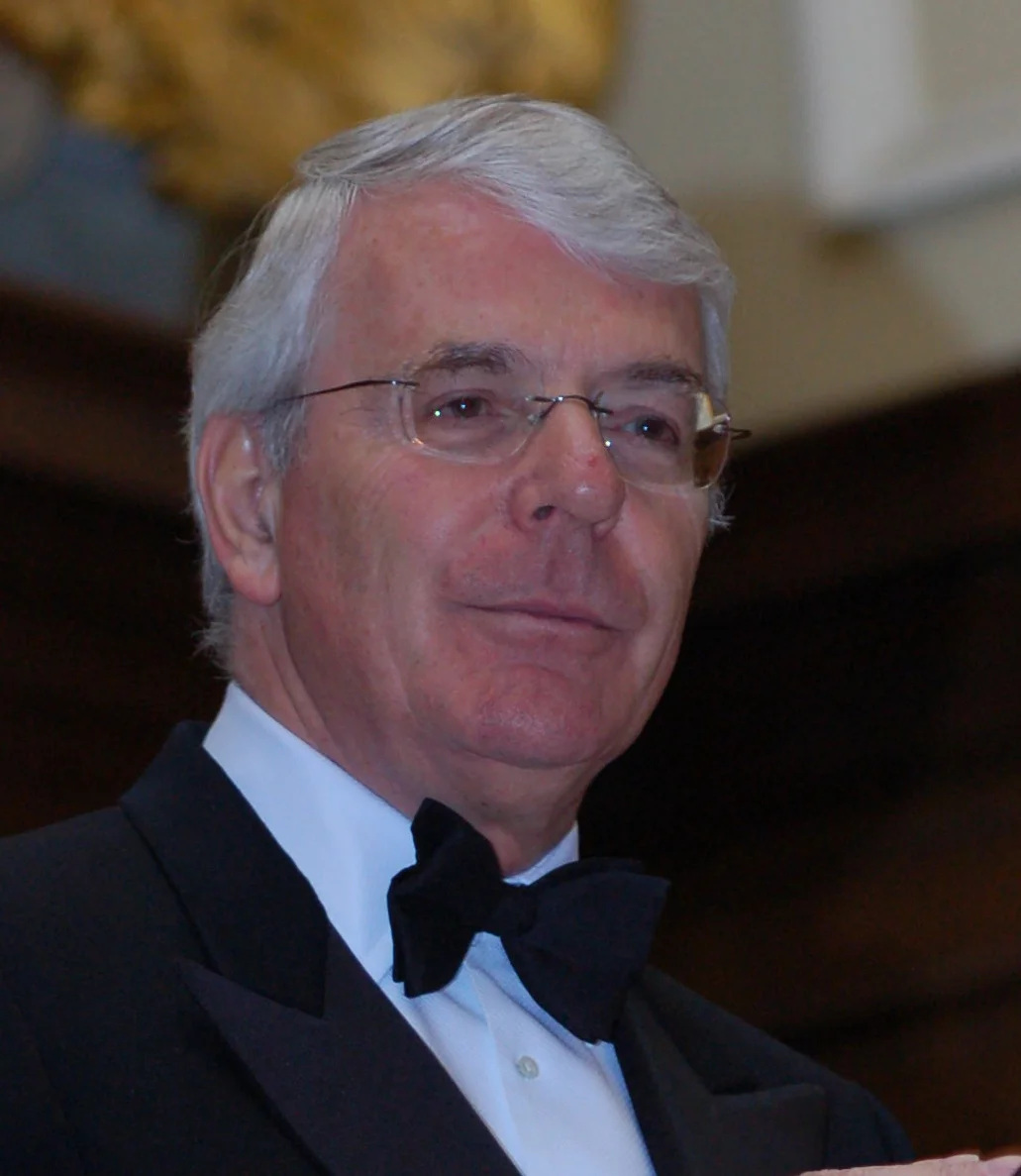
- 11. Darren Mooney / Wikimedia CommonsJohn Major at the Hist Inaugural: original upload and public-domain release
Used the full 2012 upload revision, before the later crop and levels adjustment. Both the downloaded original and WebP were visually inspected.
- 12. Creative CommonsPublic Domain Mark 1.0