
The short answer
May secured a negotiated withdrawal agreement in November 2018 but could not secure Commons approval. The backstop was a central source of resistance, although opponents wanted different outcomes. Two votes rejected the agreement with its Political Declaration; a third rejected the Withdrawal Agreement alone. That distinction is essential to understanding the parliamentary sequence.
Read the motion as well as the tally
What did MPs reject?
All three votes were defeats, but the final motion had a different scope.
| Date | Motion’s scope | Against / for |
|---|---|---|
| 15 January 2019 | Withdrawal Agreement and Political Declaration | 432 / 202 |
| 12 March 2019 | Withdrawal Agreement and Political Declaration, with further assurances | 391 / 242 |
| 29 March 2019 | Withdrawal Agreement alone; Political Declaration excluded | 344 / 286 |
Chronology
A timeline of the turning points
Negotiators agreed the texts; EU leaders endorsed them
The package combined a Withdrawal Agreement with a Political Declaration on the future relationship.
First meaningful vote failed
The Commons rejected the package by 432 votes to 202.
Second meaningful vote failed
After additional assurances, MPs rejected it by 391 to 242.
The agreement-only motion failed
A motion excluding the Political Declaration was rejected by 344 to 286.
May left Downing Street
Boris Johnson succeeded her before a revised EU–UK agreement was negotiated.
A revised agreement was published
The later package changed the Ireland/Northern Ireland arrangements while retaining much of the main text.
An exit treaty and a future framework served different purposes
The November 2018 package contained two documents. The Withdrawal Agreement addressed the arrangements for leaving, including citizens’ rights, financial obligations, separation issues and a transition. The Political Declaration described a framework for the future relationship. Negotiating the terms of departure was therefore distinct from concluding every element of a permanent trading relationship.
The UK government and EU negotiators agreed the texts in November, and the other EU leaders endorsed them on 25 November. That international agreement still required domestic approval. Since the June 2017 election, May had led a minority government with DUP support through a confidence-and-supply arrangement. A negotiating compromise still had to command support in a divided legislature.
The backstop addressed the border if other arrangements were not ready
The backstop was intended as insurance against a hard border between Northern Ireland and Ireland. The European Council explained that it should operate only if necessary and until replaced by a subsequent arrangement achieving the same objective. The unresolved question was how a commitment to avoid border infrastructure would work when the UK left the EU’s economic structures.
May’s proposed backstop envisaged a wider UK–EU customs territory, with additional Northern Ireland provisions. Critics feared obligations that the UK could not end unilaterally; others opposed the wider direction of Brexit or preferred a closer continuing relationship. Their votes could combine against the government without agreement on an alternative. A shared rejection should not be mistaken for a shared solution to the underlying border problem.
The first two defeats concerned the whole approval package
On 15 January 2019 MPs voted 432 to 202 against the government’s proposed approval. The margin was 230. Further discussions and assurances focused particularly on the backstop and the intention that it should be temporary. The central issue was whether these assurances altered the risks perceived by enough MPs to produce a different result.
On 12 March the package was rejected again, this time by 391 to 242. The government had gained some support but remained short of a majority. Counting supporters is important, but the constitutional result was the same: neither vote supplied the required approval. Parliament’s rejection did not automatically rewrite the negotiated text or choose a particular alternative such as a further referendum, a different deal or departure without one.
The third motion was deliberately narrower
On 29 March the government sought approval of the Withdrawal Agreement without the Political Declaration. Parliament’s contemporary account explicitly distinguishes this motion from the previous two meaningful votes. The Speaker had ruled against bringing back an unchanged motion, and the government also faced the conditions attached to the extension of the Article 50 period.
MPs rejected the narrower proposal by 344 to 286, a margin of 58. Describing this simply as an identical third vote loses the reason for the changed motion. Even its own wording acknowledged that approval of the agreement alone would not by itself meet all the statutory requirements. The vote was an attempt to advance part of the process, rather than evidence that the future relationship had become legally unnecessary.
Sources for this section: [6]
Johnson’s later agreement retained much and changed a crucial part
May left office on 24 July 2019. The revised agreement published on 17 October under Boris Johnson retained most of the main Withdrawal Agreement, according to the Commons Library’s comparison. Citizens’ rights, the financial settlement and other separation provisions were not invented afresh. The significant changes concerned the Ireland/Northern Ireland Protocol and the framework for the future relationship.
The previous UK-wide customs backstop was replaced by different arrangements concerning Northern Ireland. This distinction guards against two misleading extremes: that Johnson negotiated an entirely unrelated treaty, or that May’s agreement was adopted unchanged. The political crisis concerned both the content of obligations and the ability to assemble parliamentary authority. Agreement at the negotiating table and approval at Westminster were connected but separate achievements.
Continue the chronology
Related history guides
Article 50: Parliament and Notification
Distinguish authority to begin the withdrawal process from approval of its negotiated outcome.
Read the timeline1998–1999The Good Friday Agreement’s Institutions and Consent
Understand the settlement behind the commitment to protect Northern Ireland’s peace framework.
Read the timelineBiography context
Explore United Kingdom through connected lives
Connected biographies
Read the political lives behind the negotiations
1956–
Theresa May
British Conservative politician, home secretary and prime ministerTheresa May was UK home secretary from 2010 to 2016 and prime minister from 2016 to 2019. Her premiership was dominated by Brexit negotiations and parliamentary defeats, while her longer record includes policing, modern slavery, immigration policy and the 2050 net-zero target.Read biography
1953–
Tony Blair
British Labour politician and prime ministerTony Blair served as UK prime minister from 1997 to 2007 and led Labour to three general-election victories. His governments combined constitutional and public-service reforms with an interventionist foreign policy whose most disputed decision was participation in the 2003 invasion of Iraq.Read biographyQuick answers
Common questions
- What was the Irish backstop for?
- It was an insurance arrangement intended to prevent a hard border on the island of Ireland if a satisfactory replacement arrangement was not yet operating.
- Were all three votes on identical documents?
- No. The first two concerned the agreement and Political Declaration. The 29 March motion sought approval of the Withdrawal Agreement alone.
- Did Parliament’s rejection establish a different Brexit plan?
- No. Different groups opposed May’s package for different reasons, so a majority against it did not itself identify a majority for a particular alternative.
- Was Boris Johnson’s agreement completely new?
- No. Much of the main agreement remained, but the Ireland/Northern Ireland arrangements changed materially, as did the Political Declaration.
Primary and institutional sources
How this history was checked
Read the Commons Library’s public summaries, the Council’s December 2018 conclusions and Parliament’s contemporary vote accounts. The March 29 motion’s narrower scope is explicit. This guide does not claim a clause-by-clause examination of every draft treaty. This article was reviewed on 23 October 2026.
- UK Prime Minister’s OfficeTheresa May: life and premiership
- House of Commons LibraryThe 2017–19 Government at Westminster: minority government and the DUP agreement
- House of Commons LibraryEU assurances to the UK on Brexit, 16 January 2019
- European CouncilArticle 50 conclusions: the backstop, 13 December 2018
- UK ParliamentSecond meaningful vote: rejection on 12 March 2019
- UK ParliamentWithdrawal Agreement-only motion: rejection on 29 March 2019
- House of Commons LibraryThe October 2019 EU–UK Withdrawal Agreement: comparison with May’s text
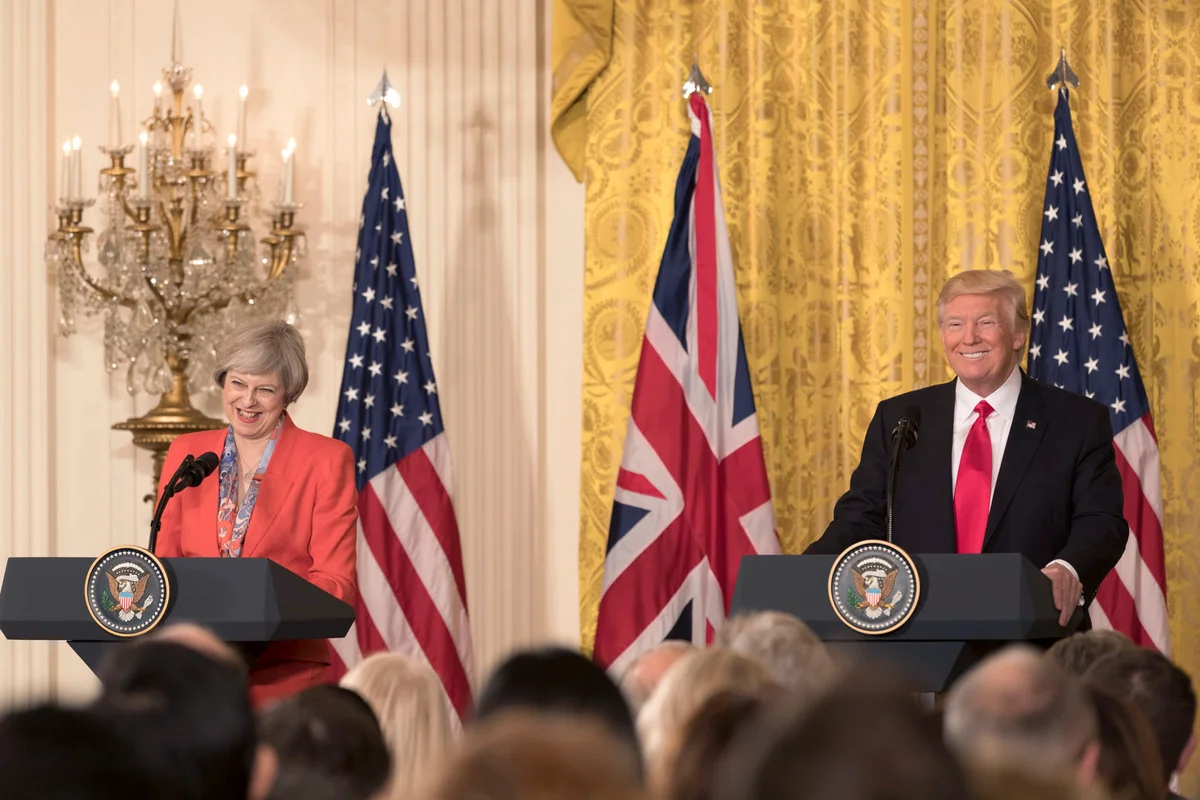
- The White House / Wikimedia CommonsMay and Trump press conference: exact photograph and public-domain record
- Creative CommonsPublic Domain Mark 1.0