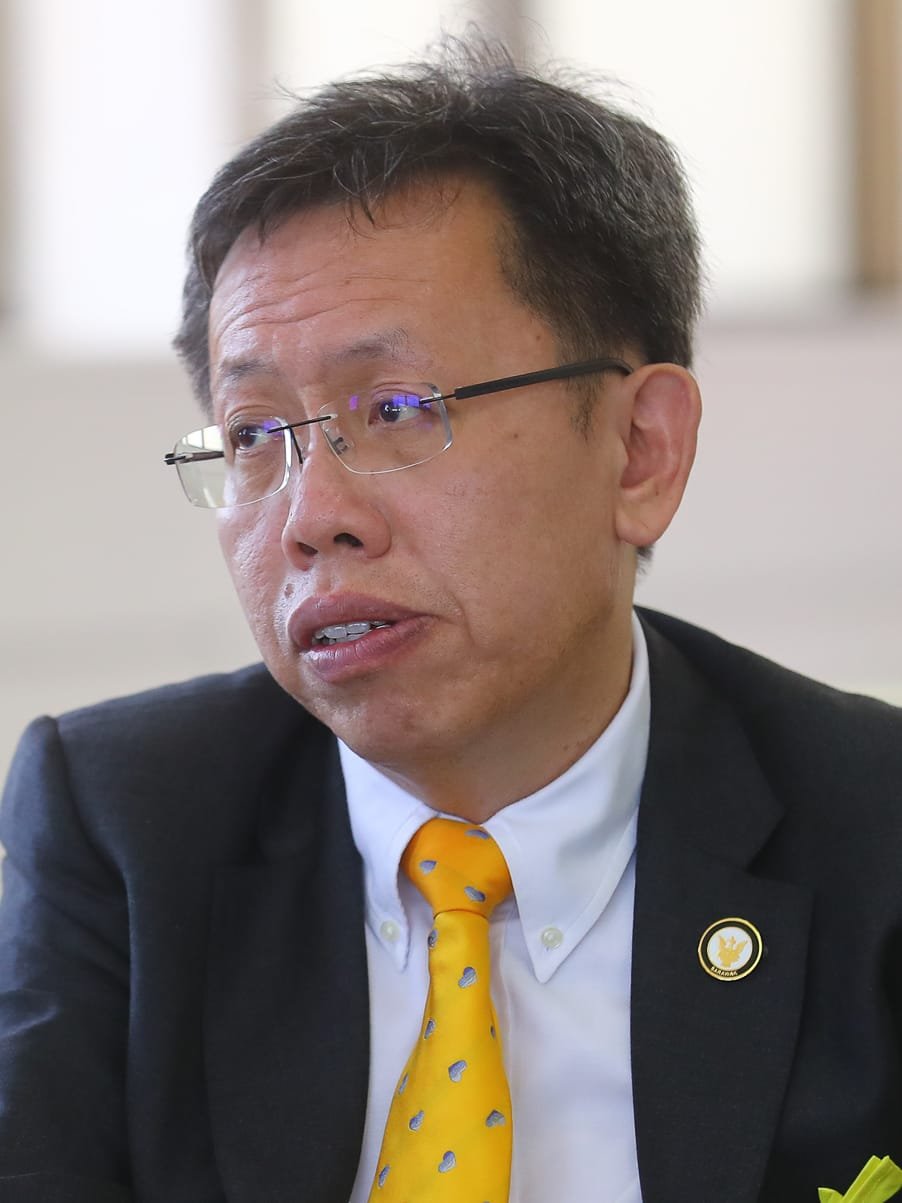
In this biography
Quick facts
- Born
- 19 August 1914
- Died
- 19 April 2000
- Birthplace
- Kuching, Sarawak
- Country
- Malaysia
- Nationality
- Malaysian
- Known for
- Co-founding Sarawak’s first political party and representing the state in federal politics
- Political party
- Sarawak United Peoples’ Party (SUPP)
- Party office
- Founding president · 1959–1982
- Federal service
- Technology, Research and Local Government; later Science, Technology and Environment
- Education
- Agricultural science, Serdang College
Why this life matters
Ong’s life traces the emergence of organised party politics in Sarawak, early disagreement over Malaysia and the later accommodation of a regional opposition party within federal government.
Timeline
Key moments
Born in Kuching
Born on 19 August into a family with a long history of public and commercial life in Sarawak.
Worked in agriculture
Served in Sarawak’s Department of Agriculture after studying at Serdang College.
Entered local government
Joined Kuching’s municipal council and later the Council Negri.
Co-founded SUPP
Helped establish Sarawak’s first political party and became its founding president.
Led Kuching’s municipal council
Served as president of Kuching Municipal Council from 1 December 1959 to 27 December 1965.
Challenged the Singapore separation procedure
Speaking in the Dewan Rakyat on 9 August, criticised the short notice given for a constitutional amendment.
SUPP joined Sarawak’s governing coalition
Won the Bandar Kuching federal seat, lost his state contest and joined the federal cabinet without portfolio in December.
Handled technology and local government
Parliamentary records identify him as Minister of Technology, Research and Local Government.
Addressed water pollution in Parliament
As science and environment minister, linked land clearing and industrial effluent to risks for water catchments.
Ended his SUPP presidency
The party’s own leadership list ends his term in 1982 and names Stephen Yong as successor in 1983.
Died in Kuching
Died on 19 April at the age of 85.
From agriculture to Sarawak’s first party
Ong Kee Hui was born in Kuching in 1914 and trained in agricultural science at Serdang College. He worked in Sarawak’s Department of Agriculture before moving into business and public service. In the 1950s he served in the Kuching Municipal Council and the Council Negri, institutions through which Sarawakians were beginning to argue over representation and self-government under British colonial rule.
In 1959 Ong, Stephen Yong and other organisers established the Sarawak United Peoples’ Party (SUPP). The party lists both men among its founders and records Ong as president from 1959 to 1982. SUPP was Sarawak’s first political party, but its founding was more than a personal milestone: it gave an organised electoral form to demands that had previously travelled through municipal, professional and community networks. Ong also led Kuching’s municipal council through the first half of the 1960s.
Malaysia, opposition and the 1965 separation
Ong and SUPP initially challenged the proposed terms and timetable for Sarawak’s entry into Malaysia, arguing for self-government before joining a wider federation. That stance matters because Sarawak’s eventual participation in the 1963 federation did not erase organised local opposition or the disagreement over safeguards and political equality. By 1965 Ong was speaking in the federal Parliament as a Sarawak representative.
On 9 August 1965, during the emergency passage of the constitutional amendment separating Singapore from Malaysia, Ong protested that members had only received the bill that morning. His parliamentary intervention focused on the lack of time to examine a major constitutional change. An Australian diplomatic account independently noted his objection to the speed of the process. It would be misleading, however, to freeze SUPP’s position in 1963: historian Vernon Porritt records that the party’s 1969 manifesto explicitly supported the concept of Malaysia.
The 1970 coalition and federal cabinet
The 1969 federal election was interrupted before voting in Sarawak after the May 13 violence in peninsular Malaysia and the declaration of emergency. Polling resumed in Sarawak in 1970. Ong won the Bandar Kuching parliamentary contest but lost his state constituency, a distinction often lost in abbreviated accounts of his career. After negotiations with Abdul Razak, SUPP joined the Sarawak governing coalition; by early July, party colleague Stephen Yong was deputy chief minister.
Ong’s own federal appointment came later. Porritt’s study dates his swearing-in as a minister without portfolio to 9 December 1970; by March 1971, parliamentary records identify him as Minister of Technology, Research and Local Government. The move from opposition to government was consequential rather than simply ceremonial. Ong later argued for ending elected local councils in peninsular Malaysia, while the same research records disagreement and a separate timetable for Sarawak’s councils. His ministerial role therefore belongs in the history of contested local representation as well as coalition-building.
Environment portfolio and a longer legacy
Ong later served as Malaysia’s Minister of Science, Technology and Environment. A March 1979 parliamentary answer under his name identifies risks to water catchments from land clearing, erosion and industrial and mining effluent. The record shows the kinds of practical questions his later portfolio covered; it should not be read as proof that those environmental problems were resolved during his term.
SUPP’s own leadership record ends Ong’s presidency in 1982 and names Stephen Yong as his successor from 1983. Ong died in 2000. His career spans three different political settings: colonial-era municipal service, opposition during the formation and early years of Malaysia, and participation in Sarawak’s coalition and the federal cabinet. Keeping those stages separate makes the biography more useful than a simple founder-to-minister story, especially for readers trying to understand why Sarawak’s place in the federation remained debated after 1963.
Quick answers
Frequently asked questions about Ong Kee Hui
- Who was Ong Kee Hui?
- Ong Kee Hui was a Sarawak politician and agriculturalist who co-founded SUPP in 1959, became its founding president and later served in Malaysia’s federal cabinet.
- When did Ong Kee Hui lead SUPP?
- SUPP’s own leadership record lists his presidency from 1959 to 1982, followed by Stephen Yong from 1983.
- Was Ong Kee Hui Kuching’s mayor?
- He was president of Kuching Municipal Council from 1 December 1959 to 27 December 1965. Kuching obtained city status in 1988, so describing this earlier office as city mayor would blur the distinction.
- Why did Ong Kee Hui object during Singapore’s separation in 1965?
- His parliamentary intervention on 9 August focused on the short notice and speed with which a major constitutional amendment was being enacted.
Keep exploring
Lives connected to this story
- Stephen Kalong Ningkan
Sarawak’s first chief minister and a key figure in the state’s early constitutional crises.
- Temenggong Jugah anak Barieng
Another Sarawak leader whose choices shaped the formation of Malaysia.
- Abdul Razak Hussein
The federal leader who negotiated SUPP’s entry into the Sarawak coalition.
- Fuad Stephens
Read about a Sabah leader facing the same separation and federal-state questions in 1965.
Sources and further reading
Explore the evidence
These references support the biography and offer further reading. Official records, first-person accounts and independent reporting provide different perspectives; image records document attribution and licensing.
- 1. Sarawak United Peoples’ PartySUPP founder members
- 2. Sarawak United Peoples’ PartySUPP past presidents and leadership terms
The party’s leadership list gives the 1959–82 presidency and a 1983 start for Stephen Yong. Some secondary summaries give 1980 as a retirement date; the party record is used here for the party-office endpoint.
- 3. Parliament of MalaysiaArchived member profile: Tan Sri Ong Kee Hui
- 4. Sarawak Museum JournalOng Kee Hui and early proposals for closer association
- 5. Parliament of MalaysiaMalaysia parliamentary debate, 23 August 1967
- 6. Parliament of MalaysiaConstitution and Malaysia (Singapore Amendment) Bill debate, 9 August 1965
- 7. Australian Department of Foreign Affairs and TradeAustralian cablegram on the Singapore separation debate
- 8. Borneo Research BulletinLocal government in Sarawak, 1963–88
Porritt distinguishes SUPP’s 1970 state-coalition entry and Ong’s 9 December 1970 federal appointment from his later named ministerial portfolio.
- 9. ElectionData.MYOng Kee Hui electoral history
- 10. Parliament of MalaysiaParliamentary debate, 12 March 1971
- 11. Parliament of MalaysiaParliamentary debate, 20 March 1979
- 12. Council of the City of Kuching SouthOfficial history: Ong’s 1 December 1959–27 December 1965 municipal presidency
The council history dates Ong’s municipal presidency from 1 December 1959, correcting the former 1960 timeline start. This was a municipal presidency before Kuching’s 1988 city status.