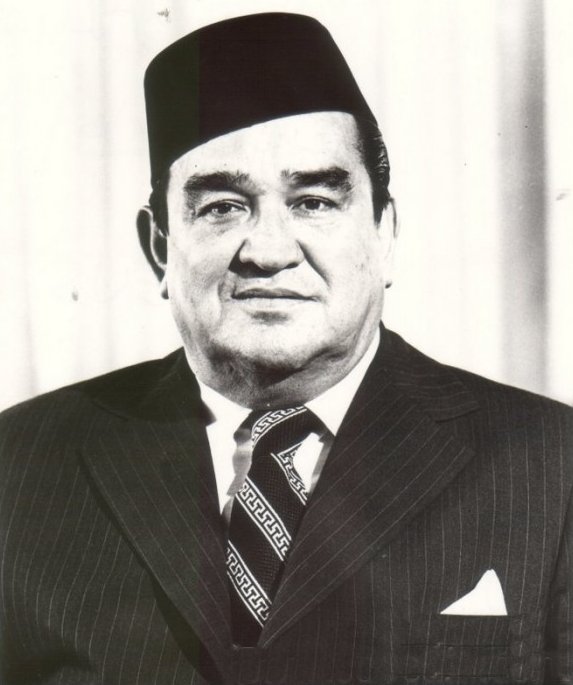
In this biography
Quick facts
- Born
- 8 June 1903
- Died
- 8 July 1981
- Birthplace
- Sungai Merirai, Kapit, Sarawak
- Country
- Malaysia
- Nationality
- Malaysian
- Known for
- Building Iban support for Malaysia and signing the Malaysia Agreement 1963
- Also known as
- Tun Jugah · Apai
- Federal office
- Minister for Sarawak Affairs · 1963–1974
- Political party
- Parti Pesaka Sarawak
- Historic role
- Sarawak signatory of the Malaysia Agreement 1963
Why this life matters
Jugah’s career shows how customary leadership, Indigenous representation and federal negotiation met during Sarawak’s transition into Malaysia.
Timeline
Key moments
Born near Kapit
Born on 8 June at a longhouse in Sungai Merirai in the upper Rejang region.
Became Temenggong
A later official commemoration dates his Kapit council chairmanship to 1 January and appointment as Temenggong to 8 February.
Mobilised support for federation
Consulted penghulu and district leaders around Kapit and advocated Sarawak’s participation in Malaysia.
Signed the Malaysia Agreement
Joined Sarawak’s delegation in London and signed the agreement on 9 July.
Served in the federal cabinet
Became the first minister responsible for Sarawak affairs after Malaysia was formed.
Became PBB’s first president
Led the new Parti Pesaka Bumiputera Bersatu after a merger of Sarawak parties.
Died in Kuching
Died on 8 July, one month after his seventy-eighth birthday.
Leadership from the upper Rejang
Jugah anak Barieng, widely known as Tun Jugah or Apai Jugah, emerged from the Iban communities of the upper Rejang around Kapit. His authority developed through customary leadership and relationships with longhouse communities, rather than through the professional and university routes taken by many later politicians.
In a 2024 commemorative speech reported by the Sarawak Tribune, the premier dated Jugah’s appointment as Kapit District Council chairman to 1 January 1955 and as Temenggong to 8 February that year. Temenggong was a community-leadership title, not another name for chief minister. Apai, meaning father, expressed the public identity associated with his leadership.
His signature on the Malaysia Agreement
Jugah supported Sarawak’s participation in Malaysia and became one of the Sarawak signatories to the agreement concluded in London on 9 July 1963. The published treaty names him as T. Jugah alongside P. E. H. Pike, Abang Haji Mustapha, Ling Beng Siew and Abang Haji Openg. He was not Sarawak’s sole signatory.
The agreement provided for North Borneo, Sarawak and Singapore to federate with the existing states of the Federation of Malaya. It entered into force on 16 September 1963. The July signing and September formation are therefore different milestones. His participation connected Iban political representation to a constitutional settlement negotiated among several territories and governments.
Sarawak in the federal cabinet
After federation, Jugah served as minister for Sarawak affairs in the federal government, a portfolio associated with him from 1963 to 1974. Contemporary parliamentary records list the ministerial office, while a later Dewan Rakyat discussion recalls the period of his service. This was a position in the national cabinet, distinct from leading Sarawak’s state government.
The distinction matters when comparing him with Stephen Kalong Ningkan, Sarawak’s first chief minister, or with the state’s governors. Jugah’s political importance did not depend on holding those offices. His career brought a community leader from Sarawak’s interior into the federal administration during the difficult early years of the new country.
Pesaka, the 1973 merger and PBB
Jugah’s party activity developed alongside his community and cabinet responsibilities. In 1973, Parti Pesaka and Parti Bumiputera merged to form Parti Pesaka Bumiputera Bersatu, commonly called PBB. He became the new party’s first president, a role different from both his customary title and his federal ministry.
The premier’s 2024 commemorative account presented his agreement to the merger as an effort to unite Indigenous political groups. That is an attributed later interpretation, not evidence that every Sarawak community held the same view. The merger nevertheless marks a specific institutional change in a career often reduced to the single act of signing MA63.
Sources for this section: [4]
Memory and cultural legacy
Jugah’s legacy extends into the preservation of Iban culture. The Tun Jugah Foundation’s textile programme promotes traditional weaving, patterns and natural dyes through classes, workshops and exhibitions. Its account records an Iban textile exhibition with the Muscarelle Museum of Art in Virginia in 1998, showing how cultural work continued beyond his lifetime.
In September 2024, the National Archives and the foundation collaborated on an exhibition connected to a statesman commemoration. These later activities help preserve records and material culture; they should not be mistaken for projects Jugah personally directed. His biography links community authority, federation, cabinet service and party building, while the surviving treaty provides a direct record of his place in Malaysia’s formation.
Quick answers
Frequently asked questions about Temenggong Jugah anak Barieng
- Who was Tun Jugah anak Barieng?
- He was an Iban community leader known as Apai Jugah, a Sarawak signatory to the Malaysia Agreement, a federal minister for Sarawak affairs and PBB’s first president.
- Was Tun Jugah Sarawak’s first chief minister?
- No. Stephen Kalong Ningkan held that state office. Jugah served as a federal minister for Sarawak affairs; the roles belonged to different levels of government.
- When did Jugah sign the Malaysia Agreement?
- He signed in London on 9 July 1963. The treaty lists T. Jugah among several Sarawak representatives. Malaysia’s formation on 16 September was a later event.
- What was Jugah’s connection to PBB?
- He became its first president when Parti Pesaka and Parti Bumiputera merged in 1973. This party office was distinct from his customary title of Temenggong and his cabinet portfolio.
Keep exploring
Lives connected to this story
- Tunku Abdul Rahman
Read the Malayan prime minister’s separate role in negotiating Malaysia’s formation.
- Fuad Stephens
Compare the North Borneo leader who signed the same agreement as D. A. Stephens.
- Stephen Kalong Ningkan
Distinguish Sarawak’s first chief minister from Jugah’s federal cabinet responsibilities.
Sources and further reading
Explore the evidence
These references support the biography and offer further reading. Official records, first-person accounts and independent reporting provide different perspectives; image records document attribution and licensing.
- 1. United Nations Treaty SeriesMalaysia Agreement — English treaty and signatory page
The English treaty’s signatory page, printed page 10 (PDF page 5), was visually checked. It lists T. Jugah among five Sarawak signatories. UN registration in 1970 is not the signing or formation date.
- 2. Parliament of MalaysiaDewan Rakyat record, 27 August 1966 — ministerial list
- 3. Parliament of MalaysiaDewan Rakyat debate, 6 November 1989
Indexed parliamentary text recalls the 1963–1974 Sarawak Affairs service. The 1966 parliamentary record separately identifies the ministry; this review does not claim a complete reading of either debate volume.
- 4. Sarawak TribunePremier’s commemoration of Jugah’s community and party leadership
Dated 10 September 2024, reporting a speech delivered the preceding day. Appointment dates and the merger interpretation are attributed to that retrospective, not to a contemporaneous appointment instrument.
- 5. Tun Jugah FoundationIban textiles: mission, background and activities
- 6. Tun Jugah FoundationTun Jugah of Sarawak: Iban Colonialism in Sarawak
Publisher catalogue for Vinson H. Sutlive’s 1992 biography. The catalogue was consulted, not the full 357-page book; detailed claims are supported by the separately linked treaty, institutional records and reported speech.
- 7. National Archives of MalaysiaTun Jugah, a distinguished statesman
- 8. United Nations Treaty CollectionAgreement relating to Malaysia
- 9. Prime Minister’s Office of MalaysiaSpeech recognising Tun Jugah’s role in Malaysia