In this biography
Quick facts
- Born
- 2 June 1955
- Birthplace
- Bangalore, Mysore State, India (now Bengaluru, Karnataka)
- Country
- India
- Nationality
- Indian
- Known for
- Infosys leadership, Aadhaar’s initial implementation and digital public infrastructure
- Education
- Electrical engineering, IIT Bombay, 1978
- Infosys executive tenure
- CEO and managing director, March 2002–June 2007
- Public office
- Founding UIDAI chairman, 2009–2014
- Dated role check
- Infosys non-executive, non-independent chairman from 24 August 2017; checked 23 October 2026
Why this life matters
His career crosses private enterprise, public administration and philanthropy. It also places technical scale beside questions of privacy, exclusion, democratic accountability and the limits of technology-led institutional reform.
Timeline
Key moments
Bangalore and IIT Bombay
Born on 2 June 1955; completes an electrical-engineering degree in 1978.
Infosys co-founder
One of seven engineers establishing the software-services company.
Executive leadership and co-chair
Serves as CEO and MD from 2002 to 2007, then co-chairman until leaving in 2009.
UIDAI
Leads the authority’s initial Aadhaar implementation; first numbers are issued in 2010.
Election and education work
Loses the Bangalore South parliamentary election; co-founds EkStep in 2015.
Returns to Infosys oversight
Becomes non-executive chairman on 24 August 2017; the 2026 filing confirms a role separate from the CEO.
Engineering training preceded a collective software venture
Nandan Nilekani was born in Bangalore on 2 June 1955 and graduated in electrical engineering from IIT Bombay in 1978. Early software work brought him into contact with colleagues who would establish Infosys. His education and professional network mattered in an industry still developing its international business model and its ability to deliver projects from India.
He was one of seven engineers who founded Infosys in 1981. Narayana Murthy was another founder, not an alternative name for Nilekani or the only contributor to the venture. The company’s later scale depended on clients, programmers, managers and successive leaders. Its 1993 Indian public offering and 1999 American depositary-share offering were later financing events, distinct from the original founding.
Infosys executive leadership involved global delivery and scale
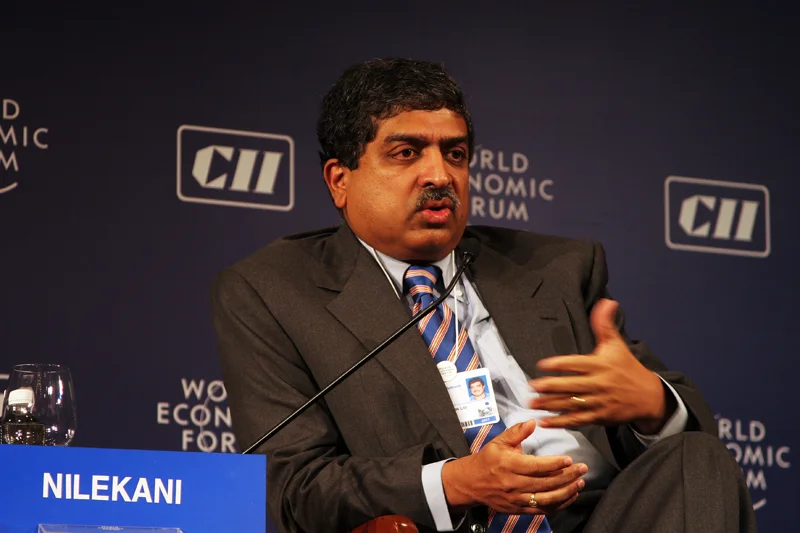
Nilekani held senior operational positions before becoming chief executive and managing director in March 2002. He remained in those offices until June 2007, then became co-chairman. This period coincided with the expansion of international demand for software services and the development of large delivery organisations in India. A chief executive had to coordinate people, customer relationships and execution rather than simply export a finished technology.
The company’s growth also required governance and disclosure systems suitable for public investors in more than one jurisdiction. Those arrangements did not remove business risks or future disagreements. Nilekani’s executive tenure should be assessed in that organisational context, with credit shared across the founding team and professional staff, rather than converted into a claim that he created India’s entire software industry.
UIDAI shifted his work from clients to resident identification
In June 2009 the government invited Nilekani to chair the Unique Identification Authority of India with the rank of a cabinet minister. He left the Infosys board that July and served at UIDAI until March 2014. The authority had been created administratively in January 2009; its institutional origins therefore preceded his arrival, while his leadership helped shape implementation at national scale.
Aadhaar sought a portable number through which residents could establish identity and undergo authentication. It was not a citizenship certificate, a welfare entitlement in itself or a payment application. Government departments, administrators, technology specialists and enrolment partners all contributed. The first numbers were issued in 2010, but the later 2016 statute and 2018 Supreme Court judgment came after his chairmanship.
Aadhaar’s reach brought contested questions of rights and access
Supporters argued that a common identity layer could reduce duplicate records and help residents use services across institutional boundaries. Critics raised concerns about surveillance, consent, security and exclusion when authentication failed. The debate cannot be resolved by counting enrolments alone: an identity system may operate at scale while individual users still face difficulty obtaining a benefit or correcting a record.
Research by Jean Drèze and colleagues documented authentication problems and transaction costs in Jharkhand’s food-distribution system. Those findings concern a particular implementation and population, not every Aadhaar use. In 2018 the Supreme Court upheld much of the statutory framework while limiting parts of it, including private contractual use under section 57. Nilekani’s role is part of this institutional debate; he was neither the sole inventor nor the judge of the programme’s legality.
An election defeat preceded his return to corporate oversight
Nilekani contested Bangalore South for the Indian National Congress in the 2014 general election and lost to the Bharatiya Janata Party’s Ananth Kumar. The result separated technological and business prominence from electoral support. His departure from UIDAI and the election were changes in public role, not a transfer of the authority into a private business or a successful parliamentary career.
On 24 August 2017 he returned to Infosys as non-executive, non-independent chairman after Vishal Sikka’s resignation and a public dispute between the board and founders. Disagreements concerned governance, executive compensation and transactions; the rival allegations should remain attributed. His appointment sought institutional stability and a new CEO, rather than a resumption of his old executive office. The 2026 filing continues to separate his chairmanship from Salil Parekh’s CEO responsibilities.
Education work developed through collaborators and changing methods
In 2015 Nilekani co-founded EkStep with Rohini Nilekani and Shankar Maruwada. Its initial literacy and numeracy ambitions led from an educational application toward infrastructure that others could use for varied content and settings. The foundation’s own origin story acknowledges that early solutions did not achieve the intended reach. That admission makes collaboration and adaptation more informative than a claim of effortless technological transformation.
Nilekani has continued writing and advocating for digital public infrastructure, while supporting educational institutions. As checked on 23 October 2026, Infosys identifies him as co-founder and chairman and EkStep as a continuing commitment. His career’s central tension remains useful: building common systems can create opportunities, but public value depends on institutions, safeguards and the practical experience of people who must use them.
Quick answers
Frequently asked questions about Nandan Nilekani
- Did Nandan Nilekani found Infosys alone?
- No. He was one of seven founding engineers in 1981. The later company was built by a much larger organisation and successive leaders.
- Is he still UIDAI chairman?
- No. He chaired UIDAI from 2009 to March 2014. Later laws, judgments and implementation decisions should not be dated to his tenure.
- Is Aadhaar proof of citizenship?
- No. Aadhaar is an identity system for eligible residents; the number does not by itself establish citizenship or domicile.
- Is his present Infosys role the same as CEO?
- No. The October 2026 record identifies him as non-executive, non-independent chairman. The CEO and managing director is Salil Parekh.
Keep exploring
Lives connected to this story
- N. R. Narayana Murthy
Compare the Infosys founders’ distinct executive careers and later governance responsibilities.
- Roshni Nadar Malhotra
Compare non-executive chairmanship and professional management in two differently owned technology enterprises.
- S. Gopalakrishnan
Read the co-founder who succeeded him as Infosys chief executive in 2007.
Sources and further reading
Explore the evidence
These references support the biography and offer further reading. Official records, first-person accounts and independent reporting provide different perspectives; image records document attribution and licensing.
- 1. InfosysCurrent Nandan M. Nilekani management biography
- 2. InfosysForm 20-F 2026: non-executive chairman and CEO responsibilities
Current office check distinguishes a non-independent founder-chair from the CEO; no market-return or wealth claims are made.
- 3. InfosysForm 20-F 2009: 2002–2007 CEO tenure and co-chairmanship
- 4. IIT BombayNamed chairs record: Nilekani’s electrical-engineering graduation in 1978
- 5. The Indian ExpressNandan Nilekani biography: 2 June 1955 and Bangalore
- 6. UIDAIOfficers Served in the Past: July 2009–March 2014 chairmanship
UIDAI table gives 23 July 2009 joining and 13 March 2014 relieving; other records describe assumption of charge on 24 July. The biography uses the unambiguous year span.
- 7. Prime Minister’s Office / PIBNilekani invited to chair UIDAI, 25 June 2009
- 8. UIDAIAnnual Report 2017–2018: administrative and statutory origins
- 9. Supreme Court of India / Indian KanoonK.S. Puttaswamy judgment, 26 September 2018, majority opinion
Historical 2018 judgment and majority conclusions, not a statement of all later amendments or current compliance requirements.
- 10. Jean Drèze, Nazar Khalid, Reetika Khera and Anmol SomanchiAadhaar and Food Security in Jharkhand: Pain without Gain?, 2017 household study
A dated household study, not a national failure-rate estimate; findings are confined to the reported Jharkhand implementation.
- 11. NDTVNilekani loses Bangalore South election, May 2014
- 12. Infosys / PR NewswireBoard disclosure: non-executive, non-independent chairman, 24 August 2017
- 13. Reuters / Sankalp PhartiyalNilekani returns amid Infosys governance dispute, August 2017
- 14. EkStep FoundationOrigin story: 2015 founding and change in educational approach
- 15. Nandan Nilekani / National Law School of India UniversityConvocation address, 2022: collaborators and EkStep
- 16. World Economic Forum / Wikimedia CommonsNandan Nilekani: complete 2007 photograph with permission record
- 17. Creative CommonsAttribution-ShareAlike 2.0 Generic licence