
The short answer
What did Aadhaar identify, and why did its legal basis become contested? This historical guide follows the programme from UIDAI’s creation to the 2018 judgment, separating an identity number from citizenship, entitlement and payment systems.
Chronology
A timeline of the turning points
UIDAI created
The authority begins as an attached office of the Planning Commission.
Founding chair
Nandan Nilekani joins after the government’s June invitation.
First number
The initial rollout takes place at Tembhli in Maharashtra.
Statute and review
The Aadhaar Act establishes a statutory basis; the Supreme Court later upholds much of the framework while limiting provisions.
The authority began before it had an Aadhaar-specific statute
UIDAI was created on 28 January 2009 as an attached office of India’s Planning Commission. The project followed earlier government discussion of identification and service delivery. In June the government invited Infosys co-founder Nandan Nilekani to chair the authority with cabinet-minister rank; he joined in July. Administrative creation and the chair’s arrival were separate steps, involving officials and committees as well as a prominent technology leader.
The original programme operated through executive arrangements before Parliament supplied its later statutory framework. That sequence became central to legal criticism. Technical implementation could move forward while questions about authorisation, data use and the boundaries of state power remained unsettled. The programme’s institutional history is therefore as important as the history of its software.
A number, enrolment and authentication performed different tasks
The first Aadhaar numbers were issued in September 2010, with the launch at Tembhli in Maharashtra. Enrolment collected demographic and biometric information, while de-duplication sought to prevent multiple identities in the system. Authentication later tested a submitted identity claim against the recorded information. These are connected operations, but issuing a number and successfully authenticating a transaction are not the same event.
The government described a portable identity layer that could work across places and programmes. Portability could help people whose existing documents were fragmented or locally specific. It did not itself determine eligibility for every service. Departments still needed accurate beneficiary records, workable delivery arrangements and a way to handle people whose enrolment, details or authentication did not work as intended.
Identity did not establish citizenship or an automatic benefit
Aadhaar was designed for residents, rather than as a register determining citizenship. Section 9 of the Aadhaar Act states that the number does not by itself confer or prove citizenship or domicile. A 2016 parliamentary answer makes the same distinction. A person’s Aadhaar record therefore could not by itself answer every legal question about nationality, residence rights or entitlement.
It should also be distinguished from the National Register of Citizens and from payment systems such as UPI. An identity reference can be used within another system without becoming that system. This distinction avoids a common causal shortcut: linking an account, a benefit or an application with Aadhaar does not make the number the source of the money or the decision about who qualifies.
Scale brought both service ambitions and exclusion concerns
Supporters expected common identification to reduce duplicate or fictitious records and make administration easier. Those aims concerned particular delivery problems. A programme’s benefit could depend on how databases were linked and how frontline staff used authentication, alongside changes in banking, communications and programme rules. Improvements should not automatically be credited to one technology when several reforms occurred together.
A 2017 household study by Drèze, Khalid, Khera and Somanchi reported exclusion problems and additional transaction costs in Jharkhand’s food-distribution system. Later comparative research stressed variation across states and programmes and the importance of exception handling. Those findings neither establish that every Aadhaar transaction failed nor justify dismissing denied access as statistically unimportant. An individual’s essential benefit can be at stake even in a system with enormous overall throughput.
The 2016 law and 2018 judgment were different milestones
Parliament enacted the Aadhaar Act in 2016, and UIDAI became a statutory authority that July. Constitutional litigation continued. In September 2018 the Supreme Court upheld much of the framework, including the central welfare-delivery provision, while striking down or limiting other provisions. The result was neither the unrestricted approval of every possible use nor the demolition of the whole identity programme.
The majority limited private contractual use under section 57 and addressed safeguards and data retention. The judgments also contained substantial disagreement, including a dissent over constitutional and legislative questions. This article describes that historical decision; it does not turn the 2018 text into a complete statement of later amendments or current institutional requirements. Those require their own dated legal examination.
The lasting question concerns accountable infrastructure
Nilekani’s UIDAI chairmanship ended in March 2014, before the statute and final constitutional judgment. Later implementation decisions belonged to successive governments, authority officials and service providers. His leadership of the initial rollout is important, but assigning every later result to one person would erase both institutional continuity and changes in policy and practice.
Aadhaar’s first decade shows why infrastructure must be evaluated at several levels: whether identity can be established, whether a service actually reaches a person, and whether the rules protect rights and constrain misuse. Enrolment totals answer only part of that inquiry. The history remains useful because it connects technological ambition with the practical and constitutional obligations of a public institution.
Biography context
Explore India through connected lives
Connected biographies
Initial leadership within a public institution
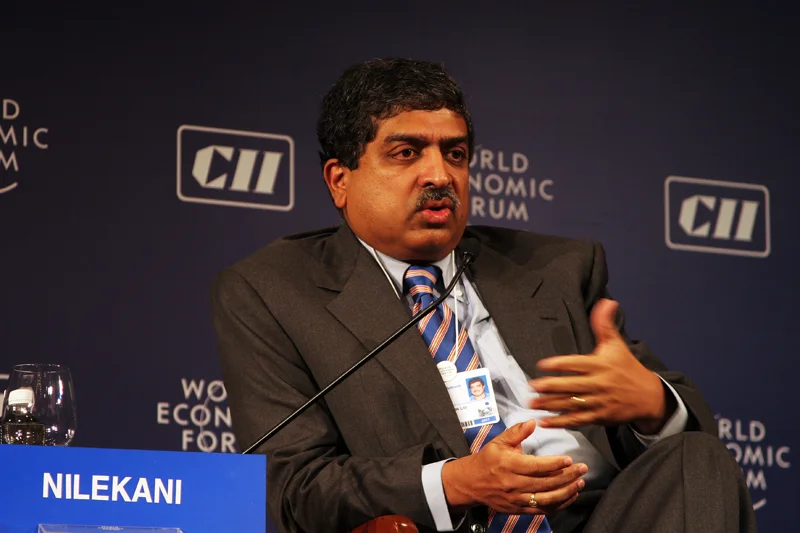
1955–present
Nandan Nilekani
Infosys co-founder, non-executive chairman and former UIDAI chairmanNandan Nilekani is an Indian technology entrepreneur who co-founded Infosys in 1981 and chaired UIDAI from 2009 to 2014. He returned as Infosys’s non-executive chairman in 2017 and has supported education and public digital infrastructure.Read biographyQuick answers
Common questions
- Did Aadhaar begin with the 2016 Act?
- No. UIDAI began administratively in 2009 and first numbers were issued in 2010; the statute came later.
- Does Aadhaar prove citizenship?
- No. The Act expressly separates the number from proof of citizenship or domicile.
- Did the 2018 Court approve every use?
- No. It upheld much of the framework while limiting or striking down provisions, including private contractual use.
- Is this a guide to current legal requirements?
- It is a history of 2009–2018. Later laws and requirements need a separate, current review.
Primary and institutional sources
How this history was checked
Administrative history, statutory text, the 2018 majority judgment and empirical studies serve different evidential purposes. Comparative 2019 analysis is used only to assess the earlier implementation period. This article was reviewed on 23 October 2026.
- InfosysCurrent Nandan M. Nilekani management biography
- InfosysForm 20-F 2026: non-executive chairman and CEO responsibilities
- InfosysForm 20-F 2009: 2002–2007 CEO tenure and co-chairmanship
- IIT BombayNamed chairs record: Nilekani’s electrical-engineering graduation in 1978
- The Indian ExpressNandan Nilekani biography: 2 June 1955 and Bangalore
- UIDAIOfficers Served in the Past: July 2009–March 2014 chairmanship
- Prime Minister’s Office / PIBNilekani invited to chair UIDAI, 25 June 2009
- UIDAIAnnual Report 2017–2018: administrative and statutory origins
- Supreme Court of India / Indian KanoonK.S. Puttaswamy judgment, 26 September 2018, majority opinion
- Jean Drèze, Nazar Khalid, Reetika Khera and Anmol SomanchiAadhaar and Food Security in Jharkhand: Pain without Gain?, 2017 household study
- NDTVNilekani loses Bangalore South election, May 2014
- Infosys / PR NewswireBoard disclosure: non-executive, non-independent chairman, 24 August 2017
- Reuters / Sankalp PhartiyalNilekani returns amid Infosys governance dispute, August 2017
- EkStep FoundationOrigin story: 2015 founding and change in educational approach
- Nandan Nilekani / National Law School of India UniversityConvocation address, 2022: collaborators and EkStep
- World Economic Forum / Wikimedia CommonsNandan Nilekani: complete 2007 photograph with permission record
- Creative CommonsAttribution-ShareAlike 2.0 Generic licence
- UIDAIFirst number and one-crore milestone: release, 30 June 2011
- Government of IndiaLok Sabha answer: Aadhaar is not citizenship proof, 27 July 2016
- UIDAIAadhaar Act: historical section 9 and statutory framework
- Center for Global Development / Alan Gelb and Anit MukherjeeBuilding on Digital ID for Inclusive Services, September 2019