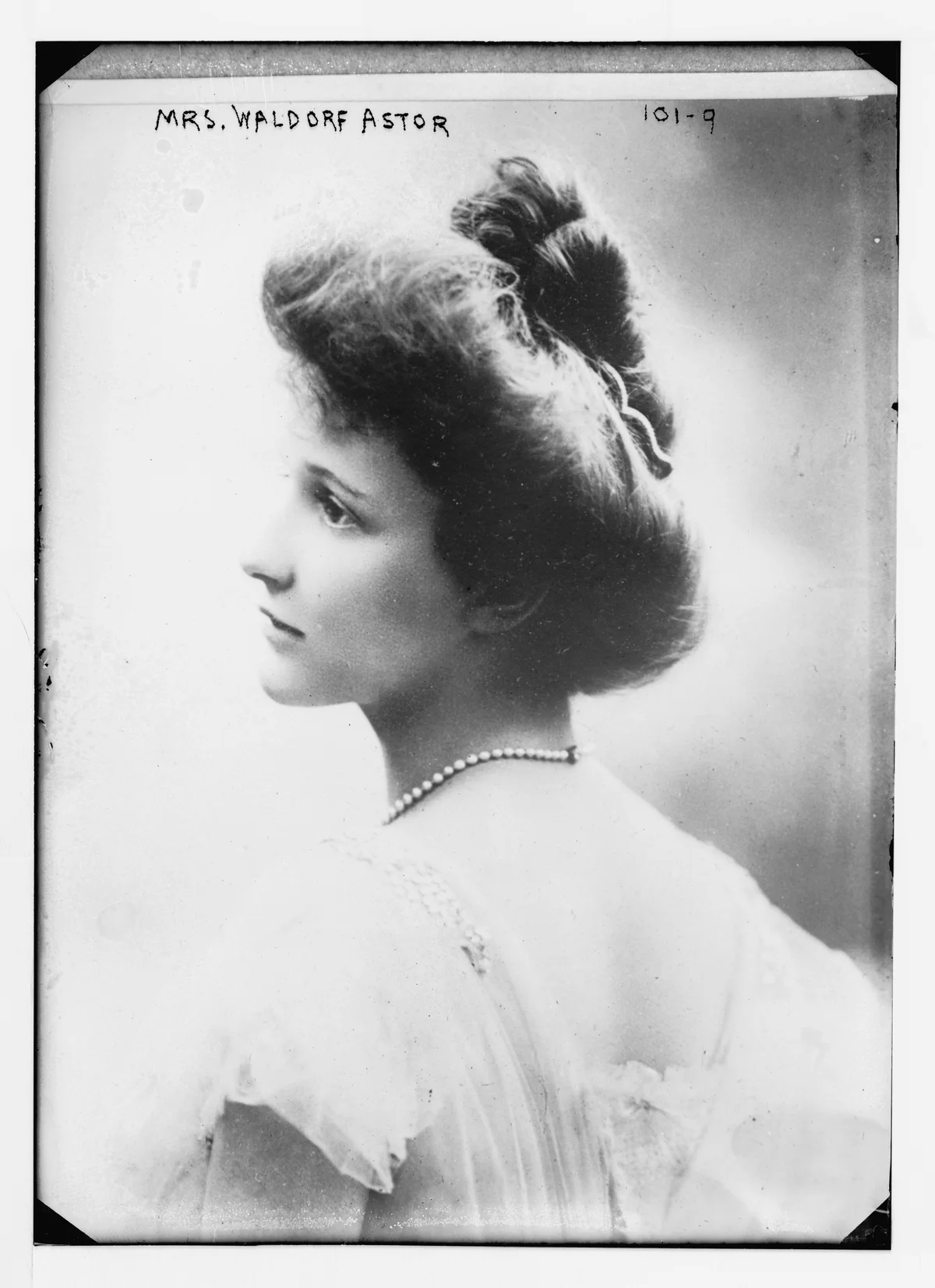
In this biography
Quick facts
- Born
- 1879-05-19
- Died
- 1964-05-02
- Birthplace
- Danville, Virginia, United States
- Country
- United Kingdom
- Nationality
- British
- Known for
- First woman to take a seat in the House of Commons, representing Plymouth Sutton from 1919 to 1945
- Born
- Danville, Virginia, 19 May 1879
- Constituency
- Plymouth Sutton, 1919–1945
- Parliamentary milestone
- First woman to take her Commons seat, 1 December 1919
- Earlier first
- Constance Markievicz was the first woman elected, in 1918
Why this life matters
Her parliamentary arrival broke an institutional barrier without making women a single political bloc or making her own politics free from exclusion and prejudice.
Timeline
Key moments
Born in Virginia
Nancy Witcher Langhorne was born in Danville on 19 May.
Married Waldorf Astor
The couple’s wealth, Cliveden home and political networks shaped her public opportunities.
Elected and took her seat
The Plymouth Sutton result was declared on 28 November; she entered the Commons on 1 December.
Maiden speech
On 24 February she defended drink restrictions and invoked women’s new electoral power.
Under-eighteen drink legislation
Her private member’s measure restricted alcohol sales to young people.
Equal voting terms
She supported the campaign for women to vote at twenty-one on the same terms as men.
Left Parliament
She retired after representing Plymouth Sutton throughout the interwar period and the Second World War.
Died on 2 May
Her first-institutional role remained central to a contested political reputation.
An American upbringing preceded a British political life
Nancy Witcher Langhorne was born in Danville, Virginia, on 19 May 1879. Her first marriage, to Robert Gould Shaw II, ended in divorce. She moved to England with her young son and in 1906 married Waldorf Astor. Their marriage brought Cliveden, considerable wealth and access to influential social and political networks. Her American birthplace and later British parliamentary career are distinct parts of the same life.
Waldorf’s election to Parliament drew Nancy into constituency work in Plymouth. She was not a leading figure in the suffrage campaign before entering the Commons. Her eventual candidacy arose from an unusual family and institutional circumstance, rather than a lifelong plan to become an MP. That origin matters when distinguishing the history of women in political office from the history of the women’s movement.
A by-election opened an unprecedented place in the Commons
When Waldorf inherited his father’s viscountcy in 1919, he had to leave the Commons. Nancy stood for the resulting Plymouth Sutton vacancy as a Conservative. The result was declared on 28 November, and on 1 December she took the oath and her seat. She became the first woman to sit in the Commons, not the first woman elected to it.
That earlier distinction belonged to Constance Markievicz, elected for Sinn Féin in 1918, who did not take her Westminster seat. Astor’s arrival also depended on the separate 1918 legislation permitting women to become MPs. Partial enfranchisement had not automatically supplied that right. Nor did one woman’s admission make Parliament representative of all women: voting qualifications, party selection and social inequalities still limited participation.
Her first speech linked social reform with women’s votes
Astor delivered her maiden speech on 24 February 1920 during a debate on liquor restrictions. Rather than apologising for speaking, she acknowledged the difficulty of receiving the first woman MP and then defended regulation of the drink trade. She disputed claims about working men’s preferences and invoked harms to women and children. These were political arguments about welfare, liberty and commercial power, not merely a ceremonial first appearance.
She ended by reminding MPs that women now possessed votes and intended to use them. The claim should not be mistaken for a mandate from every female voter; women disagreed over prohibition, party allegiance and social policy. Her temperance position nevertheless shows how the presence of a woman member could challenge the assumptions of an overwhelmingly male debating chamber.
Sources for this section: [6]
Backbench work extended beyond a symbolic first
Astor remained a backbench MP and never became a minister. She supported nursery education and legislation protecting women and children, and promoted the 1923 measure restricting alcohol sales to under-eighteens. She worked with women across party lines and pressed the Conservatives to fulfil promises on equal franchise, achieved in 1928. Her position combined personal moral convictions with practical parliamentary campaigning.
Historians Julie Gottlieb and Jacqui Turner describe her as a feminist by default rather than by an original political design. Their account stresses both her resilience in a hostile institution and the contradiction of a very wealthy woman presenting herself as a representative of working women. Institutional pioneering did not dissolve class differences or make her an uncontested spokesperson for women.
Prejudice and appeasement are integral to her record
Cliveden became associated with a circle sympathetic to appeasement of Nazi Germany. The extent of its coordinated control over policy was contested, but Astor’s antisemitic statements and anti-Catholic views are not erased by that dispute. English Heritage and the Gottlieb–Turner discussion acknowledge the prejudices directly. Context explains their setting; it does not excuse them or turn individual acts of assistance into a cancellation of discriminatory beliefs.
Equally, prejudice and support for appeasement should not be converted without evidence into a claim of Nazi Party membership. During the war she continued work in bombed Plymouth. She left Parliament in 1945 and died on 2 May 1964. A responsible account holds together the barrier she broke, the political work she undertook and the exclusions she herself perpetuated, rather than making either celebration or condemnation substitute for a biography.
Quick answers
Frequently asked questions about Nancy Astor
- Was Nancy Astor the first woman elected to Parliament?
- No. Constance Markievicz was elected in 1918 but did not take her Westminster seat. Astor became the first woman to sit in the Commons on 1 December 1919.
- Was Astor born in Britain?
- No. She was born in Danville, Virginia, in the United States. Her British political career centred on Plymouth Sutton.
- Did she become a government minister?
- No. She served as a backbench Conservative MP from 1919 until 1945, campaigning through speeches, legislation and political networks.
- Why is her legacy controversial?
- Her pioneering parliamentary role coexisted with antisemitic and anti-Catholic views and support for appeasement. Those documented positions require assessment alongside her work for women’s participation, not concealment behind it.
Keep exploring
Lives connected to this story
- Mary Wollstonecraft
Compare the earlier philosophical case for women’s independence with the later practical struggle for parliamentary participation.
- Betty Boothroyd
Explore a different institutional first: a woman becoming Commons Speaker in 1992.
- Shirley Williams
Follow a later woman’s career through party organisation, elected office and cabinet government.
Sources and further reading
Explore the evidence
These references support the biography and offer further reading. Official records, first-person accounts and independent reporting provide different perspectives; image records document attribution and licensing.
- 1. University of Reading, Astor100Nancy Astor: a short timeline
- 2. University of Reading / Julie Gottlieb and Jacqui TurnerNancy Astor: pioneering, problematic and feminist by default
Read the complete retrieved Gottlieb–Turner scholarly discussion and English Heritage profile. Their recognition of prejudice is retained; no claim is made to have read the original private correspondence in the Astor archive.
- 3. English HeritageLady Nancy Astor: political career and the Cliveden Set
- 4. UK Parliament, Historic HansardViscountess Nancy Astor: constituency and life dates
- 5. UK ParliamentWomen in the House of Commons: Markievicz and Astor
- 6. UK Parliament, Historic HansardLiquor Traffic (Restrictions): Astor’s maiden speech, 24 February 1920
Parliament’s overview, the Reading chronology and the published maiden speech distinguish first election, first seating and first formal speech. The speech is evidence of Astor’s own arguments, not proof that she represented every woman’s views.
- 7. Library of Congress / Wikimedia CommonsMrs Waldorf Astor, profile: complete glass-negative master TIFF
- 8. Lallie Charles / Wikimedia CommonsNancy Astor portrait: creator, 1906 publication and lifespan attribution; edited image not used
- 9. Creative CommonsPublic Domain Mark 1.0