In this biography
Quick facts
- Born
- 1943-11-07
- Birthplace
- Fort Macleod, Alberta, Canada
- Country
- Canada
- Nationality
- Canadian
- Known for
- Blue, Hejira and a songwriting career spanning folk, pop and jazz
- Birth name
- Roberta Joan Anderson
- Debut studio album
- Song to a Seagull (1968)
- Landmark records
- Blue (1971); Hejira (1976)
- US songwriting honour
- Library of Congress Gershwin Prize, 2023
Why this life matters
Her importance lies not only in autobiographical songwriting but also in authorship over sound: guitar tunings, production choices and collaborations that repeatedly challenged the singer-songwriter category.
Timeline
Key moments
Born in Alberta
Born Roberta Joan Anderson in Fort Macleod on 7 November.
First studio album
Song to a Seagull establishes her as a recording artist as well as a songwriter interpreted by others.
Blue
Her fourth studio album is released on 22 June.
Hejira
Road-based writing meets guitar-led arrangements and several different bass players.
Return and recognition
A Newport appearance is followed by the Gershwin Prize; neither marks a new debut or the end of her career.
From Alberta childhood to the folk circuit
Born in Fort Macleod on 7 November 1943, Roberta Joan Anderson grew up with competing interests in pictures and music. Her early life included Saskatchewan, drawing, piano lessons and later the ukulele. She attended art college in Calgary before choosing a precarious working life in music rather than completing a conventional path through art school.
Canadian clubs, Toronto and then the United States provided successive audiences. The geographical movement matters: Mitchell was Canadian, but her professional development cannot be confined to one national scene. Detroit, New York and Southern California became part of the same apprenticeship.
A songwriter before a familiar recording voice
Other performers helped circulate songs such as Both Sides Now and The Circle Game. Her own 1968 debut, Song to a Seagull, gave listeners another point of reference: the writer’s phrasing and a full album shaped around her material. Clouds and Ladies of the Canyon followed before Blue.
Mitchell also remained a visual artist. Painting was not simply a hobby added after musical fame; her artist-approved biography places it near the beginning of her ambitions, while her record packaging made the two practices publicly visible.
Blue, privacy and the work of arrangement
Released in 1971, Blue made vulnerability central to an album rather than a single confessional hit. Its small instrumental groups were carefully chosen: James Taylor, Stephen Stills and other musicians have specific credits, even where the recording feels solitary. Mitchell’s control over texture is part of the achievement, not a distraction from the words.
Personal history should not be reverse-engineered from every song. In a 2001 interview she discussed having placed a daughter for adoption in 1965 and their reunion in 1997. That dated account establishes important biographical context without making the whole catalogue a coded diary.
Beyond a fixed singer-songwriter sound
Court and Spark, Hejira and Mingus show a musician unwilling to preserve one successful formula. Hejira’s credits pair her guitars with several bass players; Jaco Pastorius appears on four tracks, not the entire record. Mingus extended the dialogue with jazz through a collaboration with Charles Mingus.
In published conversations with Larry Klein, Mitchell described wanting bass parts that were melodic rather than merely supportive. Those recollections connect her changing arrangements with her changing visual art. They also make clear that the musicians’ individual voices were selected, not incidental decoration.
Later records, recovery and a public return
Her later discography includes Shine in 2007, archival releases and the 2023 At Newport album. These are different kinds of publication: a new studio record, recovered earlier performances and documentation of a return should not be counted as interchangeable events.
Following a 2015 brain aneurysm, Mitchell gradually returned to public performance. Associated Press reporting credits Brandi Carlile’s role in the informal Joni Jams and the 2022 Newport appearance. In 2023 Mitchell received the Library of Congress Gershwin Prize and performed at the Washington celebration. These are dated public milestones, not a medical assessment of her present health.
How to understand her influence
Mitchell’s career invites more than a ranking of famous lyrics. Compare who plays on a track, how much space the voice has and how an album changes the relationship between guitar, piano and rhythm. Her 2021 conversation about bass offers an unusually direct account of those decisions.
The same approach resists a simple folk-to-jazz progress story. Her work repeatedly changes the balance between personal narrative and musical experiment. The continuity is her insistence on making those choices, rather than maintaining a genre that listeners had already assigned to her.
Quick answers
Frequently asked questions about Joni Mitchell
- What is Joni Mitchell’s real name?
- She was born Roberta Joan Anderson in Fort Macleod, Alberta, on 7 November 1943.
- When were Blue and Hejira released?
- Blue was released in 1971 and Hejira in 1976. They belong to different stages of her recording career and have different instrumental credits.
- Is Joni Mitchell also a painter?
- Yes. Visual art preceded her recording career and remained a parallel practice. Her published accounts connect painting with her approach to musical colour and arrangement.
- Did Jaco Pastorius play all the bass on Hejira?
- No. He is credited on four tracks; Max Bennett and Chuck Domanico also have bass credits on the album.
Keep exploring
Lives connected to this story
- Leonard Cohen
Compare another Canadian writer whose poems and songs developed through different publication forms.
- Oscar Peterson
Explore a Canadian jazz musician whose arranging and collaborative choices also resist a purely solo-virtuoso account.
Sources and further reading
Explore the evidence
These references support the biography and offer further reading. Official records, first-person accounts and independent reporting provide different perspectives; image records document attribution and licensing.
- 1. Joni Mitchell / Music CenterArtist-approved 2018 programme biography
Artist-approved programme biography, not a claim to have interviewed Mitchell.
- 2. Library of Congress2023 Gershwin Prize programme: early life and recording career
- 3. Library of CongressJoni Mitchell: 2023 Gershwin Prize honoree
- 4. Joni MitchellOfficial discography and dated releases
- 5. Larry Klein / E. E. Bradman, Bass Magazine2021 conversations: arranging, bass and collaboration
- 6. Billboard / Joni Mitchell archive2001 interview: daughter, reunion and painting
- 7. Maria Sherman / Associated Press2025 Brandi Carlile review: Mitchell’s recovery and return
Dated reporting supports the 2015 recovery context and later public return; no present medical prognosis is inferred.
- 8. Associated Press2023 Gershwin ceremony report
- 9. Joni MitchellBlue: 1971 release and recording credits
- 10. Joni MitchellHejira: 1976 release and track-specific credits
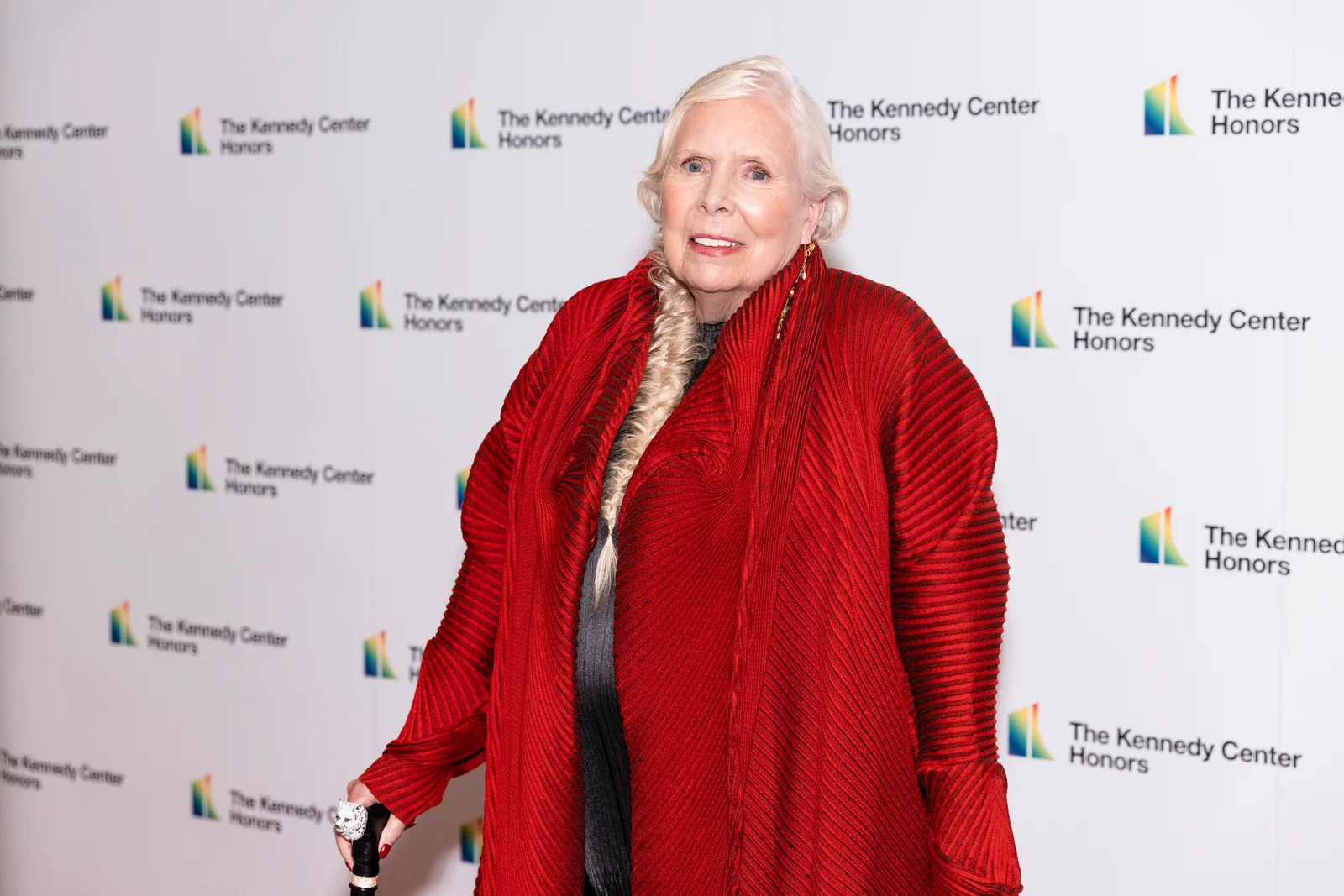
- 11. Shawn Miller / Library of Congress / Wikimedia Commons2021 ceremony original and reviewed CC0 grant
Item-specific CC0 source and reviewed upstream grant; the full ceremony photograph is retained.