In this biography
Quick facts
- Born
- 12 April 1942
- Birthplace
- KwaNxamalala, Nkandla, South Africa
- Country
- South Africa
- Nationality
- Not independently established
- Known for
- ANC underground and exile work, the 2009–2018 presidency and major accountability disputes
- Full name
- Jacob Gedleyihlekisa Zuma
- Born
- 12 April 1942, Nkandla area
- Robben Island
- Ten-year sentence, 1963–1973
- National deputy president
- 1999–2005
- State president
- 9 May 2009–14 February 2018
- Later party role
- MK Party leader; verified October 2026
Why this life matters
His career connects liberation authority, electoral popularity and the limits on executive power. It requires a careful distinction between a political movement’s loyalties, an institution’s findings and an individual’s criminal guilt.
Timeline
Key moments
Rural upbringing and political activity
Born in the Nkandla area, he enters ANC and underground networks.
Imprisonment
He serves a ten-year sentence on Robben Island.
Exile
Southern African assignments lead into senior ANC underground and intelligence responsibilities.
Provincial and national executive work
KwaZulu-Natal office is followed by the national deputy presidency and dismissal.
Party leadership and presidency
ANC leadership leads to state office, later constitutional rebuke and resignation.
Conviction, party change and separate proceedings
A contempt conviction is distinct from pending arms-deal charges and later MK Party leadership.
Political organisation preceded imprisonment
Zuma was born at KwaNxamalala in the Nkandla area on 12 April 1942. Family and political networks connected him with the ANC and trade union activism during the 1950s. Government and historical records differ on the precise joining year, so the broader sequence is more reliable than an artificially exact date.
He became involved in MK after the ANC was banned. Arrested while attempting to leave South Africa in 1963, he received a ten-year sentence and served it on Robben Island. Imprisonment placed him within the political and educational networks of the liberation movement.
Exile responsibilities led into provincial government
After release he resumed underground organisation in Natal. He left South Africa in 1975 and worked in Swaziland, Mozambique and Zambia. By the late 1980s he held senior responsibilities for the ANC’s underground structures and intelligence operations.
The unbanning of the ANC brought a different organisational task: rebuilding public political structures. Zuma held regional party office and, after the 1994 election, became KwaZulu-Natal’s MEC for Economic Affairs and Tourism. His route to national executive power therefore included both clandestine work and provincial administration, rather than beginning with the presidency.
Dismissal from the deputy presidency was an executive decision
Zuma became ANC deputy president in 1997 and national deputy president in 1999. In June 2005 Mbeki dismissed him after the Schabir Shaik judgment raised questions about their relationship. Shaik was the accused in that trial; removing Zuma from office was not itself a criminal conviction of Zuma.
Mbeki’s parliamentary statement acknowledged continuing legal processes and explained his judgment about the responsibilities of government. The distinction matters because political consequences can precede a final finding against the person removed. Zuma’s influence within the ANC nevertheless survived the loss of state office.
The presidency involved policy choices as well as party power
Elected ANC president in 2007, Zuma became head of state in 2009 and began a second term in 2014. His administration promoted the National Development Plan as a framework for long-term social and economic change. Stated priorities need to be assessed against implementation, rather than accepted as accomplished outcomes.
HIV policy provides a concrete change of direction. UNAIDS welcomed his administration’s 2009 commitment to expanded testing and treatment and an evidence-informed response. That institutional shift forms part of his governing record, alongside controversies; it does not excuse failures in other areas or establish that one leader alone produced public-health improvements.
Constitutional accountability exposed limits on presidential authority
In the 2016 Nkandla judgment, the Constitutional Court found that Zuma had failed to uphold, defend and respect the Constitution through his handling of the Public Protector’s remedial action. This was a constitutional finding about conduct and institutional obligations, rather than a criminal corruption verdict.
He resigned on 14 February 2018 after the ANC recalled him and parliamentary pressure mounted. Party authority, resignation and judicial findings were separate elements of the episode. His departure did not complete the examination of decisions made during his administration or remove the obligations of a former president.
Later party leadership coexists with distinct legal proceedings
In June 2021 the Constitutional Court found him guilty of contempt and imposed fifteen months’ imprisonment for defying its order to cooperate with the state-capture inquiry. The conviction concerned disobedience of a court order, not a verdict on every corruption allegation investigated by that inquiry.
By October 2026 he led the MK Party. Separately, The Citizen’s 14 October report described an arms-deal trial scheduled for February 2027 and recorded his not-guilty plea. Those charges remained allegations in the cited record. A current party title should neither be confused with the state presidency nor used to merge separate cases into one judgment.
Quick answers
Frequently asked questions about Jacob Zuma
- Was the 2005 Shaik judgment a conviction of Zuma?
- No. Shaik was on trial; Zuma’s dismissal was a separate executive decision.
- Was the 2021 sentence for an arms-deal corruption conviction?
- No. It was for contempt of court involving non-compliance with an inquiry-related order.
- Had the cited October 2026 report established guilt in the arms-deal case?
- No. It described pending charges, his not-guilty plea and a future trial date.
- Does his MK Party presidency make him President of South Africa?
- No. His state presidency ended in February 2018; party leadership is a different office.
Keep exploring
Lives connected to this story
- Phumzile Mlambo-Ngcuka
Read the public career of the deputy president appointed after his 2005 dismissal.
- Thabo Mbeki
Compare the president who dismissed him from the national executive.
- Cyril Ramaphosa
Follow the leader who succeeded him as state president.
Sources and further reading
Explore the evidence
These references support the biography and offer further reading. Official records, first-person accounts and independent reporting provide different perspectives; image records document attribution and licensing.
- 1. South African GovernmentJacob Gedleyihlekisa Zuma: selected biographical and term record
- 2. The Presidency, South AfricaJacob Zuma: selected early life and presidential priorities
- 3. South African History OnlineJacob Zuma timeline: selected imprisonment and exile chronology
- 4. South African History OnlineJacob Gedleyihlekisa Zuma: selected provincial and national offices
Selected historical career passages; stale “present” party/state-office labels are not used.
- 5. Thabo Mbeki / Department of Justice archive14 June 2005 statement: selected executive decision and judicial-process passages
- 6. UNAIDS1 December 2009: expanded South African HIV-response commitments
- 7. Constitutional Court / SAFLIIEFF v Speaker, 2016: selected Nkandla reasoning, paragraphs 81–83
- 8. SAnews14 February 2018: Zuma announces resignation
- 9. Constitutional Court of South Africa29 June 2021: CCT 52/21 media summary
The Court’s explanatory media summary was read; it expressly is not the binding judgment itself.
- 10. KwaZulu-Natal High Court / SAFLIIS v Zuma and Another, 14 May 2026: selected procedural introduction
- 11. The Citizen14 October 2026: pending arms-deal trial and appeal position
Dated procedural reporting; no finding of guilt or promise that the announced future trial date cannot change.
- 12. Western Cape High Court / PolityKubukeli v MK Party, September 2026: selected order and party-office identification
- 13. SABC News18 October 2026: dated identification of Zuma as MK Party leader
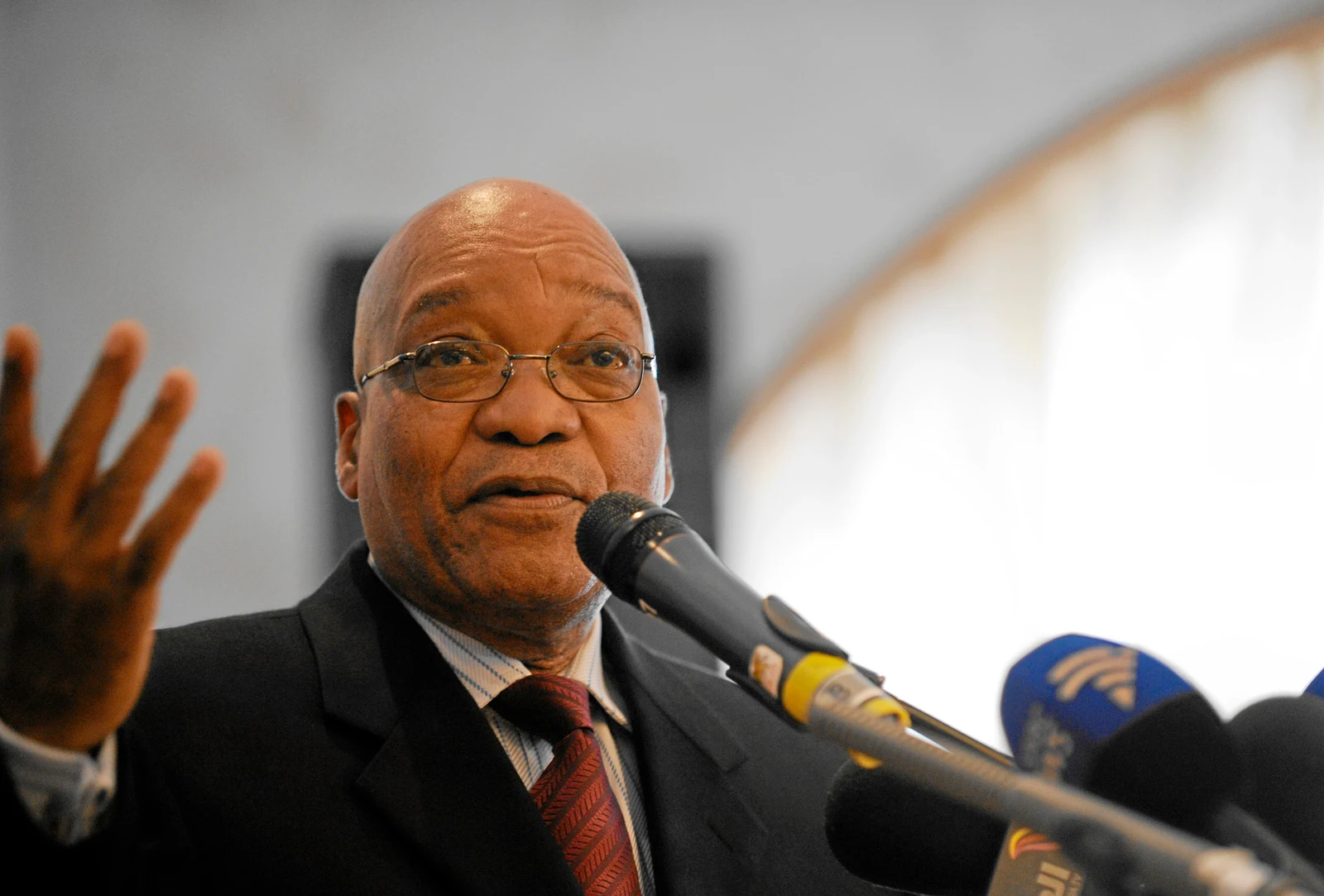
- 14. World Economic Forum / Wikimedia CommonsZuma at Davos, 27 January 2010: original full frame
Selected the archived 2010 full frame; current Commons binary is a later portrait crop. Initial completed licence and all four binary entries checked.