In this biography
Quick facts
- Born
- 18 June 1942
- Birthplace
- Mbewuleni, Eastern Cape, South Africa
- Country
- South Africa
- Nationality
- Not independently established
- Known for
- Exile diplomacy, democratic government, African institutions and a deeply disputed HIV-policy record
- Full name
- Thabo Mvuyelwa Mbeki
- Born
- 18 June 1942, Mbewuleni
- University
- Economics at Sussex; MA completed in 1966
- Exile
- Left South Africa in 1962
- President
- 1999–2008
- African Union chair
- 2002–2003
Why this life matters
His career connects liberation diplomacy with the different responsibilities of governing. Technical knowledge and international standing did not remove the need for evidence-based policy or accountability, and party authority did not itself replace the constitutional rules governing presidential succession.
Timeline
Key moments
Family, school and organisation
Eastern Cape upbringing and youth politics precede departure into exile.
Study and ANC service
Economics, overseas training and diplomatic assignments shape his political career.
Negotiations and return
He participates in talks leading to democratic government.
Executive deputy
He serves under Nelson Mandela before succeeding him.
Presidency
Continental initiatives accompany contested domestic policy and mounting party conflict.
Recall and resignation
An ANC decision is followed by a resignation and parliamentary succession.
A politically active family shaped his early choices
Mbeki was born in Mbewuleni in the Idutywa area on 18 June 1942. His parents combined teaching with political activism. Education took him through Eastern Cape schools to Lovedale, while family networks and the ANC brought national conflict into everyday life.
He joined the ANC Youth League as a teenager. School protest, correspondence study and underground organisation followed as the state intensified repression. His path differed from that of his father, a Rivonia prisoner: Thabo left the country in 1962 and would spend much of his political formation abroad.
Exile combined economics with practical political work
At Sussex he studied economics while maintaining ANC activity; the university identifies him among its economics alumni. The O’Malley career record dates his MA to 1966. Study was not a retreat from politics: overseas organisation sought support for a movement banned at home.
He worked in the ANC’s London office, underwent training in the Soviet Union and served in African assignments, including Botswana, Swaziland and Nigeria. He became a close adviser to Oliver Tambo. Diplomatic work required building relationships with governments, exiles and people who disagreed with the ANC, rather than speaking only to an already sympathetic audience.
Negotiating experience led into democratic executive power
During the 1980s Mbeki engaged business and intellectual delegations, and later joined contacts with the South African government. He participated in the 1990 talks associated with the Groote Schuur and Pretoria Minutes and in the wider constitutional negotiations.
He became an executive deputy in 1994, ANC president in 1997 and state president in 1999, returning for a second term in 2004. Continental engagement included chairing the African Union in 2002–2003 and work associated with NEPAD. These institutional roles mattered, but their titles alone cannot establish the success of every diplomatic or developmental objective.
HIV policy exposed the human consequences of presidential judgment
Mbeki publicly challenged the scientific consensus linking HIV and AIDS, while access to effective treatment was delayed or restricted. This was not merely a dispute about diplomatic style. Activists and researchers challenged policies affecting people’s survival, including prevention of transmission to infants.
Harvard’s account of Pride Chigwedere and colleagues’ research explains how they estimated avoidable losses by comparing treatment access with feasible programmes in neighbouring countries. Those are research estimates of policy consequences, not a criminal judgment against Mbeki or a count proving one individual caused every death. The evidence nevertheless makes the treatment delays a central part of evaluating his presidency.
Sources for this section: [5]
Party defeat and resignation were separate from judicial guilt
Jacob Zuma defeated him for the ANC leadership in December 2007. In September 2008 the party’s national executive recalled Mbeki after a court judgment that included damaging political-interference observations. He announced his resignation rather than treating the party instruction as a constitutional instrument of removal.
The Supreme Court of Appeal subsequently overturned the lower court’s ruling and criticised unsupported, extraneous findings. That correction matters to a fair account of the episode. It did not restore Mbeki to office, and it was not a general judgment on every aspect of his administration. Political consequences and the legal scope of a case need separate explanations.
His post-presidential standing remains subject to public scrutiny
Leaving office did not end public engagement. Sussex identifies him as founder of the Thabo Mbeki Foundation, while contemporary records continue to describe him as a former president, not a serving head of state. His legacy remains contested rather than frozen at the moment of resignation.
On 19 October 2026, AP reported his denial at an inquiry that he had suppressed apartheid-era prosecutions; victims’ families sought answers. This is contested testimony, not an adverse finding. His career therefore invites assessment across distinct roles: liberation organiser, negotiator, executive and former leader required to explain decisions and omissions.
Quick answers
Frequently asked questions about Thabo Mbeki
- Was his main anti-apartheid experience imprisonment on Robben Island?
- No. His father Govan was a Rivonia prisoner; Thabo’s career developed principally through exile, organisation and diplomacy.
- Did an ANC recall automatically remove him under the Constitution?
- No. The political recall was followed by his resignation and a parliamentary succession process.
- Was the 2009 appeal a trial of Mbeki’s criminal guilt?
- No. It addressed the prosecution litigation and the lower court’s reasoning, not such a criminal charge against him.
- Are the HIV-policy mortality figures direct individual counts?
- The cited study estimated losses against feasible alternative treatment access; they are not individual criminal findings.
Keep exploring
Lives connected to this story
- Desmond Tutu
Compare a church-based critic whose commitment to accountability continued after apartheid.
- Nelson Mandela
Read the president under whom Mbeki served as executive deputy.
Sources and further reading
Explore the evidence
These references support the biography and offer further reading. Official records, first-person accounts and independent reporting provide different perspectives; image records document attribution and licensing.
- 1. The Presidency, South AfricaThabo Mvuyelwa Mbeki: selected exile, diplomatic and public-office chronology
Selected chronology used. Its compressed study/return sequence is not adopted literally; Sussex and the O’Malley record distinguish university study from later ANC assignments.
- 2. South African History OnlineThabo Mvuyelwa Mbeki: selected upbringing, education and early organisation
- 3. O’Malley Archives / Nelson Mandela FoundationMbeki, Thabo: selected study and exile career record
- 4. University of Sussex Business SchoolNotable alumni: selected Thabo Mbeki entry
- 5. Harvard T. H. Chan School of Public Health2009 account of Chigwedere and colleagues’ research on restricted HIV treatment
The university’s account of the research and method was read; no entire thesis or clinical evidence review claimed, and no treatment instructions offered.
- 6. Thabo Mbeki / South African History Online archive21 September 2008 address: selected resignation and political-accountability passages
- 7. Government Communication and Information System21 September 2008: Cabinet’s account of the pending resignation
- 8. Supreme Court of Appeal / SAFLIINDPP v Zuma, 12 January 2009: selected scope, evidence and order
- 9. Associated Press19 October 2026: Mbeki’s inquiry testimony
Selected inquiry reporting, not a full hearing transcript or findings report.
- 10. SABC News19 October 2026: former president appears at TRC-cases inquiry
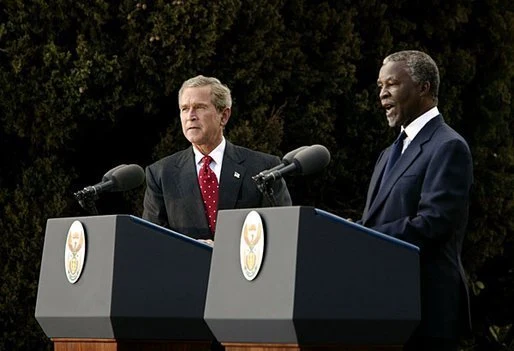
- 11. White House / National Archives9 July 2003: complete Paul Morse Pretoria press-event frame
Exact originating caption and raw EXIF name Paul Morse; Smithsonian staff-role record corroborates official duties. Full archived frame, not the Commons portrait extraction. No originating revision-history IDs exposed.
- 12. Smithsonian National Museum of American History2009 exhibition release: Paul Morse’s White House staff role, 2001–2007