In this biography
Quick facts
- Born
- 19 July 1949
- Birthplace
- Sources differ: Alexandra and Boksburg-Benoni Hospital, South Africa
- Country
- South Africa
- Nationality
- Not independently established
- Known for
- NUM leadership, ANC administration, the 2008–2009 presidency and later public dialogue
- Full name
- Kgalema Petrus Motlanthe
- Born
- 19 July 1949
- Early communities
- Alexandra and Meadowlands, Johannesburg
- NUM general secretary
- From 1992
- State president
- September 2008–May 2009
- State deputy president
- 2009–2014
Why this life matters
His career makes political education and organisational work visible alongside high office. It also separates a reputation for restraint from the harder questions of electoral authority, policy implementation and the outcomes of institutional service.
Timeline
Key moments
School and community
Church, schooling and life in Alexandra and Meadowlands shape his early years.
Underground organisation
Municipal employment overlaps with MK recruitment and clandestine activity.
Robben Island
Imprisonment includes study and political education.
Union work
Worker education leads into NUM’s general secretary role.
Party and executive service
ANC administration precedes a short presidency and five years as deputy president.
Public review and dialogue
Foundation work and a parliamentary panel extend his public activity.
Childhood formed around church, schooling and forced removal
Motlanthe was born on 19 July 1949 and grew up in Alexandra before his family moved to Meadowlands. Sources disagree about his precise birthplace: the Presidency gives Alexandra, while SAHO specifies Boksburg-Benoni Hospital. That unresolved detail should remain visible rather than being silently reconciled.
Anglican schooling and service as an altar boy influenced his early outlook. He considered religious study abroad, but permission to leave was refused. Schooling and family displacement took place within apartheid’s restrictions, while football and municipal employment later widened his social and political contacts.
Underground activity led to a decade in prison
While employed by Johannesburg City Council he joined the ANC’s armed wing, MK. His unit recruited people for military training and later received instructions involving sabotage. Arrest in 1976 was followed by lengthy detention and a 1977 conviction under the Terrorism Act.
The effective ten-year sentence took him to Robben Island. Political education became an important part of his prison experience, alongside formal study and exchanges across organisational boundaries. The scholarly review of his biography highlights this intellectual formation, while also questioning an overly admiring interpretation of his leadership.
Worker education linked political ideas to everyday organisation
Released in 1987, he joined NUM as an education officer. Training shop stewards meant helping workers develop their own representative structures. Teaching was practical organisational work in an industry marked by difficult conditions and intense conflict, rather than merely preparing speeches for established leaders.
He became general secretary in 1992. Development initiatives associated with his union service included the Mineworkers Investment Company and Mineworkers Development Agency. These addressed needs extending beyond an immediate wage settlement, including those of former workers and their communities. His responsibilities connected workplace organisation with wider social development.
ANC administration preceded a short national presidency
Motlanthe became ANC secretary-general in 1997 and served two terms before becoming party deputy president in 2007. His record included rebuilding legal structures after the movement’s unbanning and maintaining relations across the organisation. Party office and state office remained distinct responsibilities.
He served as state president from September 2008 until May 2009, during the global financial crisis. The Nelson Mandela Foundation records engagement with multilateral institutions and domestic business, labour and civil society. Such activity establishes what his administration attempted; a short term and official intentions alone cannot prove a complete economic outcome.
A defeated leadership challenge did not end executive service
Jacob Zuma appointed him deputy president in 2009. In December 2012 Motlanthe challenged Zuma for the ANC presidency at Mangaung and lost decisively. Contemporary results reporting also records Cyril Ramaphosa’s election as the party’s new deputy president.
Motlanthe nevertheless remained national deputy president until May 2014. His parliamentary responsibilities as Leader of Government Business included coordinating the executive’s legislative programme and ministers’ attendance. Defeat for a party post therefore did not immediately end a separate state appointment or its practical responsibilities.
Later work examined the distance between laws and lived outcomes
As chair of Parliament’s High Level Panel, he helped assess whether post-1994 legislation delivered the society envisaged by the Constitution. Appointed in 2016, the panel used hearings and submissions before handing its report to the Speakers’ Forum in November 2017. Its recommendations required further action by other institutions.
The Kgalema Motlanthe Foundation identifies him as its patron and describes work in education, youth development and public dialogue. These provide a later public platform, rather than a continuing elected state office. They extend the educational thread running through prison study and union organising without establishing that every programme has achieved its stated aims.
Quick answers
Frequently asked questions about Kgalema Motlanthe
- Is his precise birthplace settled in the cited sources?
- No. Alexandra and Boksburg-Benoni Hospital are both reported; the page therefore withholds a verified structured birthplace.
- Did he join NUM as its general secretary in 1987?
- No. He first worked in education and became general secretary in 1992.
- Did his 2012 ANC defeat immediately remove him as national deputy president?
- No. He continued in the state position until May 2014.
- Was the High Level Panel itself a law-making body?
- It assessed legislation and made recommendations; implementation required parliamentary or other institutional action.
Keep exploring
Lives connected to this story
- Cyril Ramaphosa
Compare another NUM general secretary’s route into business and state leadership.
- Thabo Mbeki
Read the circumstances preceding Motlanthe’s short presidency.
- Nelson Mandela
Place prison political education within a wider liberation-generation history.
Sources and further reading
Explore the evidence
These references support the biography and offer further reading. Official records, first-person accounts and independent reporting provide different perspectives; image records document attribution and licensing.
- 1. South African History OnlineKgalema Petrus Motlanthe: selected childhood and education
Selected upbringing and education only. Its stale “present” office label is not used; precise birthplace conflicts with the Presidency.
- 2. The Presidency, South AfricaKgalema Motlanthe: selected imprisonment, union and ANC service
- 3. Simphiwe Ngwane / Yesterday and Today2013 review of Ebrahim Harvey’s Motlanthe biography
The review was read, not Harvey’s complete book; its inconsistent childhood-age chronology is not adopted.
- 4. Nelson Mandela FoundationKgalema Motlanthe: union development and public-office terms
- 5. NewsFire and Sapa / IOL18 December 2012: Mangaung leadership-election results
- 6. Parliament of South Africa, In SessionJune 2009: Leader of Government Business, printed page 23
- 7. Parliament of South Africa23 November 2017: High Level Panel report and public consultation
Parliament’s description of the process was read, not the whole panel report or each provincial transcript.
- 8. Kgalema Motlanthe FoundationWhat we do: patron and education programmes
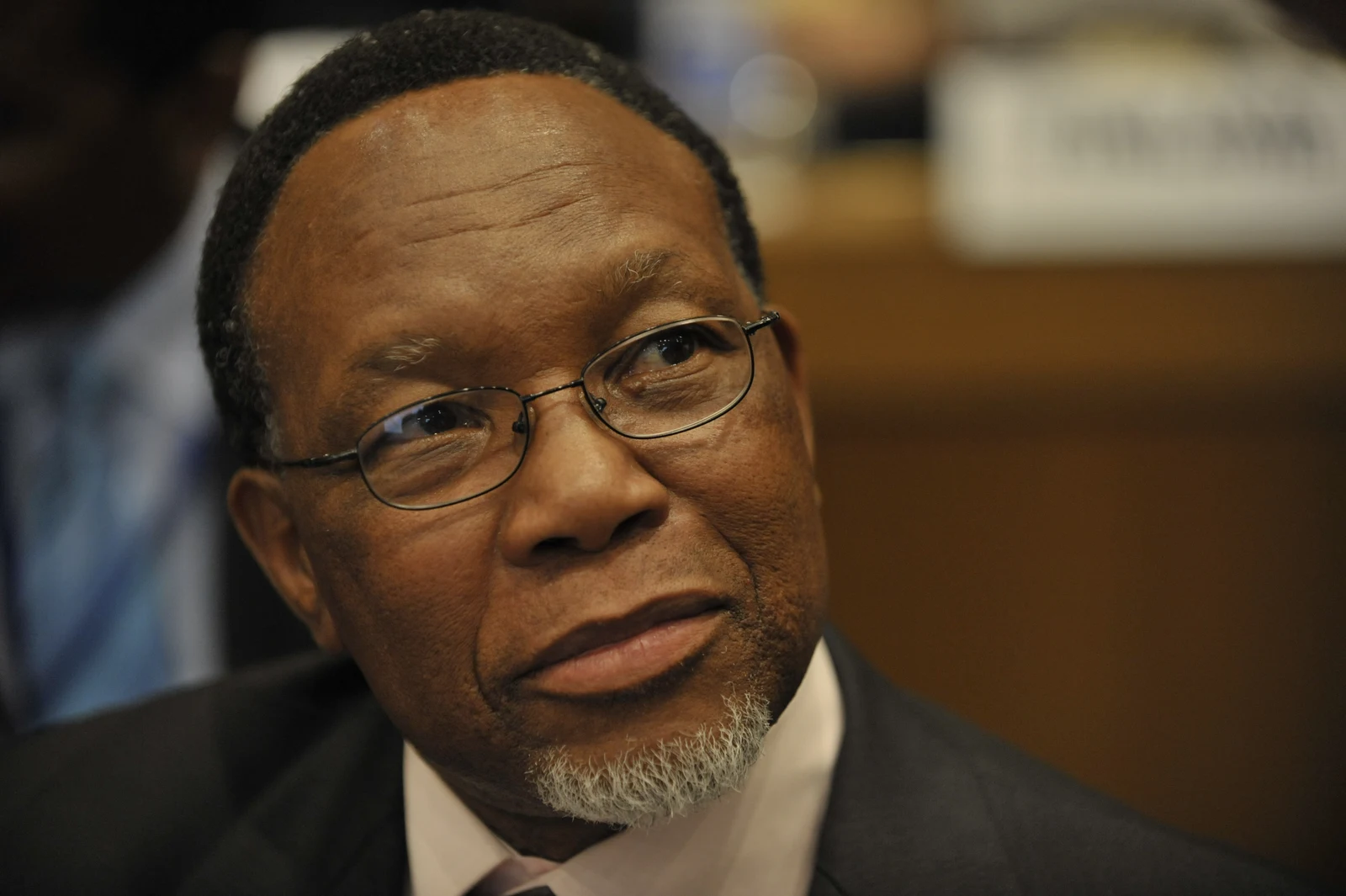
- 9. U.S. Navy / Wikimedia CommonsMotlanthe at the AU Summit, 1 February 2009
Exact first/current official-duty attribution and sole binary version checked. Filename’s 090202 differs from caption/XMP’s 1 February; caption date used.