
The short answer
The EFF’s emergence was a sequence of organising decisions rather than one announcement by one leader. Consultation, a national assembly, a programme, electoral registration and a public launch each did different work. Following those stages explains how a movement became an organisation able to contest an election.
Chronology
A timeline of the turning points
Consultation and mission
A call for participation leads into a statement proposing an electoral movement.
Programme and assembly
A manifesto and the Soweto national assembly give the organisation a political framework.
Registration decision
The party announces that electoral registration has been approved.
Certificate handover
Malema receives the registration certificate at the IEC’s offices.
Public launch at Marikana
The movement links its electoral project with workers’ grievances.
First national result
The EFF wins 1,169,259 votes in the national election.
July’s mission statement still described decisions to be made
The 11 July statement refers to a June call for participation and a representative organising meeting held the previous day. It proposed a radical electoral movement but said a national assembly should settle the organisation’s constitution, symbols and founding programme.
The statement also identified provincial structures and a collective national team, with Malema as convenor. This is evidence of an organising process, not merely a new label attached to his personal following. It also distinguishes the movement’s announced intentions from decisions that a later gathering still had to adopt.
Sources for this section: [1]
The assembly and manifesto supplied an organisational programme
SAHO places the national assembly at Uncle Tom’s Hall in Orlando West on 27 July. It records delegates adopting a constitution and founding manifesto. The published manifesto argued that political freedom had not delivered economic emancipation and proposed a different distribution of ownership and state capacity.
Its seven pillars included land redistribution without compensation, nationalisation of strategic sectors and expanded public services. These were the EFF’s claims and commitments. Reading the text as a political programme preserves what the organisation advocated without adopting its diagnosis as an uncontested account or treating proposed policies as accomplished results.
Electoral registration was different from the public certificate ceremony
The party’s September statement welcomed the IEC’s registration decision and announced a Marikana launch for 13 October after an earlier postponement. Business Day then reported Malema receiving the certificate at the IEC’s Centurion offices on 7 October.
Those records should not be collapsed into one founding date. Approval, the handover of its documentary evidence and a public launch were related but distinct steps. The certificate established the party’s ability to contest the coming election; it did not establish how many people would vote for it. Recruitment and electoral campaigning remained substantial tasks after registration.
Marikana gave the launch a political argument and a constituency
The EFF’s announcement explained Marikana as a symbol of workers’ exclusion and a rupture with the post-1994 settlement. Sowetan’s report from the following day places the 13 October launch at the Nkaneng informal settlement and records Malema addressing workers’ conditions and land ownership.
The location connected the new party with the aftermath of the 2012 mineworker killings. That political identification did not mean every worker supported the EFF or that the launch decided legal responsibility for the violence. It showed how the organisers wanted their party to be understood and which grievances they sought to represent.
The first election supplied a different measure of support
The Electoral Commission’s 2014 party-support report records 1,169,259 national votes for the EFF, amounting to 6.35% of valid votes. It provides a firmer measure of electoral backing than either a membership claim or the size of a rally. The party had converted part of its mobilisation into votes.
That result also sets a limit on interpretation. National vote share is not a majority mandate and does not measure every person who sympathised with one policy. The formation story ends most usefully with this distinction: creating an organisation, gaining ballot access, mobilising a public audience and winning electoral support were separate achievements.
Sources for this section: [7]
Biography context
Explore South Africa through connected lives
Connected biographies
From former alliance to organised opposition
1981–
Julius Malema
EFF leader and National Assembly memberJulius Malema rose through student organisation and the ANC Youth League before his expulsion and the formation of the Economic Freedom Fighters. He joined electoral politics through a new opposition organisation, while his public rhetoric, political methods and legal accountability remain contested parts of his record.Read biography
1942–
Jacob Zuma
Former President of South Africa and leader of the MK PartyJacob Zuma moved through anti-apartheid imprisonment, exile intelligence work and provincial politics before leading the ANC and South Africa. His presidency combined policy initiatives with serious institutional failures, while his later MK Party leadership and distinct legal proceedings keep him central to public debate.Read biographyQuick answers
Common questions
- Was the public launch held on the July assembly date?
- No. The assembly was in July; the Marikana public launch followed on 13 October 2013.
- Was receiving the certificate the same as winning an election?
- No. Registration enabled electoral participation. Votes were a later measure of support.
- Was the EFF’s manifesto already national government policy?
- No. It set out the new organisation’s proposals and political commitments.
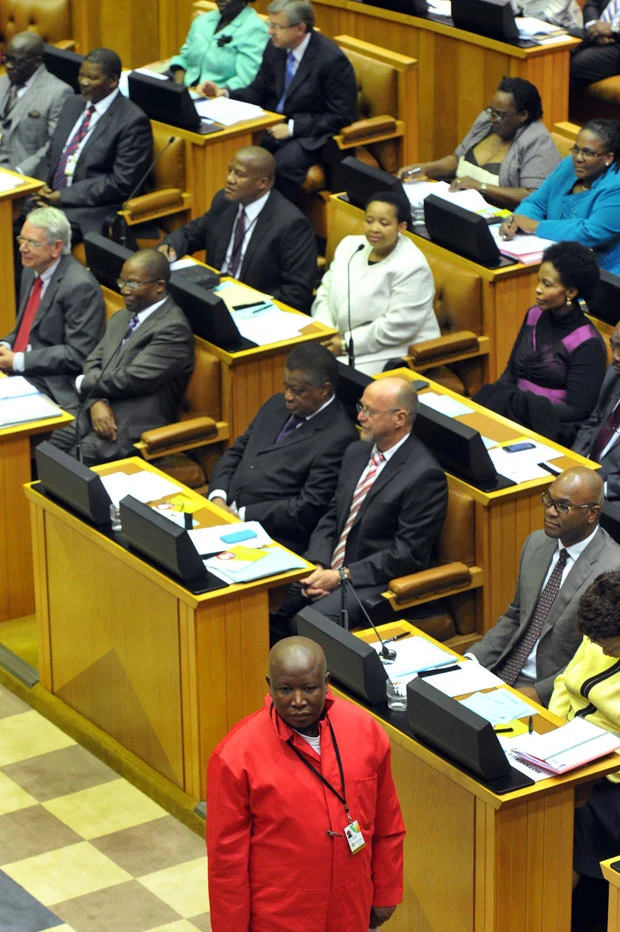
- Does the photograph show the Marikana launch?
- No. It shows Malema in Parliament in May 2014, after the first national election.
Primary and institutional sources
How this history was checked
Selected mission, manifesto and organising passages were checked against historical and contemporary reporting and the one-page election result. Party statements are primary evidence of intentions, not independent verification of every claim. No complete manifesto evaluation or launch video was reviewed; the photograph is from 2014. This article was reviewed on Reviewed 24 October 2026.
- Economic Freedom Fighters / Polity11 July 2013 mission statement: organising and proposed national assembly
- South African History OnlineFounding the EFF: selected consultation and July assembly account
- Economic Freedom Fighters / Polity25 July 2013 founding manifesto: selected strategic mission and seven pillars
- Mbuyiseni Ndlozi / Economic Freedom Fighters / Polity17 September 2013: registration, organising and Marikana launch announcement
- Business Day7 October 2013: EFF receives its registration certificate
- Sowetan14 October 2013: report from the previous day’s Marikana launch
- Electoral Commission of South Africa2014 national election: EFF party-support report
- GovernmentZA / FlickrSwearing-in ceremony of Members of Parliament, 21 May 2014