In this biography
Quick facts
- Born
- 1775
- Died
- 19 December 1851
- Birthplace
- Covent Garden, London, England
- Country
- United Kingdom
- Nationality
- English
- Known for
- Landscapes, seascapes, The Fighting Temeraire and experiments with light and colour
- Full name
- Joseph Mallord William Turner
- Training
- Royal Academy Schools from 1789
- Print project
- Liber Studiorum, 1807–1819
- National legacy
- Turner Bequest, accepted in 1856
Why this life matters
He expanded the subjects and expressive possibilities of landscape painting, bringing historic memory, dangerous weather and modern machines into the same artistic field.
Timeline
Key moments
Born in London
Turner was born in the Covent Garden area.
Training and exhibition
Entered the Royal Academy Schools; exhibited watercolours from 1790 and oils from 1796.
Slavery-linked investment
Bought a share in a Jamaican cattle estate worked by enslaved people; the venture failed.
Liber Studiorum
A print series explored different categories of landscape.
Historic ships and modern railway
Exhibited The Fighting Temeraire and later Rain, Steam, and Speed.
Death and bequest
Died in 1851; the national bequest was accepted in 1856.
London training and the skills behind the atmosphere
Joseph Mallord William Turner was born in London in 1775 and entered the Royal Academy Schools in 1789. The artist later associated with dissolving forms began with disciplined work in drawing and topography. Architectural drafting, colouring prints and studying earlier artists helped build a practical foundation. His first Royal Academy exhibits were watercolours; oil paintings followed in 1796.
This beginning matters because atmosphere was not simply a substitute for knowledge of objects. Turner learned how buildings, coastlines and vessels could be organised into a convincing pictorial space. He could then decide what to clarify and what to leave uncertain. The contrast between precise structure and elusive weather became an expressive resource, rather than a choice between accuracy and imagination.
Travel, sketchbooks and a circulating art
Over decades Turner travelled through Britain and continental Europe, filling sketchbooks with observations. The Metropolitan Museum describes these records as foundations for even his most imaginative pictures. A finished painting could combine viewpoints or transform a remembered scene; an observed place was a starting point, not a binding instruction to reproduce a single view mechanically.
Watercolour was central to this practice and to his income. Designs could also circulate through engravings, reaching viewers beyond the exhibition room. Liber Studiorum, issued from 1807 to 1819, organised landscape into categories including marine, mountainous, architectural and historical subjects. It asserted that landscape possessed intellectual variety and ambition, rather than serving merely as an attractive setting behind a more important human drama.
History and contemporary technology
The Fighting Temeraire, exhibited in 1839, transforms the scrapping of a famous warship into a meditation on passing power. Turner did not simply record the tow of 1838. He restored the ship’s masts and changed details of its appearance and the tug, giving a commercial operation an imaginative, commemorative form. The sunset contributes to that transformation without proving one fixed political message.
Rain, Steam, and Speed, exhibited in 1844, brings a locomotive across Brunel’s Maidenhead bridge towards the viewer. The National Gallery emphasises that Turner used modern transport and treated technology as a serious pictorial subject. It is therefore misleading to cast him solely as an opponent of industrial change. Trains, steamships, older vessels and natural forces all belonged to the world he wished to paint.
Colour, controversy and a slavery-linked investment
Turner’s freer handling and brilliant colour attracted criticism as well as admiration. John Ruskin became an influential champion after meeting him in 1840. Calling Turner a precursor of abstraction can describe a later response to his work, but it should not strip away the histories, places and material events that gave his pictures their subjects. Their ambiguity often depends on those connections.
His career also includes an uncomfortable documented financial connection. The National Gallery records that in 1805 he bought a £100 share in Dry Sugar Work Pen, a Jamaican cattle estate operated with enslaved labour. He expected a return, but the enterprise failed and he lost the investment. This evidence complicates celebratory accounts of the painter; it should neither be omitted nor inflated into unsupported claims about every work’s meaning.
The bequest and how to look at Turner
Turner died in London on 19 December 1851. His bequest to the nation included hundreds of paintings and many thousands of drawings, providing the core of a major public collection. Works were divided institutionally over time, with most of the bequest transferred to what became Tate. The Fighting Temeraire and other selected pictures remain at the National Gallery.
A useful way into Turner is to ask what a picture makes visible, what it withholds and how its light changes the status of an ordinary object. A bridge can become an encounter with speed; an obsolete hull can become a national memory. His achievement lies not in abandoning the world for beautiful effects, but in making the world’s transformations difficult to see as merely routine.
Quick answers
Frequently asked questions about J. M. W. Turner
- What do Turner’s initials stand for?
- Joseph Mallord William. He is commonly called J. M. W. Turner or simply Turner.
- Was Turner mainly an oil painter?
- Oil painting was important, but watercolours, drawings and prints were equally fundamental to his observation, experimentation and public reach.
- Did Turner witness the Temeraire’s final tow?
- Probably not. The National Gallery describes the painting as an imaginative reconstruction, with deliberate changes to the ship, tug and sunset.
- Where did the Turner Bequest go?
- It became a national collection. Most is held at Tate, while selected paintings, including The Fighting Temeraire, are at the National Gallery.
Keep exploring
Lives connected to this story
- William Blake
Compare the expressive ambitions of another London artist who also worked with prints.
- Isambard Kingdom Brunel
Read about the engineer of the Maidenhead bridge depicted in Rain, Steam, and Speed.
Sources and further reading
Explore the evidence
These references support the biography and offer further reading. Official records, first-person accounts and independent reporting provide different perspectives; image records document attribution and licensing.
- 1. National GalleryJoseph Mallord William Turner: career, bequest and documented slavery investment
The specific 1805 Jamaican investment is included without inferring unsupported positions from it. The institution cites Sam Smiles’s underlying research.
- 2. Metropolitan Museum of Art / Elizabeth E. BarkerJoseph Mallord William Turner, 1775–1851: training, travel and printmaking
The essay’s training, travel, watercolour and printmaking passages were read; no inspection of every sketchbook or print is claimed.
- 3. Paul Mellon CentreTurner artist subject guide: concise chronology and collection context
- 4. The HuntingtonJoseph Mallord William Turner: life dates and the bequest
- 5. National GalleryThe Fighting Temeraire, NG524: overview, in-depth account and key facts
Overview, in-depth discussion, object facts and selected description were read. The 1838 event is distinguished from the painting’s 1839 exhibition.
- 6. National Gallery / Judy EgertonThe Fighting Temeraire: selected object, provenance, engraving and ship-history catalogue passages
- 7. National GalleryRain, Steam, and Speed, NG538: technology and perspective
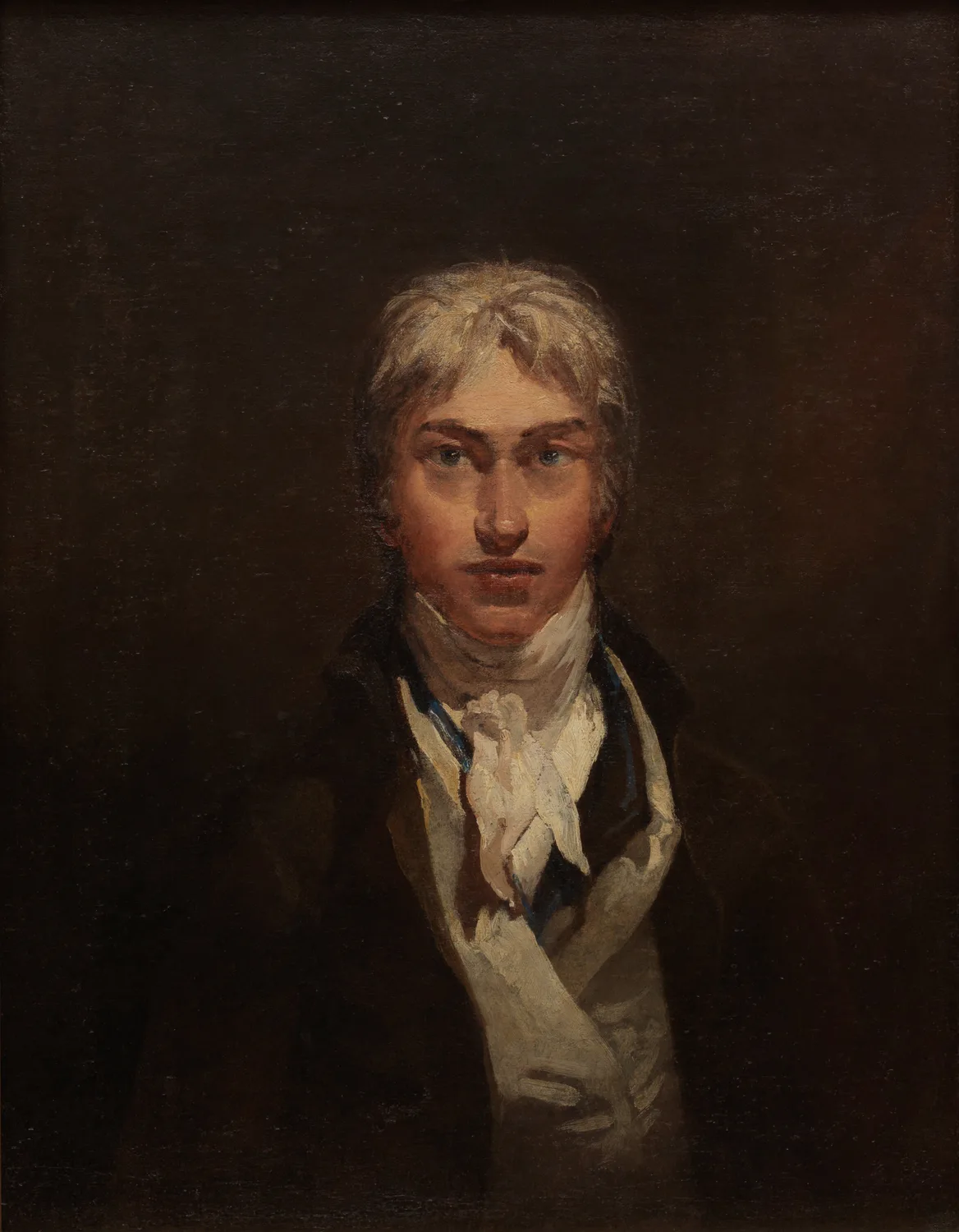
- 8. J. M. W. Turner / Wikimedia CommonsExact self-portrait, creator, public-domain basis and file history
Current full supplied Tate-source reproduction was checked against file history; an earlier remastered revision was not used.
- 9. Wikimedia Commons / Tate sourceComplete current self-portrait JPEG