In this biography
Quick facts
- Born
- 30 August 1797
- Died
- 1 February 1851
- Birthplace
- Somers Town, London, England
- Country
- United Kingdom
- Nationality
- English
- Known for
- Frankenstein, The Last Man, Valperga and editions of Percy Bysshe Shelley’s writing
- Parents
- Mary Wollstonecraft and William Godwin
- Frankenstein first edition
- Anonymous, three volumes, 1818
- Revised Frankenstein
- 1831, with a new introduction
- Other fiction
- Valperga (1823), The Last Man (1826), Lodore (1835), Falkner (1837)
Why this life matters
Her fiction made the created being’s experience a central moral and narrative problem, while her later writing and editorial work extended far beyond the novel that made her famous.
Timeline
Key moments
Born in London
Mary Wollstonecraft Godwin was born on 30 August; her mother died eleven days later.
Travels with Percy Shelley
Mary, Percy and Claire Clairmont left England for continental Europe in July.
The Geneva summer
The ghost-story challenge associated with Byron’s circle began the project that became Frankenstein. Mary and Percy married in December.
Frankenstein published
The first edition appeared anonymously in three volumes; the family moved to Italy that year.
Widowhood and return
Percy drowned in 1822. Mary returned to England in 1823 with their surviving son, Percy Florence; Valperga appeared that year.
New fiction and revision
The Last Man appeared in 1826; a substantially revised Frankenstein followed in 1831.
Editing, travel and later life
Her edition of Percy’s poetry appeared in 1839 and Rambles in Germany and Italy in 1844. She died in London on 1 February 1851.
A literary inheritance without an ordinary childhood
Mary Wollstonecraft Godwin was born in Somers Town, London, on 30 August 1797. Her mother, the political writer Mary Wollstonecraft, died eleven days later. Her father, William Godwin, was a philosopher and novelist whose arguments about justice and education made the family home part of a wider intellectual world. Mary inherited her mother’s name and writings, rather than memories of being raised by her. That distinction matters when considering a literary influence that was powerful but necessarily mediated through books and other people.
Godwin’s household introduced her to literature, history and languages, with visitors including Samuel Taylor Coleridge and Charles and Mary Lamb. Periods in Scotland with the Baxter family widened her experience beyond London. In her later account of her childhood imagination, she remembered inventing stories around the landscape near Dundee. This was a retrospective description of imaginative freedom, rather than evidence that the complete plot of Frankenstein already existed in her childhood.
Travel, family responsibilities and the Geneva story
In July 1814 Mary left England with Percy Bysshe Shelley and her stepsister Claire Clairmont. Percy was already married to Harriet Shelley. The journey through continental Europe brought financial difficulty as well as new places and reading; Mary’s relationship with her father became severely strained. The travel writing later published as History of a Six Weeks’ Tour in 1817 grew from journeys and correspondence, and was a joint publication with Percy rather than a novel by Mary alone.
The death of their first infant in 1815 preceded the birth of William in 1816. That summer Mary and Percy stayed near Lake Geneva and visited Byron’s circle, where a challenge to write ghost stories prompted Frankenstein. Mary was eighteen when the project began, twenty when the first edition appeared. After Harriet’s death, Mary and Percy married on 30 December 1816. These events supply the circumstances of composition; they cannot establish one private thought as the explanation for every fictional incident.
Frankenstein and the responsibility of telling a story
Frankenstein; or, The Modern Prometheus appeared anonymously in three volumes in 1818. Percy contributed its preface and participated in the manuscript’s development, but Mary was its author. Her 1831 introduction explicitly distinguishes his encouragement from her own invention. Acknowledging collaboration and editorial assistance does not require transferring authorship to the better-known poet. Nor does the later introduction function as a diary written during the Geneva summer: it presents an origin story fifteen years afterwards.
Victor Frankenstein creates the being, then recoils from it. The creature learns language and describes its own exclusions before its violence becomes part of a cycle of revenge. Walton’s letters contain Victor’s account, which in turn contains the creature’s testimony. These nested speakers make responsibility a problem of listening as well as action. The novel does not give its creature the surname Frankenstein, or reduce it to the largely speechless figure familiar from some later screen versions.
Italy, bereavement and a wider professional career
The Shelleys moved to Italy in 1818. Their children Clara and William died in 1818 and 1819; Percy Florence, born in 1819, survived. Percy Bysshe Shelley drowned in July 1822, leaving Mary a widow in her twenties. She returned to England with her son the following year. Loss belongs centrally to her history, but a biography that ends at the drowning misses nearly three decades of subsequent work and the practical demands of supporting a household.
Valperga appeared in 1823, followed by The Last Man in 1826. The latter imagines humanity’s destruction by plague, extending her fiction beyond an individual experiment into a future catastrophe. Later novels included The Fortunes of Perkin Warbeck, Lodore and Falkner. She also supplied stories, reviews and biographical writing for publication. Different genres offered different kinds of work; the author of Frankenstein did not spend the rest of her life merely repeating its creation scene.
An editor, reviser and maker of literary memory
Mary edited Percy’s Posthumous Poems in 1824 and the substantial Poetical Works in 1839. Family restrictions complicated the earlier project and the possibility of an accompanying biography. Her later explanatory notes helped readers encounter the poetry through the circumstances she chose to preserve. This was consequential editorial labour, involving selection and presentation as well as affectionate remembrance. It should be considered alongside her own fiction rather than treated as the only purpose of her widowhood.
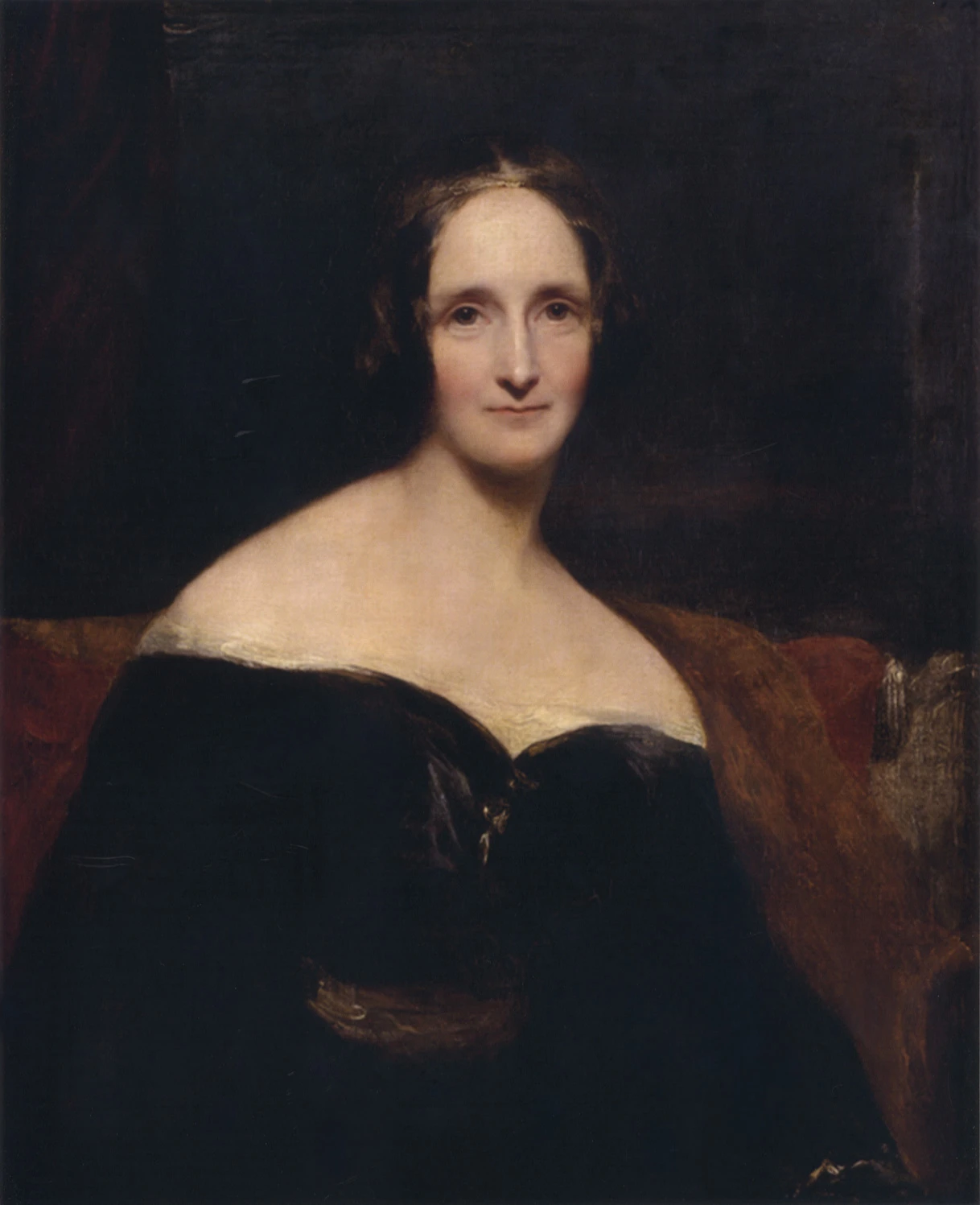
She revised Frankenstein for the 1831 edition and published Rambles in Germany and Italy in 1844 after renewed continental travel. She died in London on 1 February 1851 and was buried at St Peter’s, Bournemouth. Rothwell’s portrait, reproduced here from a scan retaining its marks, represents the later writer: the National Portrait Gallery dates the painting circa 1831–1840 and records its exhibition in 1840. It cannot show the eighteen-year-old author exactly as she looked on the night she imagined the creature.
Quick answers
Frequently asked questions about Mary Shelley
- How old was Mary Shelley when she wrote Frankenstein?
- She began the project in 1816 at eighteen, continued developing it into 1817, and was twenty when the anonymous first edition appeared in 1818.
- Did Percy Shelley write Frankenstein?
- Mary Shelley was the author. Percy encouraged the project, made editorial contributions and wrote the original preface; those contributions do not make him the novelist.
- Is Frankenstein the creature’s name?
- Victor Frankenstein is the creator. The creature is not given a personal name in the novel, although later popular usage often transfers Frankenstein to it.
- Did Mary Shelley write anything else?
- Yes. Her work includes The Last Man, Valperga, The Fortunes of Perkin Warbeck, Lodore, Falkner, travel books, stories and biographies, alongside editions of Percy Shelley’s writing.
Keep exploring
Lives connected to this story
- Oscar Wilde
Compare another Gothic novel whose revised edition changes the reader’s view of influence, art and responsibility.
- Jane Austen
Compare anonymous publication and the professional work of another English woman novelist across the early nineteenth century.
- Thomas Hardy
Read another novelist and poet whose manuscripts, revisions and later family narratives need to be distinguished.
Sources and further reading
Explore the evidence
These references support the biography and offer further reading. Official records, first-person accounts and independent reporting provide different perspectives; image records document attribution and licensing.
- 1. National Library of MedicineFrankenstein: An Extraordinary Life — parents, education and reading
- 2. National Library of MedicineFrankenstein: The Birth of Frankenstein — genesis and publication
- 3. Universitat de València / Shanon LawsonMary W. Shelley: chronology of life and works
Selected life and publication entries read in Shanon Lawson’s university-hosted chronology. Its conjectural entries about relationships and manuscripts are not converted into established facts. No survey of the complete journals, correspondence or autograph drafts is claimed.
- 4. Mary Shelley / Project GutenbergFrankenstein: transcription from a photo-reprint of the 1818 edition
- 5. Mary Shelley / Project GutenbergFrankenstein: 1831 introduction and revised text
The introduction and selected narrative passages were read in a transcription explicitly based on a photo-reprint of the 1831 edition. The introduction is retrospective; its account of composition is not presented as a contemporaneous transcript of private thoughts.
- 6. National Portrait GalleryNPG 1235: Rothwell’s Mary Shelley — identity, dating and provenance
- 7. Wikimedia CommonsRothwellMaryShelley.jpg: public-domain record and revision history
The 5 July 2008 file revision was selected from the visible history. The later 2009 and 2020 versions explicitly remove marks, and the 2020 version also alters aspect ratio. The full earlier scan is retained; NPG supplies identity and qualified dating, not the downloaded reproduction.
- 8. Wikimedia CommonsExact 5 July 2008 print scan before documented mark removal