In this biography
Quick facts
- Born
- 11 June 1776
- Died
- 31 March 1837
- Birthplace
- East Bergholt, Suffolk, England
- Country
- United Kingdom
- Nationality
- English
- Known for
- The Hay Wain, Stour Valley landscapes, cloud studies and English Landscape prints
- Training
- Royal Academy Schools, entered 1799
- Major exhibition picture
- The Hay Wain, 1821
- Paris recognition
- Gold medal at the 1824 Salon
- Royal Academician
- Elected in 1829
Why this life matters
His landscapes combine close outdoor observation with studio composition, making local places vehicles for both technical experiment and personal feeling.
Timeline
Key moments
Born in East Bergholt
Born on 11 June into a Suffolk family engaged in milling and commerce.
Royal Academy training
Entered the Royal Academy Schools in London.
Marriage
Married Maria Bicknell; their family eventually included seven children.
Large Stour landscapes
Exhibited the group of monumental landscapes commonly called the six-footers.
The Hay Wain
London exhibition in 1821 preceded its celebrated appearance at the 1824 Paris Salon.
Loss and recognition
Maria died in 1828; Constable became a full Royal Academician in 1829.
Prints and final years
Worked with David Lucas on landscape mezzotints; died in London on 31 March 1837.
A commercial landscape before it became Constable country
John Constable was born at East Bergholt, Suffolk, on 11 June 1776. His father Golding’s interests in farming, milling and the corn trade meant that the Stour Valley was a workplace as well as a childhood home. The river, mills, carts and cultivated fields that recur in his paintings belonged to an organised economy. Their later picturesque reputation can obscure that working foundation.
He initially worked in the family business and learned from the local amateur painter John Dunthorne. Encouragement and access to other people’s pictures helped him move towards a professional career. The familiar story of an artist responding directly to beloved scenery therefore needs a second element: looking at earlier art, acquiring skills and deciding what kinds of landscape deserved ambitious treatment.
London training and the choice of ordinary places
Constable entered the Royal Academy Schools in 1799. London offered training, exhibitions and potential patrons, while visits to Suffolk supplied drawings and oil studies. He first exhibited at the Academy in 1802. His subjects could seem modest beside landscapes organised around ancient history or spectacular scenery: a mill, a lane or a river crossing might provide the basis of a substantial painting.
That choice did not mean indifference to the Old Masters. He studied earlier landscape painting while developing a practice grounded in familiar places. A finished canvas could bring together studies made in different years. Seeing the pictures as effortless records of a single moment misses the work of selection, rearrangement and revision that made ordinary surroundings persuasive on an exhibition wall.
Maria, family life and places beyond Suffolk
In 1816 Constable married Maria Bicknell. They established a household in London and eventually had seven children. Maria’s health was a major concern, contributing to periods at Hampstead and Brighton. These places became fresh subjects for observation: the sea, working shore and open heath prevent his career from being reduced to repeated views of one river valley.
Maria died in 1828, leaving Constable with young children. Surviving letters preserved in the National Art Library reveal practical affection, encouragement of a daughter’s drawing and memories of the picture that had brought his Paris medal. These glimpses widen the picture of his work without allowing every cloud or storm to be read as a directly decipherable record of family emotion.
Six-foot canvases and an international reputation
From 1819 to 1825 Constable exhibited a sequence of large Stour landscapes, often called the six-footers. Full-size oil sketches helped him test composition, colour and light before completing the exhibition canvases. The Hay Wain appeared at the Royal Academy in 1821 as Landscape: Noon. It received favourable attention but remained unsold at that exhibition.
A dealer later sent the painting to the Paris Salon of 1824, alongside other Constables. The works attracted marked interest, and Constable received a gold medal. French artists responded to the surfaces and fresh effects of his painting. The sequence is important: an 1821 English picture acquired a significant new reception in 1824, while Constable himself did not need to travel abroad for that encounter to occur.
Clouds, records and expressive construction
On Hampstead Heath Constable made concentrated studies of skies, often recording time, date and weather. Such annotations connect visual experiment to patient observation. In an 1821 letter to John Fisher he described the sky as a major agent of feeling in landscape. Accuracy and expression were related aims, rather than two incompatible ways of approaching a picture.
The Fitzwilliam’s Hampstead Heath discussion shows how unseen clouds can organise light and shadow across the ground. Weather also affects work: labourers fill hollows where rainwater gathers. This conjunction helps explain why calling Constable simply a painter of tranquil nature is inadequate. His skies change the visibility, atmosphere and use of a place; they are structural parts of the painted world.
Printmaking, late recognition and the preserved studies
Constable became a full Royal Academician in 1829. Work with the printmaker David Lucas translated his landscapes into mezzotint, a medium suited to variations of light and darkness. The series known as English Landscape appeared in the early 1830s. It made the relationship between atmosphere and tonal structure available in a different medium, requiring collaboration rather than merely mechanical reproduction.
He died in London on 31 March 1837. Family preservation and later gifts, notably his daughter Isabel’s substantial gift to the V&A, helped establish the visibility of his drawings and oil sketches. These works now invite comparison with the finished pictures. Their survival lets viewers see an artist making decisions, not only an icon of an apparently timeless English countryside.
Quick answers
Frequently asked questions about John Constable
- Where was John Constable born?
- He was born at East Bergholt in Suffolk, England, on 11 June 1776.
- Was The Hay Wain painted outdoors?
- The finished 1821 canvas was made in Constable’s London studio using earlier studies, including a full-size preparatory oil sketch.
- Why are his cloud studies important?
- They record close attention to changing weather while developing the light and expressive atmosphere of his landscapes. Many include dates, times and weather notes.
- When did Constable become a Royal Academician?
- He became a full Royal Academician in 1829, aged fifty-two.
Keep exploring
Lives connected to this story
- J. M. W. Turner
Compare another major British landscape painter’s treatment of atmosphere, modernity and exhibition pictures.
Sources and further reading
Explore the evidence
These references support the biography and offer further reading. Official records, first-person accounts and independent reporting provide different perspectives; image records document attribution and licensing.
- 1. National GalleryJohn Constable: career and collection biography
- 2. Metropolitan Museum of Art / Elizabeth E. BarkerJohn Constable, 1776–1837: training, six-footers, sky studies and prints
- 3. Victoria and Albert MuseumJohn Constable: introduction, development of compositions and family collection
- 4. Victoria and Albert Museum / Diane SpaulYour Affectionate Father: selected indexed letter and family passages
Selected indexed family and letter passages were accessible; the live blog returned 403. No direct examination of the original letters is claimed.
- 5. Fitzwilliam MuseumHampstead Heath: sky, weather and an excerpt of Constable’s 1821 letter
Read the object discussion and quoted 1821 letter excerpt, not Constable’s entire correspondence.
- 6. National GalleryThe Hay Wain, NG1207: object, place, preparation and reception
Read object facts, selected in-depth discussion and the written audio-description transcript. The audio was not played; no physical inspection or technical examination is claimed.
- 7. National GalleryDiscover Constable and The Hay Wain: 2024 exhibition context
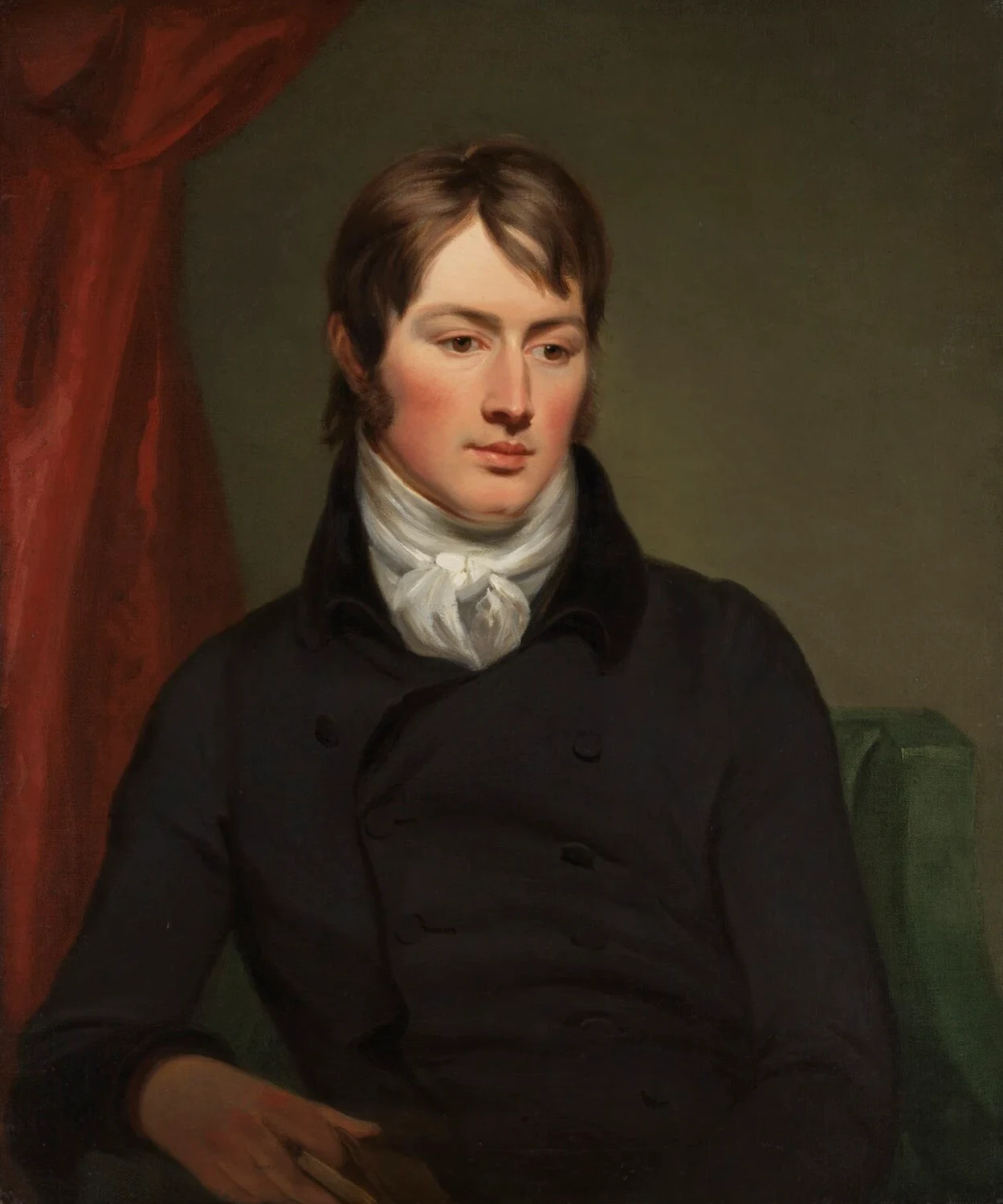
- 8. Ramsay Richard Reinagle / Wikimedia CommonsExact portrait, rights and sole 2026 upload
Commons’s exact-day 1799 metadata is not adopted: NPG dates the portrait circa 1799. The current sole original upload was used.
- 9. Wikimedia CommonsComplete current Reinagle JPEG
- 10. National Portrait GalleryNPG 1786: sitter, circa date and Reinagle’s lifespan