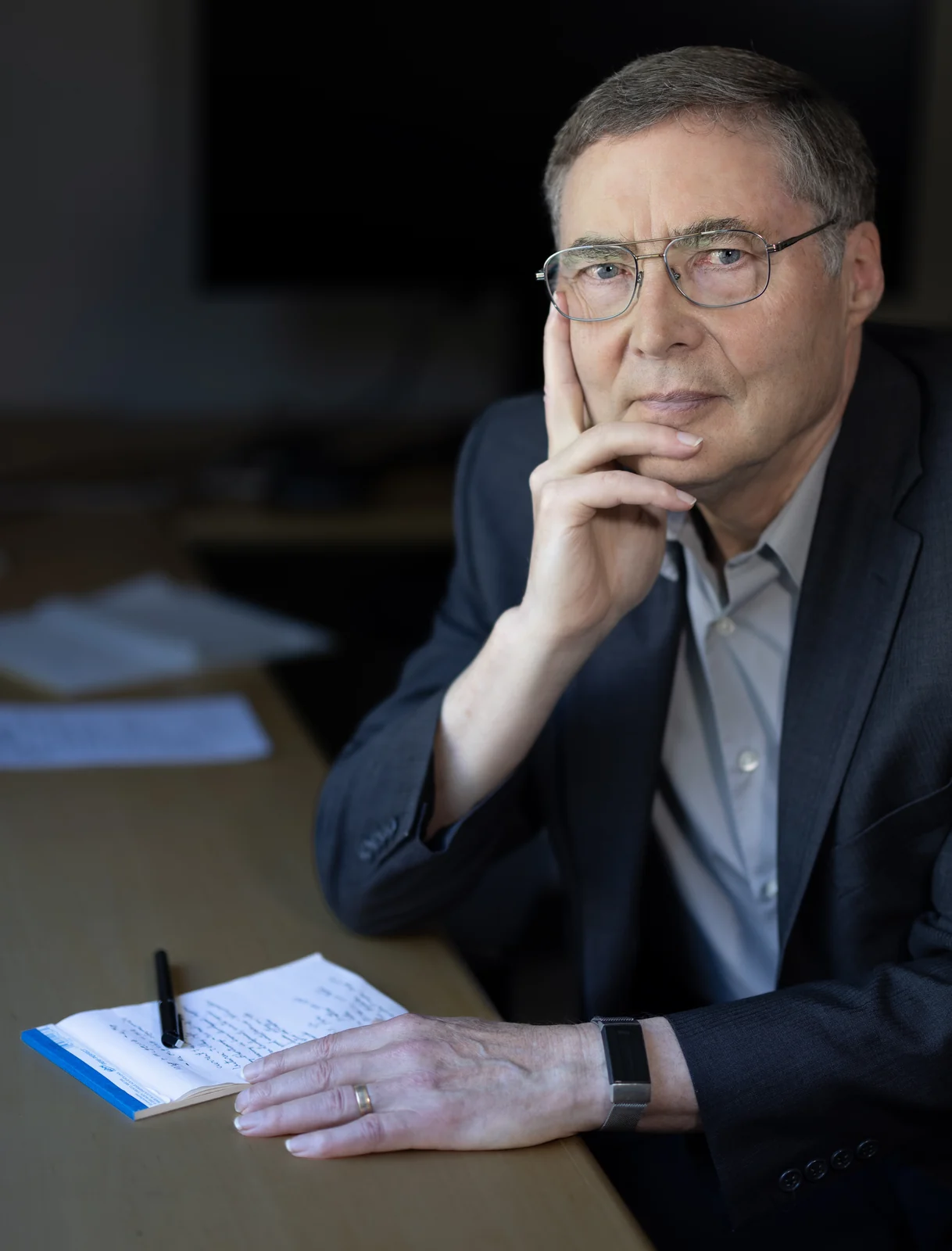
In this biography
Quick facts
- Born
- 29 July 1898
- Died
- 11 January 1988
- Birthplace
- Rymanów, Austria-Hungary (now Poland)
- Country
- United States
- Nationality
- Not independently established
- Known for
- Molecular-beam and resonance researcher.
- Early qualification
- Cornell chemistry degree
- Research team
- Zacharias, Millman and Kusch
- Postwar institutions
- Brookhaven and CERN
Why this life matters
He made resonance a precision tool for studying nuclei and helped organise the institutions and public responsibilities of postwar physics.
Timeline
Key moments
Cornell
Chemistry graduation.
Columbia
Lectureship begins.
Research note
Resonance experiment reported.
Physics recognition
Nobel Prize for the resonance method.
Chemistry, crystals and European teachers
Rabi graduated in chemistry from Cornell in 1919 and completed a Columbia physics doctorate on crystals in 1927. European fellowships brought work with Sommerfeld, Bohr, Pauli, Stern and Heisenberg. He returned to Columbia in 1929.
His experimental programme drew on both that international training and a growing interest in what atomic beams could reveal about magnetic properties.
Sources for this section: [2]
A resonance method and its team
Rabi, Zacharias, Millman and Kusch’s 1938 note reported resonant reorientation through a loss and recovery of refocused molecular-beam intensity.
The 1944 physics Nobel recognised his resonance method for recording nuclear magnetic properties.
The primary note distinguishes the observed effect from the remaining field calibration needed for precise magnetic moments. That distinction is part of the achievement, not an embarrassment to conceal in hindsight.
War work without conflating roles
During the war Rabi was associate director of MIT’s Radiation Laboratory, working on radar. He declined an offer to become Manhattan Project deputy director but served as a consultant and visited Los Alamos.
Those roles are related but not interchangeable. A whole-career account can acknowledge weapons involvement without assigning an office he did not accept.
Sources for this section: [3]
Building institutions and arguing about their use
After returning to Columbia he helped establish Brookhaven and CERN and advocated limits on nuclear weapons. He served on national scientific and atomic-energy advisory bodies.
His international service included the 1955 Geneva peaceful-uses conference.
He died in New York in 1988.
Research organisation and public judgement became major parts of his later career. Neither a later medical application of resonance nor an institutional role should be reduced to a claim that he alone invented every technology that followed.
Quick answers
Frequently asked questions about Isidor Isaac Rabi
- Was a Nobel lecture read for this biography?
- No. The Nobel record says no lecture was delivered; the technical guide uses the actual earlier research note.
- Does a resonance observation by itself fix a magnetic moment?
- No. The measurement must retain the field calibration and the other quantities in the stated relation.
Keep exploring
Lives connected to this story
- Willis Lamb
Follow a later precision experiment that used microwave techniques.
- Hans Bethe
Compare another physicist’s research and public service.
- Norman Ramsey
Follow Ramsey’s development of separated oscillatory fields from Rabi’s molecular-beam magnetic resonance work.
- William Phillips
Read Phillips’s laser-cooling career as a later extension of the atomic-beam tradition into controlled motion and trapping.
- Martin Perl
Explore Martin Perl’s related research on tau lepton.
- Samuel Ting
Explore Samuel Ting’s related research on j/psi particle.
Sources and further reading
Explore the evidence
These references support the biography and offer further reading. Official records, first-person accounts and independent reporting provide different perspectives; image records document attribution and licensing.
- 1. Nobel Prize OutreachIsidor Isaac Rabi: Facts
- 2. Nobel Foundation, award-era biography with stated updatesIsidor Isaac Rabi: Biographical
- 3. Atomic Heritage Foundation / National Museum of Nuclear Science & HistoryIsidor I. Rabi
- 4. I. I. Rabi, J. R. Zacharias, S. Millman, P. Kusch / Physical Review53, 318, 15 February 1938A New Method of Measuring Nuclear Magnetic Moment
The exact one-page reprint was read and viewed. The original publisher PDF request returned403; the later full experimental account and 1937 theory paper were not read.
- 5. Nobel Prize OutreachIsidor Isaac Rabi: Nobel Lecture record