
The short answer
What did a narrow electron-pair mass peak establish before its full theoretical interpretation?
Read the evidence
Different records within the same investigation
The following comparison distinguishes the specific questions answered by the inspected records.
| Record or test | What it establishes | What remains different |
|---|---|---|
| Particle identification | Tests whether tracks meet the electron–positron definition. | Does not alone reconstruct their source mass. |
| Pair-mass distribution | Reveals a narrow concentration among reconstructed pairs. | Needs the apparatus and background interpretation. |
| Independent energy scan | Tests resonance through varied collision energy at SPEAR. | Uses a different measurement route from Brookhaven. |
The measured pair carried information about its source
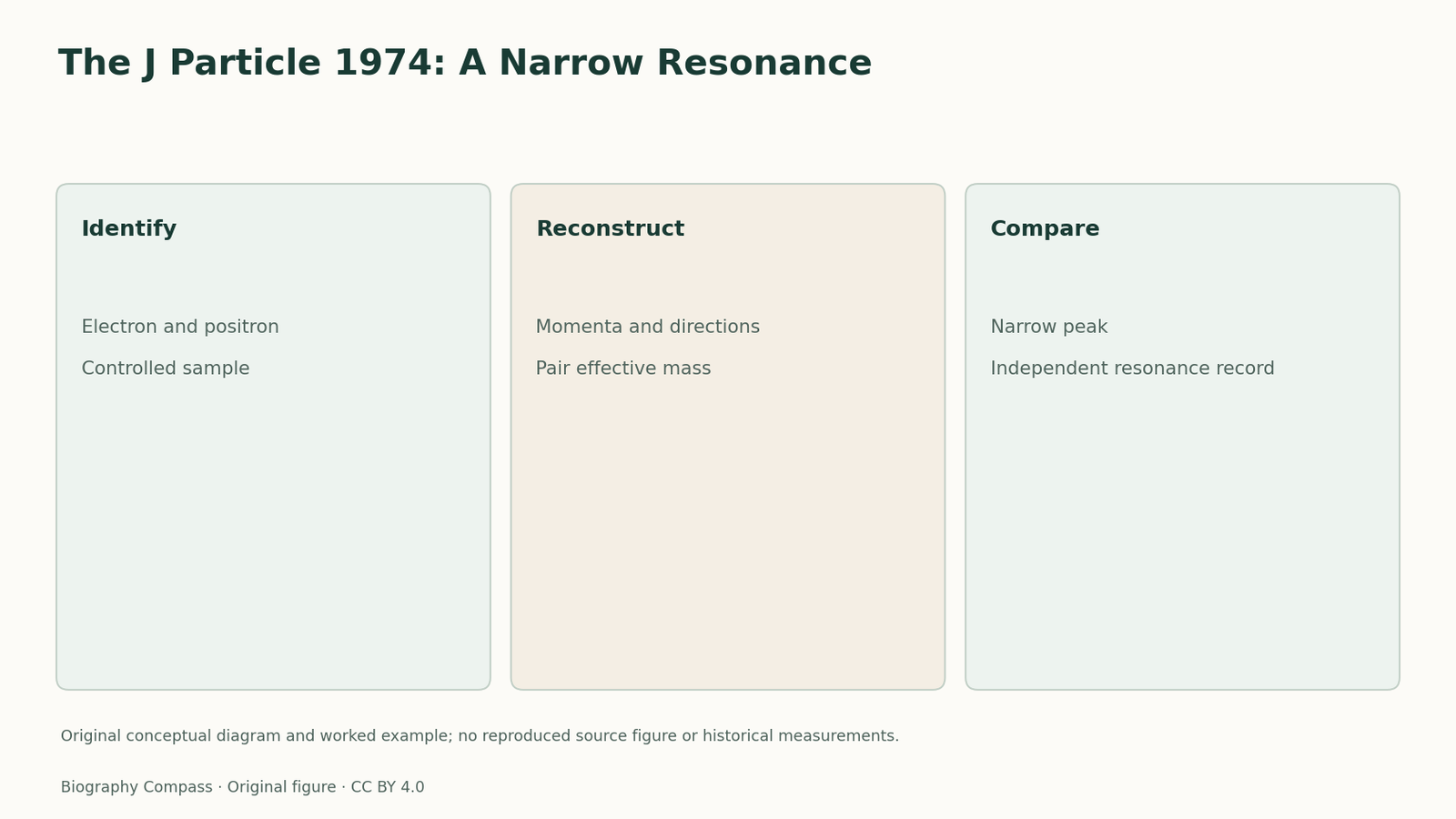
The 1974 Brookhaven paper reported a narrow resonance in electron–positron pairs. The experimental question was not whether two tracks appeared near one another in a drawing. A pair spectrometer measured particle momenta and geometry, allowing an effective mass to be reconstructed. Ting’s lecture explains why correlated pairs from a resonance can produce a concentration in this distribution, whereas uncorrelated combinations tend to contribute a smoother background. The inference depends on measured particle properties, not on visual resemblance alone.
Identification and mass reconstruction served different roles
Ting’s lecture describes magnetic tracking together with detectors sensitive to particle velocity and electromagnetic showers. These helped distinguish electrons from other particles before the pair distribution was interpreted. Identification addresses what the detected tracks are; mass reconstruction addresses their combined kinematics. A narrow peak is most informative when the sample definition and reconstruction are controlled. The same event record can therefore contain several logically distinct checks rather than one all-purpose signal labelled “new particle.”
Sources for this section: [2]
An independent experiment asked a different measurement question
The Brookhaven result should be distinguished from the SPEAR experiment associated with Richter. Ting’s collaboration studied the reconstructed mass of produced lepton pairs; the SPEAR collaboration scanned electron–positron collision energy and observed resonant production. Both approaches contributed to the J/psi discovery, but their horizontal axes and experimental controls were different. Preserving that distinction explains why independent observations were valuable: the result was not merely the same analysis copied to another graph with a new particle name.
An original reconstruction exercise
Imagine two fictional event samples. In one, accurately identified lepton pairs accumulate within a small reconstructed-mass interval; in the other, a detector’s acceptance changes sharply across that interval. What should be investigated before interpreting the accumulation? The researcher should test whether the selection or reconstruction could create the feature and whether control samples show it too. This exercise does not assert that Ting’s detector suffered such a problem. It illustrates why a peak is interpreted through the apparatus response and sample definition. The supported answer also distinguishes a reconstructed pair mass from the accelerator’s beam energy: those quantities are related by the collision and final-state kinematics, but they are not automatically the same measurement. No historical event count, width or mass value is invented.
Continue the chronology
Related history guides
The Tau Lepton: Missing Particles and Event Classes
Examine Perl’s 1975 electron–muon anomaly and later interpretation, with an original exercise distinguishing event selection from a complete particle model.
Read the timeline1974SPEAR Energy Scans: A Resonance from Collisions
Understand Richter’s 1974 psi discovery as a collision-energy scan, with an original sampling exercise distinguishing a narrow resonance from coarse coverage.
Read the timelineBiography context
Explore United States through connected lives
Connected biographies
Researchers and related approaches
1936–
Samuel Ting
Experimental particle physicistSamuel Ting developed precision lepton-pair experiments and led the Brookhaven collaboration that observed the narrow J resonance in 1974.Read biography1898–1988
Isidor Isaac Rabi
Experimental physicistMolecular-beam and resonance researcher.Read biographyQuick answers
Common questions
- Was the mass peak a photograph of the particle?
- No. It was reconstructed from identified pair kinematics.
- Was Brookhaven’s analysis identical to SPEAR’s?
- No. Pair-mass reconstruction and a collision-energy scan were different experimental approaches.
Primary and institutional sources
How this history was checked
The references below distinguish the original study from later explanations. The worked exercise and comparison are newly written for this article. This article was reviewed on 8 November 2026.