
The short answer
How did unusual electron–muon events support a new lepton interpretation rather than directly photograph a tau?
Read the evidence
Different records within the same investigation
The following comparison distinguishes the specific questions answered by the inspected records.
| Record or test | What it establishes | What remains different |
|---|---|---|
| Selected event signature | States which visible events entered the report. | Is not a direct image of the proposed parent particle. |
| Missing energy | Shows visible products do not account for the whole event. | Does not identify each unseen product by itself. |
| Follow-up predictions | Can distinguish competing interpretations. | Must be tested beyond initial compatibility. |
The paper reported a specific visible pattern
The 1975 collaboration reported electron–positron collision events containing an electron and an oppositely charged muon, with missing energy and no other detected charged particles or photons. This was a defined category of events, not a direct photograph of a tau. The missing energy also indicated that the visible pair did not account for the complete final state. The investigators compared this pattern with known explanations and found no conventional account satisfactory within the paper’s analysis.
Sources for this section: [1]
A proposed interpretation needed more than an anomaly
Perl’s later lecture reconstructs the heavy-lepton search, the Mark I detector and the subsequent development of the tau interpretation. An unusual event category can motivate a model, but a proposed particle brings additional expectations about production and decay. Those expectations must be confronted with further observations. Reading the 1975 abstract as if it already contained every later tau result removes the actual inferential work. The discovery’s strength came from the investigation that connected the anomaly with a consistent new-lepton account.
Selection rules define what a sample can answer
A detector records particular visible products under specified selection conditions. If a sample requires an electron and a muon, that requirement shapes which events enter the analysis. It does not establish that every new particle must always produce that pair, nor does missing energy identify each unseen object separately. The distinction is useful beyond this example: an observed signature, a reconstruction of unseen products and a model of the underlying interaction are connected stages, but they are not identical statements.
An original signature exercise
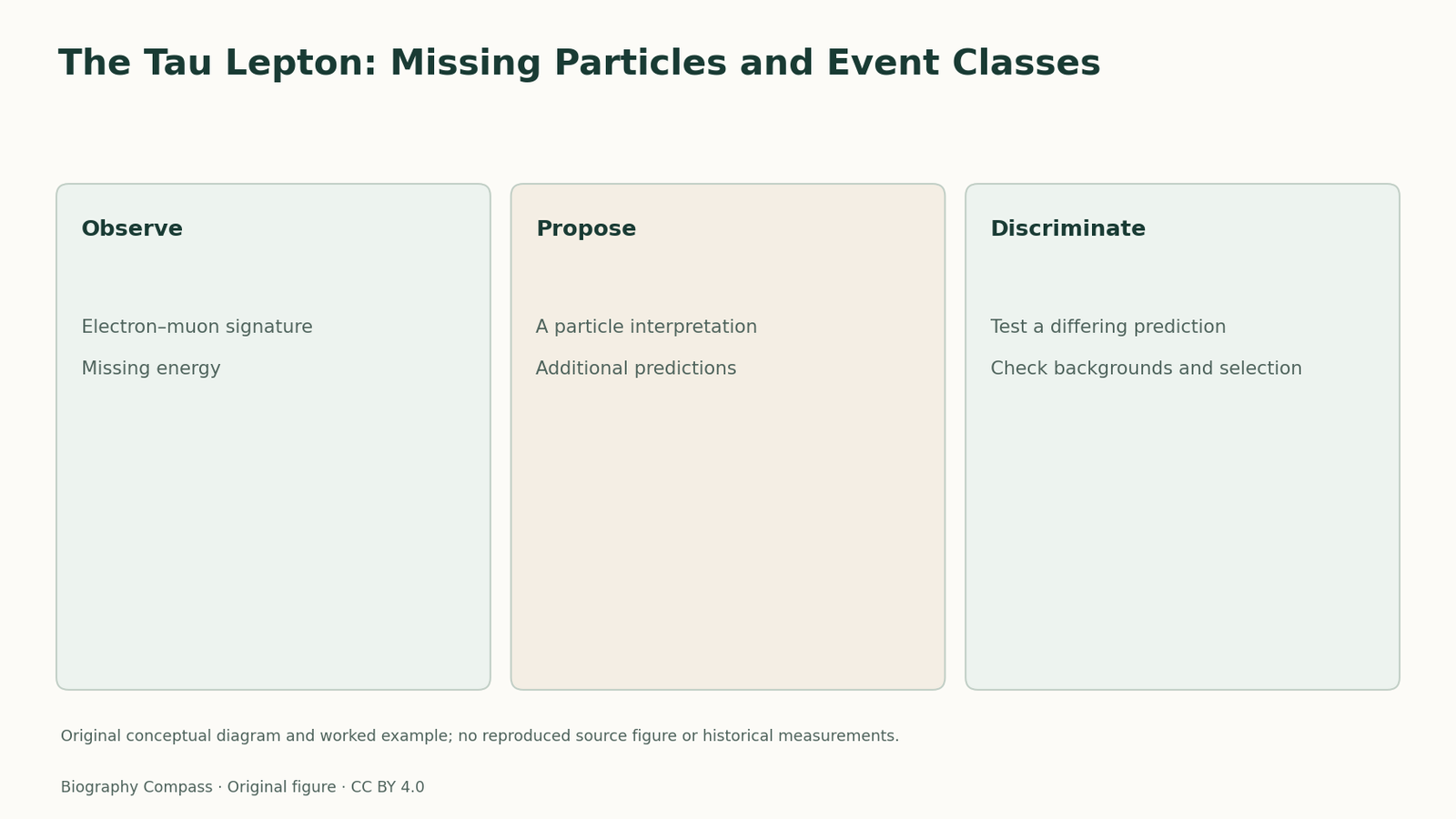
Imagine a fictional experiment with two possible decay models. Both can produce a visible electron–muon pair, but only one predicts a second independently testable class of events. If the first sample contains electron–muon pairs, has the model been uniquely identified? No, because the stated signature is compatible with both possibilities. The next useful step is to test their differing prediction or obtain another discriminating observable. This is a logic exercise, not a reanalysis of Mark I data or a claim that those were the historical alternatives. Its supported answer separates compatibility from discrimination. A strong response also asks whether background processes and detector selection could generate the visible pattern before treating an unusual sample as evidence for a new particle. No historical count or branching fraction is invented here.
Continue the chronology
Related history guides
The J Particle 1974: A Narrow Resonance
Read Ting’s 1974 Brookhaven experiment as a mass-reconstruction study, distinguishing its narrow pair resonance from SPEAR’s independent energy scan.
Read the timeline1974SPEAR Energy Scans: A Resonance from Collisions
Understand Richter’s 1974 psi discovery as a collision-energy scan, with an original sampling exercise distinguishing a narrow resonance from coarse coverage.
Read the timelineBiography context
Explore United States through connected lives
Connected biographies
Researchers and related approaches
1927–2014
Martin Perl
Experimental particle physicistMartin Perl moved from chemical engineering into particle physics and led the search that turned unusual electron–muon events into evidence for the tau lepton.Read biography1898–1988
Isidor Isaac Rabi
Experimental physicistMolecular-beam and resonance researcher.Read biographyQuick answers
Common questions
- What did the visible signature contain?
- An oppositely charged electron–muon pair with missing energy under the report’s selection conditions.
- Does a compatible signature uniquely identify a model?
- Only if other viable explanations are excluded by appropriate evidence; compatibility alone is insufficient.
Primary and institutional sources
How this history was checked
The references below distinguish the original study from later explanations. The worked exercise and comparison are newly written for this article. This article was reviewed on 8 November 2026.