
The short answer
A reproducible effect and a precise parameter value are different achievements. Read what the authors reported and what they still intended to calibrate before turning their note into a finished catalogue of magnetic moments.
Original record and worked interpretation
Effect versus parameter
Separate the observation from the value inferred with calibration.
| Stage | Inputs | Result |
|---|---|---|
| Initial estimate | F=6, G=3 | K=2 |
| Revised field | F=6, G=3.3 | K=20/11 |
| Common multiplicative error | Both F and G scaled equally | Ratio unchanged; absolute scales unresolved |
Chronology
A timeline of the turning points
Primary note
Resonance reported before final recalibration.
Original fixture
Scaled values, not operational settings.
What was observed and what remained
The note reports a decrease and recovery of refocused molecular-beam intensity as the steady field passes resonance. Its final paragraph postpones magnetic-moment values until field recalibration.
The same record can therefore establish a striking effect without yet supplying the most precise final parameter. That is a useful distinction between an observable pattern and the calibrated quantity inferred from it.
Sources for this section: [1]
Use the relation with its other quantities
Equation 1 gives frequency nu=mu×H/(h×i), with magnetic moment mu, field H, nuclear spin i and Planck constant h.
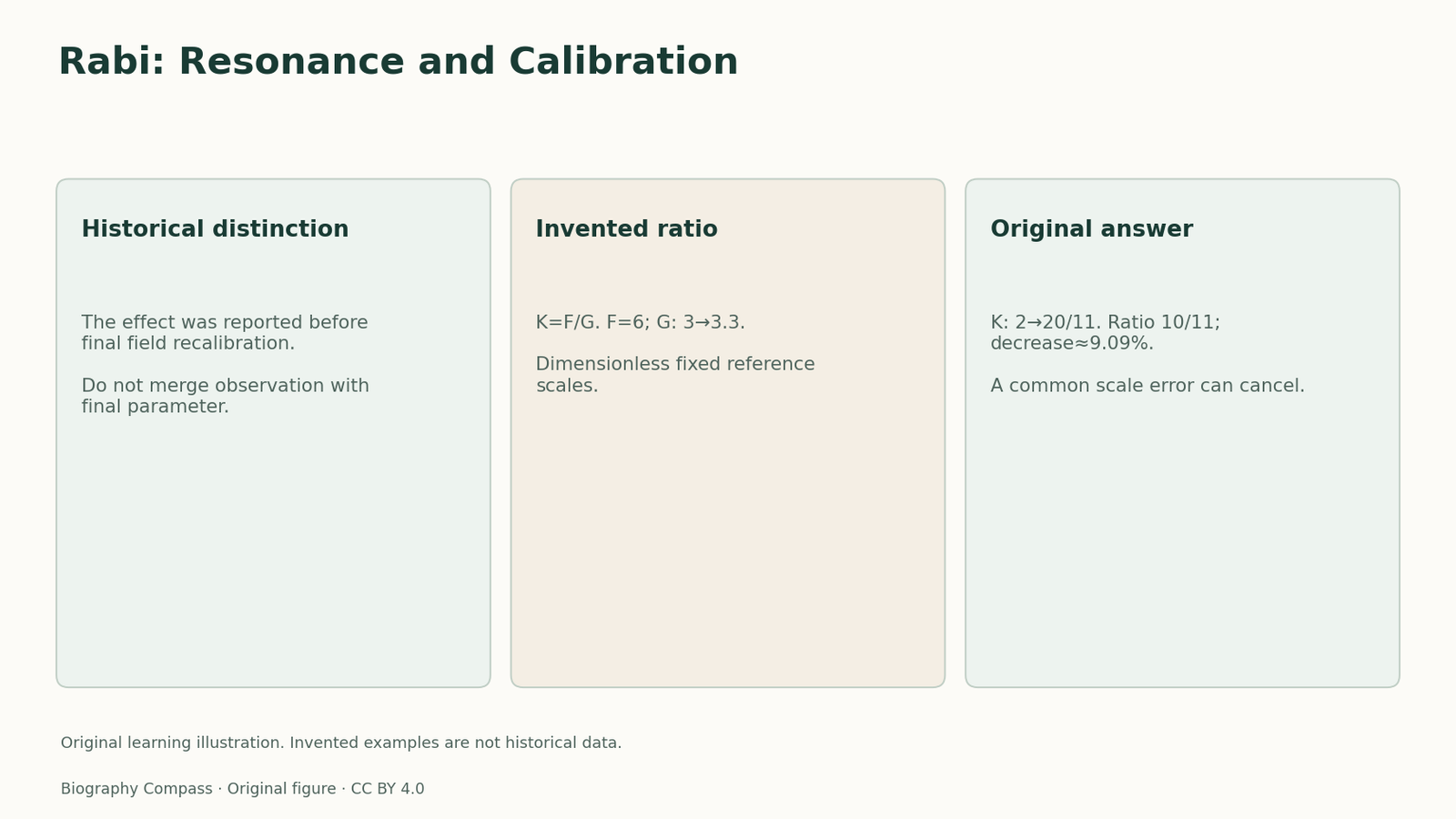
For fixed h and i, define a scaled coupling K=F/G, where F and G are dimensionless ratios of frequency and field to fixed reference values. The reference scales remain unchanged between estimates. The exercise concerns this scaled ratio, not an actual nuclear moment or a practical apparatus setting.
Sources for this section: [1]
An original calibration audit
Suppose an invented observation has F=6 and an initial field estimate G=3. Recalibration changes G to 3.3 while leaving F unchanged. Find the initial and revised K, then assess the statement that a 10% increase in field causes exactly a 10% decrease in the inferred ratio.
Reference answer: K initial=6/3=2. K revised=6/3.3=20/11≈1.81818. The revised-to-initial ratio is 10/11≈0.90909, a reduction of about 9.09%, not 10%. The inverse relation is not the same as subtracting an equal percentage.
If frequency and field instead both change by the same multiplicative factor, K stays fixed. That does not prove either absolute calibration is correct; a ratio can hide a shared scale error.
Sources for this section: [1]
The scope of the lesson
The original fixture separates an observed pattern from its calibration and then makes a shared-error limitation explicit. It does not reproduce the resonance line shape or calculate a real magnetic moment. No Nobel lecture was delivered by Rabi; the historical technical source here is the actual earlier research note.
Continue the chronology
Related history guides
Biography context
Explore United States through connected lives
Connected biographies
The researcher behind the record
1898–1988
Isidor Isaac Rabi
Experimental physicistMolecular-beam and resonance researcher.Read biographyQuick answers
Common questions
- Does an unchanged ratio prove both scales are right?
- No. The stipulated common multiplicative error cancels.
- Was the later full experimental account read?
- No. The inspected primary source is the one-page note, including its recalibration qualification.
Primary and institutional sources
How this history was checked
Historical claims use the selected records below. Invented inputs and worked interpretations are labelled; they are not reconstructed experiments. This article was reviewed on 31 October 2026.