
The short answer
How does a changing magnetic field keep decelerating atoms resonant with a laser?
Read the evidence
Keep the observable attached to the claim
The same experiment can involve a resonance condition, a mean speed and a distribution width without making them synonyms.
| Record or test | What it establishes | What remains different |
|---|---|---|
| 1982 experimental abstract | Reports deceleration and velocity bunching, with magnetic compensation of Doppler shift. | Does not identify slowing with complete positional trapping. |
| NIST historical methods account | Distinguishes slowing, trapping and later temperature results. | Combining methods does not remove their different roles. |
| Original beam exercise | Shows why resonance must be maintained as speed changes. | The cards are not measured magnetic-field or temperature data. |
Why a fixed laser soon loses the atoms
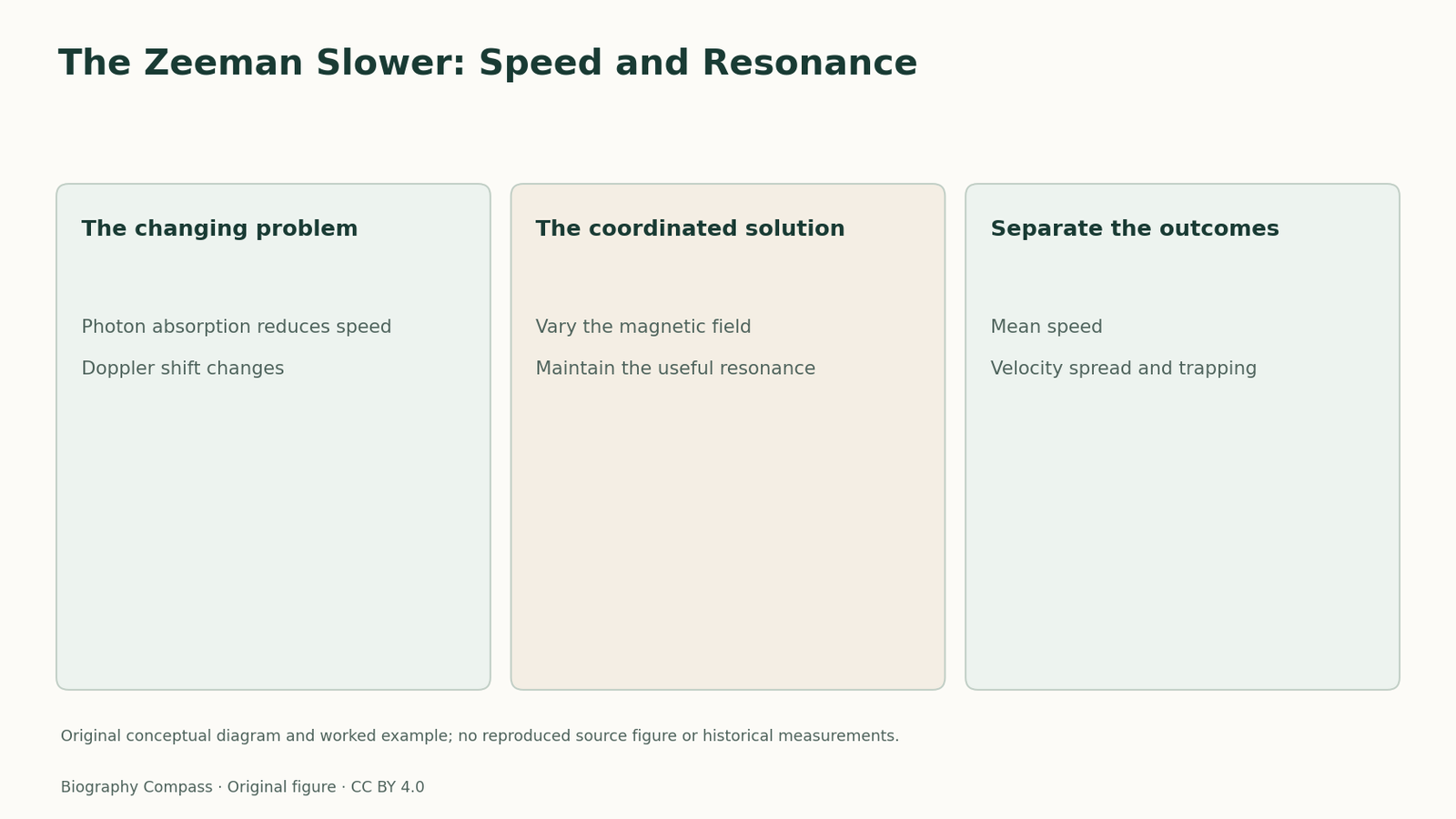
An atom’s motion changes the light frequency it experiences. When a beam of atoms absorbs counterpropagating laser photons, its forward speed decreases. The Doppler shift therefore changes during the slowing process. A laser initially close to resonance can become ineffective as the atoms decelerate. The engineering question is how to keep the transition and laser matched over a substantial part of the beam’s trajectory. It is not answered simply by increasing light intensity while leaving the changing resonance condition untouched.
A magnetic field supplies the compensation
Phillips and Metcalf used a spatially varying magnetic field to shift atomic energy levels as the atoms travelled along the apparatus. The changing Zeeman shift compensated for their changing Doppler shift. Their 1982 abstract reports both deceleration and velocity bunching of sodium atoms. The combination matters: repeated absorption of resonant photons can transfer substantial momentum, but only while the atoms continue interacting effectively with the beam. The field profile is therefore part of a coordinated slowing design, rather than a separate device that mechanically pulls every neutral atom backward.
Sources for this section: [1]
Mean velocity and temperature answer different questions
A directed beam may have a large mean forward speed and a spread around that mean. Reducing the mean speed is not identical to reducing the spread, and neither by itself says that the atoms are trapped. NIST’s historical discussion distinguishes Zeeman slowing, other slowing approaches, magnetic trapping and later sub-Doppler cooling. These methods can be combined in a larger experiment, but the observable should remain explicit. A claim about beam deceleration should not silently become a claim that every degree of atomic motion has reached an exceptionally low temperature.
A resonance-matching exercise
Draw an invented sequence of three positions along a slowing beam. Label the atoms fast, intermediate and slower. A fixed-frequency laser is used at all three positions. First omit the changing magnetic field and ask whether the initial resonance condition is guaranteed to remain true. It is not, because the Doppler shift changes. Then add a field chosen to compensate that change and identify what the design is trying to preserve: resonance with the slowing atoms, not constant atomic speed. Finally imagine two beams with the same reduced mean speed but different velocity spreads. They need not have the same temperature. These are conceptual comparison cards, not a field profile calculated for the historical sodium apparatus.
Continue the chronology
Related history guides
Laser Cooling: Momentum and Random Recoil
Use Chu’s 1985 optical-molasses experiment to distinguish directed absorption, random recoil and viscous confinement, with an original cooling exercise.
Read the timeline1949–1950; retrospective lecture 1989Ramsey’s Separated Fields and Interference
Compare Ramsey’s 1950 resonance calculation with his later explanation of separated fields, including phase coherence and a worked timing exercise.
Read the timelineBiography context
Explore United States through connected lives
Connected biographies
Researchers and related approaches
1948–
William Phillips
Experimental atomic physicistWilliam Phillips developed laser cooling at the National Bureau of Standards and NIST, building on MIT precision-measurement training and a collaboration with Harold Metcalf.Read biography1898–1988
Isidor Isaac Rabi
Experimental physicistMolecular-beam and resonance researcher.Read biographyQuick answers
Common questions
- What does the varying magnetic field do in a Zeeman slower?
- It changes the transition frequency along the apparatus to compensate for the changing Doppler shift of decelerating atoms.
- Is a slower beam automatically a colder beam?
- Not in every sense. Mean forward speed and the width of the velocity distribution are different properties, and trapping is another requirement.
Primary and institutional sources
How this history was checked
The original experimental abstract is compared with NIST’s method history. The worked example uses no invented historical numbers. This article was reviewed on 7 November 2026.
- William D. Phillips and Harold Metcalf / American Physical SocietyLaser Deceleration of an Atomic Beam
- National Institute of Standards and TechnologyBill Phillips: 1997 Nobel Prize in Physics
- NIST, A Century of Excellence in Measurements, Standards and TechnologyLaser Cooling Below the Doppler Limit
- Nobel Prize OutreachWilliam Phillips — Facts
- Nobel Prize OutreachWilliam Phillips — Biographical