
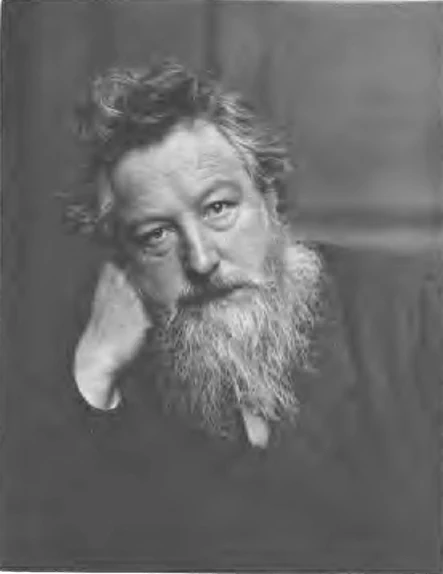
In this biography
Quick facts
- Born
- 24 March 1834
- Died
- 3 October 1896
- Birthplace
- Walthamstow, Essex, England (now London)
- Country
- United Kingdom
- Nationality
- British
- Known for
- Morris & Co., the Arts and Crafts movement and the Kelmscott Press
- Furnishing firm
- Founded with six partners in 1861
- Morris & Co.
- Restructured under Morris in 1875
- Workshops
- Merton Abbey from 1881
- Publishing
- Kelmscott Press founded 1891
- Major fiction
- News from Nowhere, 1890
Why this life matters
Morris made the organisation and quality of work part of the argument about design, linking manufacturing practice with a far wider vision of social change.
Timeline
Key moments
Born in Walthamstow
Family wealth later gave Morris unusual freedom to experiment.
Home and partnership
He married Jane Burden, established Red House, and joined friends in founding a decorating firm.
Business reorganisation
Morris took sole ownership; an Oxford Street showroom followed in 1877.
Merton Abbey
A larger riverside site brought major production processes together.
Fiction and fine printing
News from Nowhere appeared in 1890 and the Kelmscott Press began in 1891.
Chaucer and death
The Kelmscott Chaucer appeared shortly before Morris died in Hammersmith.
Privilege, medieval art and a different ambition
William Morris was born in Walthamstow on 24 March 1834. His father’s financial success gave him a privileged upbringing and an inheritance that reduced the immediate pressure to earn a living. This freedom helped support experiments that were artistic and commercial, but also shaped the contradiction between his own resources and his later opposition to class inequality.
At Oxford he formed a lasting friendship with Edward Burne-Jones and encountered the writings of John Ruskin. Architecture, medieval buildings and historical literature supplied an alternative to the industrial society he increasingly disliked. After briefly training with the architect George Edmund Street, Morris turned towards art and design rather than the clerical career he had originally considered.
Red House and a collective enterprise
Morris married Jane Burden in 1859 and commissioned Philip Webb to design Red House in Kent. Furnishing it became a collaborative undertaking involving paintings, embroidery and decorative objects. Dissatisfaction with available goods helped turn a circle of friends into a business: Morris, Marshall, Faulkner & Co., founded in 1861.
Its partners included Webb, Burne-Jones, Dante Gabriel Rossetti, Ford Madox Brown, Charles Faulkner and Peter Paul Marshall. Church commissions and stained glass helped establish the enterprise. Jane Morris and other makers contributed work that cannot be reduced to the proprietor’s name. The ideal of a small artistic community at Red House proved impractical, and the family returned to London in 1865.
Building a market for craftsmanship
The firm was restructured as Morris & Co. under Morris’s sole ownership in 1875. An Oxford Street shop opened in 1877, bringing furnishing products and schemes before a fashionable clientele. Wallpapers and fabrics used rhythmic plant patterns, while the range extended to carpets, embroidery, furniture, stained glass and tapestry.
Morris investigated how things were made rather than supplying drawings alone. Work with Thomas Wardle in Staffordshire developed his knowledge of dyeing; outside manufacturers remained important when the firm lacked capacity. His reputation therefore grew through an exchange between design, technical experiment, contractors and retail organisation. A recognisable style had to be translated into repeatable goods before it could sustain a business.
Merton Abbey and the people behind the name
In 1881 Morris secured larger premises beside the River Wandle at Merton Abbey. Water suitable for dyeing, open ground for washing and drying, and room for looms helped bring production under closer control. Printed textiles, carpets, tapestries and stained glass connected different skilled departments rather than a single undifferentiated craft workshop.
John Henry Dearle became a vital designer and production manager; May Morris directed embroidery from 1885. Experienced dyers, printers, weavers and glaziers made the goods customers associated with Morris. Apprentices also worked within this system. Pleasant surroundings and an aspiration to worthwhile work mattered, but did not abolish the hierarchy of employer and employee or make demanding craft products universally affordable.
Fine printing and a difficult legacy
Morris founded the Kelmscott Press in 1891, treating type, illustration, borders, paper and the printed page as an integrated design problem. The 1896 edition of Chaucer became its celebrated achievement. Morris died at Kelmscott House in Hammersmith on 3 October that year, leaving an influence that extended across design, publishing, conservation and political thought.
His legacy contains a productive tension. He opposed alienating work, yet many elaborate furnishings required wealthy patrons and skilled labour that could not be made cheap without compromising his methods. Less costly products widened access without resolving that problem. Understanding the business through its collaborators and customers makes this tension clearer than either celebrating a solitary genius or dismissing his social ideals as mere marketing.
Quick answers
Frequently asked questions about William Morris
- Did William Morris make everything sold by Morris & Co.?
- No. Partners, designers, contractors and skilled employees were indispensable. John Henry Dearle, May Morris, Jane Morris, Burne-Jones and the firm’s makers had distinct contributions.
- Was Morris & Co. founded in 1875?
- The original partnership was founded in 1861. In 1875 it was restructured under Morris’s sole ownership and became Morris & Co.; the two dates describe different events.
- Why did Morris move production to Merton Abbey?
- The 1881 move offered larger workshops, water suitable for dyeing and space for washing and drying cloth. It helped the firm bring major manufacturing processes under closer control.
- How did his socialist beliefs fit his expensive products?
- Not neatly. Labour-intensive production often served wealthy buyers, even while Morris argued for enjoyable work and wider access to good design. His political ambition was broader social change, not a claim that his business had already achieved equality.
Keep exploring
Lives connected to this story
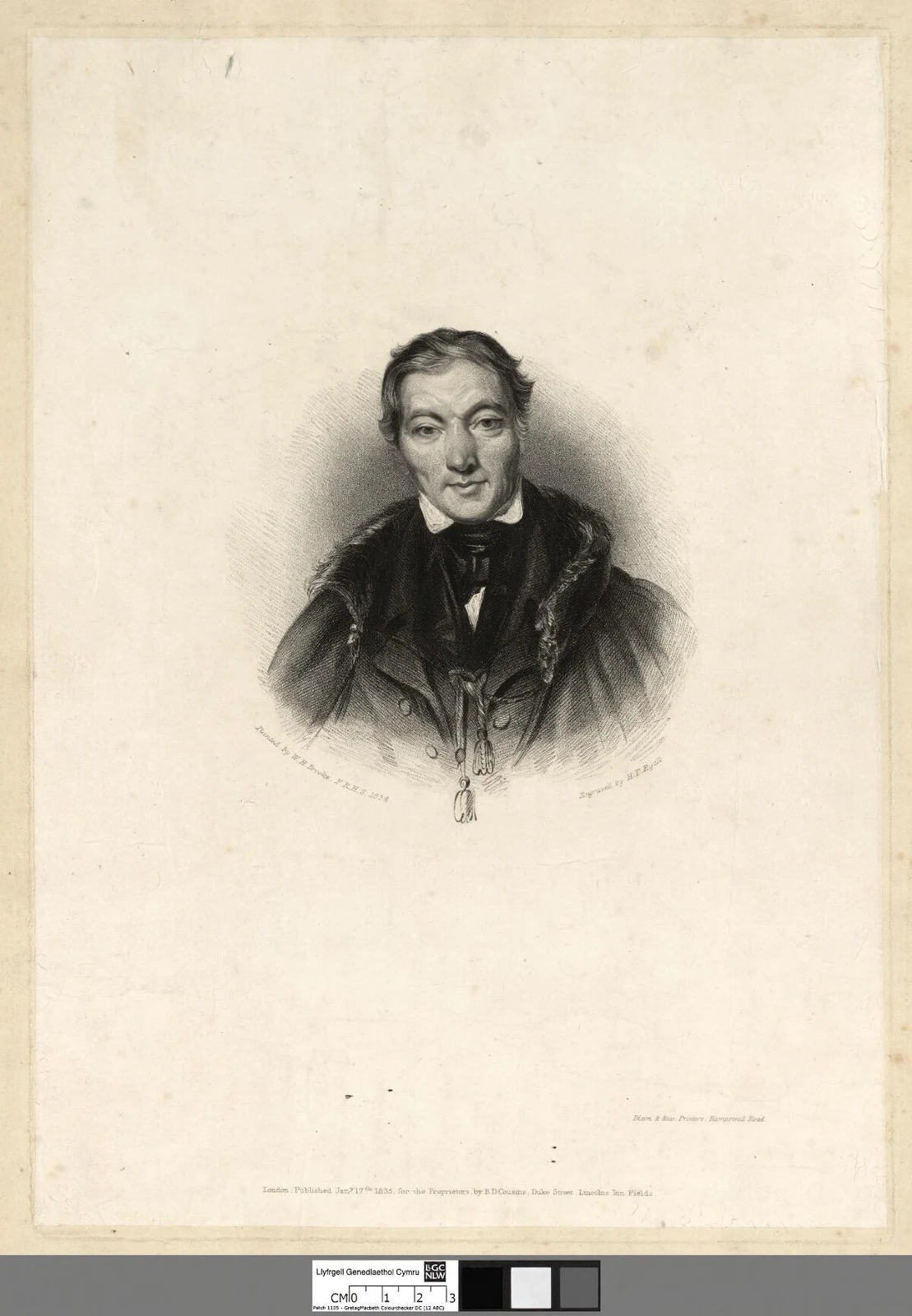
- Robert Owen
Another manufacturer whose ideas about work and social reform exceeded one enterprise.
- Richard Arkwright
An earlier factory system against which Morris’s craft-centred production offers a contrast.
Sources and further reading
Explore the evidence
These references support the biography and offer further reading. Official records, first-person accounts and independent reporting provide different perspectives; image records document attribution and licensing.
- 1. Victoria and Albert MuseumIntroducing William Morris: life, business, politics and printing
- 2. Victoria and Albert MuseumWilliam Morris textiles: techniques, contractors and Merton Abbey production
- 3. William Morris GalleryAbout William Morris: partnerships, design, politics and selected objects
The page’s 1864 renaming statement conflicts with the V&A and NPG accounts, which place the restructuring in 1875; the latter corroborated date is used. Unqualified superlatives about individual influence are not adopted.
- 4. National Portrait Gallery / Carol Blackett-OrdWilliam Morris: Later Victorian Portraits Catalogue biography
- 5. J. W. Mackail / WikisourceThe Life of William Morris, 1899, chapter XIII: selected Merton Abbey site-search and lease passages
Selected chapter XIII passages on the site search, water, premises and June 1881 lease were read, not Mackail’s complete two-volume biography. This is a sympathetic early account rather than an independent labour audit.
- 6. Wandle Industrial MuseumWilliam Morris, 1834–1896: Merton production and working surroundings
- 7. Merton Historical Society / Dave Saxby talk reportBulletin 222: William Morris and the Workers at Merton, 2022
A published report of archaeologist Dave Saxby’s talk, not personnel files or a full wage series. Used to make skilled workers and apprentices visible without claiming comprehensive employment conditions.
- 8. University of Iowa, William Morris ArchiveWilliam Morris, photographed by Frederick Hollyer, 1887: image catalogue metadata
- 9. Wikimedia CommonsWilliam Morris age 53: Hollyer, 1899 publication and original upload history
The original 2008 upload, attributed to the 1899 book scan, is used instead of the later replacement and level-adjusted versions; Iowa’s archive separately corroborates Hollyer and the approximate photographic date.
- 10. Creative CommonsPublic Domain Mark 1.0

Socialism, writing and conservation
Morris increasingly argued that good design could not be separated from the conditions of labour. During the 1880s he became a prominent socialist speaker and organiser, associated with the Socialist League and later the Hammersmith Socialist Society. His criticism went beyond improving a company’s products towards changing the society that organised production and consumption.
His writing was equally important. The Earthly Paradise established his poetic reputation; News from Nowhere, first serialised in 1890, imagined a future beyond competitive capitalism. Conservation formed another strand: in 1877 he helped establish the Society for the Protection of Ancient Buildings. These activities were connected by a concern with useful work and inherited material culture, not simply nostalgia for decorative medieval motifs.
Sources for this section: [4] · [1] · [3]