In this biography
Quick facts
- Born
- 14 May 1771
- Died
- 17 November 1858
- Birthplace
- Newtown, Montgomeryshire, Wales
- Country
- United Kingdom
- Nationality
- Welsh
- Known for
- Reforms at New Lanark and experiments in co-operative community
- Origins
- Newtown, Wales
- New Lanark purchase
- 1799, with business partners
- Management began
- 1 January 1800
- Institute
- Formation of Character, opened 1816
- New Harmony
- Indiana, United States; purchased 1825
Why this life matters
Owen helped make the treatment and education of workers a public question, influencing socialist and co-operative movements without creating a fully equal or slavery-free industrial economy.
Timeline
Key moments
Born in Newtown
Owen later trained in drapery before entering cotton manufacturing.
Manchester management
Experience with machinery, spinning and a large workforce established his business reputation.
New Lanark
Owen and partners bought David Dale’s mills; Owen assumed management in January 1800.
Institute and schools
New social and educational buildings gave physical form to his reform programme.
New Harmony experiment
An American community project failed to sustain the co-operative society he envisaged.
Return to Newtown
Owen died on 17 November and was buried near his parents.
A Welsh childhood and a commercial education
Robert Owen was born in Newtown, Montgomeryshire, on 14 May 1771, the son of a saddler and ironmonger. Formal schooling ended early, but reading remained important throughout his life. Apprenticeship with a draper in Stamford and subsequent work in London and Manchester provided a practical education in trade, accounts and the conditions experienced by employees.
In Manchester he entered a partnership making spinning machinery and then moved into cotton spinning. Managing Peter Drinkwater’s mill while still young gave him responsibility for production and a substantial workforce. His reputation depended on manufacturing and commercial competence before it rested on reform. Intellectual discussion in Manchester also helped develop his conviction that circumstances shaped character.
Buying a business, not founding a village
Owen’s work brought him to Glasgow, where he met Caroline Dale, daughter of the manufacturer David Dale. They married in 1799. That year Owen and his business partners bought the New Lanark mills; he assumed management on 1 January 1800. The cotton village already existed, founded by Dale and Richard Arkwright in the 1780s and subsequently developed under Dale.
This distinction is essential. Owen inherited buildings, machinery, housing and a community, including earlier educational provision. He sought to reshape that system rather than create it from nothing. His freedom was also constrained by partners who expected a financial return. New partnerships later gave him greater scope for educational experiments, but disagreements over expenditure and religion did not disappear.
Reform through profitable management
Owen improved stock control, production records and supervision while pursuing changes to working and living conditions. Continuing wages during a cotton-supply stoppage helped win employees’ trust. He ended the recruitment of pauper apprentices and later excluded children under ten from mill work. Housing, cleanliness, provisions and schooling became parts of a connected reform programme.
Welfare did not mean an absence of control. The silent monitor, a coloured wooden block beside each worker, publicly graded conduct and performance; entries were also recorded. Rules reached into drinking, family responsibilities and village behaviour. Owen believed these measures improved people as well as productivity, but employees were not equal partners in defining the moral standards imposed on them.
Education and the limits of humanitarianism
The Institute for the Formation of Character opened in 1816, followed by the School for Children in 1817. Music, movement, pictures and nature study broadened learning beyond elementary literacy. Facilities served adults as well as children and attracted visitors interested in the possibility of combining industrial profitability with a better social environment.
The benefits at New Lanark did not remove the enterprise from exploitation elsewhere. The Robert Owen Museum’s slavery essay explains its dependence on cotton grown by enslaved people in the Americas and Caribbean. Owen’s humanitarian reputation should therefore be assessed alongside the sources of industrial wealth and his equivocal comments about slavery. Reform for a Scottish workforce was not equivalent to emancipation throughout its supply chain.
From factory improvement to co-operative communities
In A New View of Society and subsequent proposals, Owen argued that poverty and harmful behaviour could be addressed by changing social circumstances. After the Napoleonic Wars he promoted planned co-operative communities as an answer to unemployment. This went beyond improving one mill, and his criticism of established religion alienated some potential supporters.
In 1825 Owen and William Maclure purchased Harmony in Indiana, renaming it New Harmony. The American experiment did not reproduce New Lanark’s commercial foundation or stable organisation. Internal divisions and practical difficulties undermined the intended community, and by 1828 Owen had returned to Britain. Educational and scientific activities continued there, but the project’s survival in other forms was not proof that his original social plan had succeeded.
Later campaigns and an influence beyond ownership
Back in Britain, Owen became involved in labour exchanges, co-operative activity and the trade-union movement. These ventures often struggled, and his preferred reconciliation through co-operation did not always match workers’ demands for collective bargaining. His ideas nevertheless travelled through followers and institutions rather than vanishing with individual commercial failures.
Owen continued writing and speaking into old age. He returned to Newtown and died on 17 November 1858. His importance lies in making environment, education and the organisation of work central to social debate. It is a legacy of significant reforms and ambitious experiments, but also paternalism, failed communities and a cotton economy whose benefits were distributed unequally across the world.
Quick answers
Frequently asked questions about Robert Owen
- Did Robert Owen found New Lanark?
- No. David Dale and Richard Arkwright founded the cotton village in the 1780s. Owen and partners bought the established mills in 1799, and he began managing them in January 1800.
- What was the silent monitor?
- A four-sided coloured block displayed an assessment of a worker’s conduct and performance. Records accompanied it. It avoided corporal punishment but remained a form of employer supervision and social control.
- Was New Harmony in Scotland?
- No. New Lanark is in Scotland; New Harmony is in Indiana, United States. Owen and William Maclure purchased the American settlement in 1825 for a different co-operative experiment.
- Did Owen’s reforms eliminate exploitation?
- They improved important aspects of work and education at New Lanark, but retained employer authority and relied on a cotton economy connected to enslaved labour overseas. Local welfare was not universal equality.
Keep exploring
Lives connected to this story
- Richard Arkwright
The earlier industrialist associated with the foundation of New Lanark and the spread of factory production.
- William Morris
A later employer and socialist who also connected the quality of work with social change.
- Titus Salt
Compare another industrial settlement and its records of provision and control.
Sources and further reading
Explore the evidence
These references support the biography and offer further reading. Official records, first-person accounts and independent reporting provide different perspectives; image records document attribution and licensing.
- 1. New Lanark TrustRobert Owen: business background, management, education and social reforms
The biographical and reform sections were read. Superlative claims of the world’s first nursery are not adopted; the profile distinguishes ending pauper-apprentice recruitment from later exclusion of children under ten.
- 2. New Lanark TrustHistorical Timeline: Dale and Arkwright foundations, Owen and subsequent owners
- 3. Dictionary of Welsh Biography / J. F. ReesOwen, Robert, 1771–1858: life, ideas and death
- 4. Robert Owen MuseumOverview of his life: selected career, education, co-operation and later-life passages
Selected career, education, co-operative, religious and later-life passages were read. Institutional accounts disagree about precise reduced working-day hours and the date of the cotton embargo; neither precision is reproduced.
- 5. Open University / Ian Donnachie and contributorsRobert Owen and New Lanark: selected workplace, social-control and reform passages, including video transcripts
Selected historical discussion and published video-transcript passages about Dale, workplace reforms, the silent monitor and paternalism were read; no claim is made that the full course, linked essays or audiovisual material was studied.
- 6. Robert Owen Museum / Colin LakerRobert Owen and Slavery: cotton supply and the limits of humanitarian rhetoric
The four-page museum essay was read as a later synthesis, not as original plantation or company accounts. It supports a qualified account of cotton supply and Owen’s uneven humanitarianism; father and son are kept distinct.
- 7. Historic Environment ScotlandNew Lanark: industrial village and World Heritage significance
- 8. Indiana Archives and Records AdministrationNew Harmony Indiana: Owen–Maclure purchase in 1825
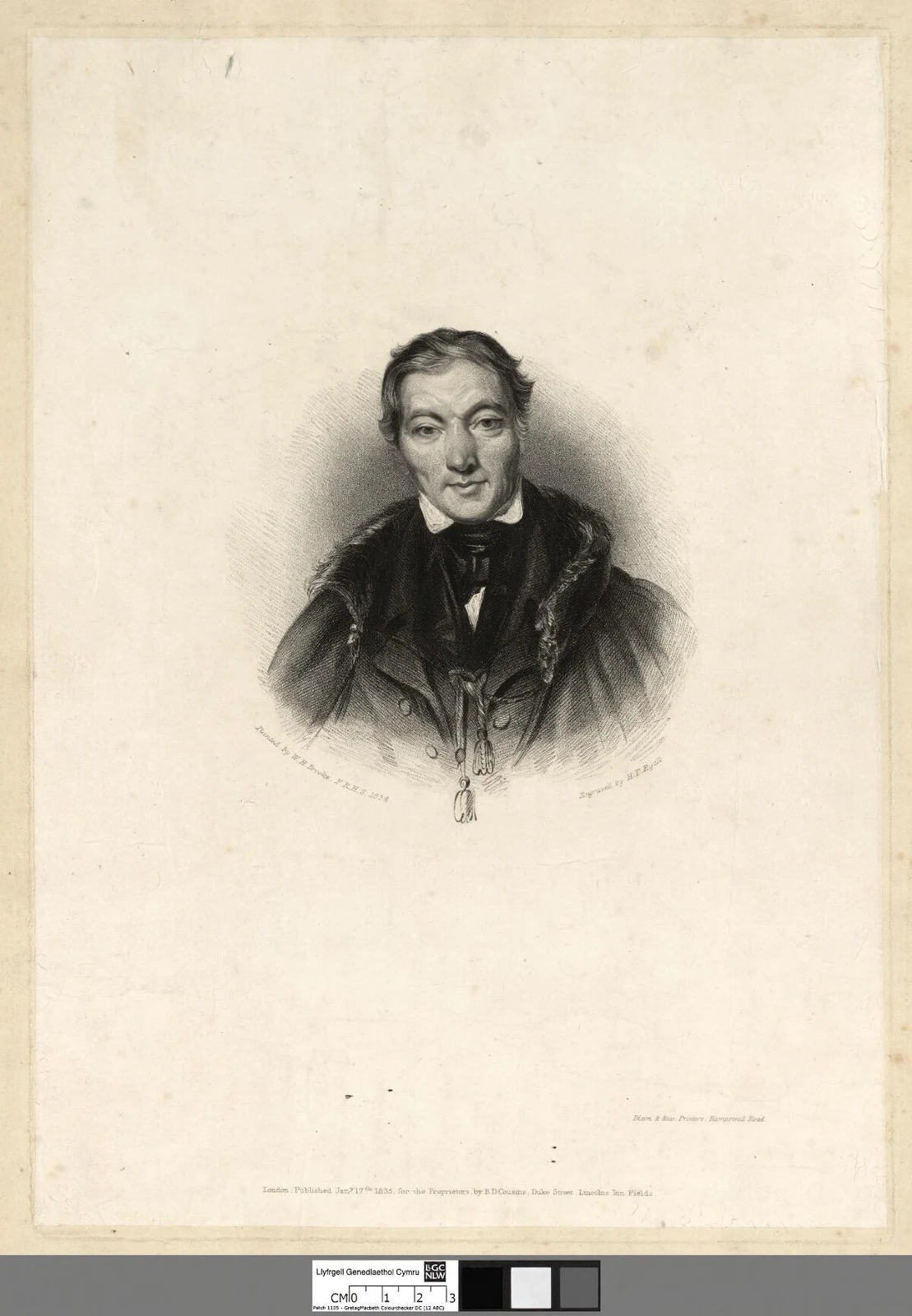
- 9. National Library of Wales / Wikimedia CommonsRobert Owen by Henry Thomas Ryall, 1835: full scan, item 4674544
- 10. National Portrait GalleryRobert Owen: extended catalogue, Ryall engraving published 17 January 1835
- 11. Creative CommonsPublic Domain Mark 1.0