In this biography
Quick facts
- Born
- 8 September 1933
- Died
- 12 April 2026
- Birthplace
- Present-day Sangli district, Maharashtra, India
- Country
- India
- Nationality
- Indian
- Known for
- Hindi and multilingual film playback, Umrao Jaan, R. D. Burman collaborations and international concerts
- Family background
- Daughter of musician Deenanath Mangeshkar; younger sister of Lata Mangeshkar
- Umrao Jaan collaborators
- Composer Khayyam, poet Shahryar and director Muzaffar Ali
- Career honours
- Dadasaheb Phalke Award, 2000; Padma Vibhushan, 2008
- Death and funeral
- Died 12 April 2026; state funeral in Mumbai on 13 April
Why this life matters
Her changing vocal personas expanded what a female playback voice could express, while concerts made the usually unseen singer an unmistakable performer.
Timeline
Key moments
Born in the Sangli district
She grew up in a Marathi musical and theatrical family.
A child’s professional beginning
The government retrospective dates the start of her singing career to this year.
Distinctive screen voices
Popular film work made her rhythmic energy and low register widely recognisable.
Marriage to R. D. Burman
A musical partnership also became a marriage.
Umrao Jaan
The ghazal score gave her a different dramatic persona.
Renewal and international audiences
New composers, pop collaborations and touring connected different generations.
Death in Mumbai
She died on 12 April at the age of 92.
A musical family and an early working life
Asha Bhosle was born on 8 September 1933 in the Sangli district of what is now Maharashtra. Her father, Deenanath Mangeshkar, was a musician and theatre performer; Lata Mangeshkar was her elder sister. The family environment offered a musical education, although it should not be mistaken for a documented school or conservatoire qualification.
The government’s 2026 retrospective dates her professional beginning to 1943. A childhood entry into paid performance became a working life extending across eight decades. Her first marriage ended in separation; in 1980 she married composer R. D. Burman. Personal hardship belongs in that chronology without turning every expressive song into autobiography.
A voice capable of playing different people
Bhosle’s film career developed alongside a playback system that separated the recorded singer from the actor seen on screen. Cabaret, flirtation, exuberance and conversational play offered room for a recognisable voice whose identity could change with a character. Her low register and rhythmic attack were resources rather than a single permanent style.
Raju Bharatan’s account of Umrao Jaan places Khayyam’s use of her lower voice beside O. P. Nayyar’s earlier appreciation of it. That comparison matters: the 1981 score did not discover an ability that had never existed. It reorganised an experienced singer’s resources for a different dramatic world.
Umrao Jaan and the authority of restraint
For Muzaffar Ali’s Umrao Jaan, Khayyam composed and Shahryar wrote the songs sung by Bhosle for Rekha’s character. The National Film Award citation recognised how her ghazal rendering belonged to the texture of the film. It was an award for a particular performance, not a judgement that her other musical identities were less serious.
Accounts disagree about the precise interval by which her pitch was lowered. The consistent point is the change of register and dramatic emphasis. The collaboration lets a listener consider how restraint, a sustained phrase and verbal attention can carry feeling without the more extrovert energy associated with some of her earlier hits.
Renewal through collaborators and live audiences
In Arthur J. Pais’s 2003 account, Bhosle credited A. R. Rahman’s confidence in her during Rangeela with encouraging younger composers to write for her. She also described the practice required for a difficult number. Longevity was therefore an active process of rehearsal and new relationships, rather than simply the repeated sale of familiar songs.
On stage she used stories, mimicry, movement and changing programmes to connect with audiences. Requests could reach back decades, while younger listeners came for the vitality of the performance itself. Her work with international musicians, including Boy George, extended this willingness to enter unfamiliar musical settings.
Popularity, reception and the limits of a rivalry story
The contrast between Bhosle and Lata Mangeshkar is part of public discussion, but it can reduce a large professional life to a family contest. Pais records her tributes to her father and sister as well as to composers who used her only occasionally. A song’s dramatic assignment offers a more useful starting point than assuming that every difference in repertoire proves personal hostility.
Reception also changes. Bharatan argues that television circulation gave Umrao Jaan a renewed audience after its initial commercial difficulties. That is his interpretation of the score’s afterlife; the songs’ present standing should not be projected backwards as proof that every contemporary listener immediately welcomed them.
Honours and the end of a long career
Bhosle received the Dadasaheb Phalke Award for 2000 and the Padma Vibhushan in 2008. Reuters also records two Grammy nominations. These honours identify different institutions and kinds of recognition; nominations are not Grammy wins, and a career honour is distinct from a playback award for one film.
She died in Mumbai on 12 April 2026, aged 92. The Ministry of Information and Broadcasting records the state funeral at Shivaji Park on 13 April. Her recorded work survives in multiple languages and performance traditions, making the history of her voice larger than a single catalogue of Hindi hits.
Quick answers
Frequently asked questions about Asha Bhosle
- Was Asha Bhosle still alive in October 2026?
- No. She died on 12 April 2026. Her state funeral in Mumbai was held the following day.
- Who created the songs she sang in Umrao Jaan?
- Khayyam composed, Shahryar wrote the words and Bhosle sang for Rekha’s screen performance in Muzaffar Ali’s film.
- Did she work only in Hindi film music?
- No. Her career included several Indian languages, concerts and international collaborations, as well as non-film recordings.
Keep exploring
Lives connected to this story
- Lata Mangeshkar
Read her sister’s distinct musical life and compare the dramatic work assigned to two major playback voices.
- Gulzar
Explore the writer and director of Ijaazat, whose songs Bhosle also performed.
Sources and further reading
Explore the evidence
These references support the biography and offer further reading. Official records, first-person accounts and independent reporting provide different perspectives; image records document attribution and licensing.
- 1. Ministry of Information and Broadcasting / New India SamacharSeptember 2026 retrospective: birth, family and early work
- 2. Ministry of Information and Broadcasting / PIB13 April 2026 state funeral announcement
Official 13 April 2026 ministry release separates 12 April death from the next day’s state funeral; corroborated by Reuters and AP. An older living biography is not retained.
- 3. Ira Dugal and Chandni Shah / Reuters12 April 2026 obituary and international career
- 4. Associated Press12 April 2026 obituary: family, marriage and death
- 5. Arthur J. Pais / Rediff2003 report and interviews: rehearsal, touring and renewal
- 6. Raju Bharatan / Hay House, excerpted by ScrollUmrao Jaan: lower register and changing reception
Permitted book excerpt supplies critical interpretation and lower-register history. Its repeated 1982 film dating is not adopted; official award record identifies the 1981 film.
- 7. Manash Firaq Bhattacharjee / The WireKhayyam’s compositions and the Umrao Jaan collaboration
The exact lowered interval varies across accounts. No precise interval, raga identification or fresh complete listening is claimed.
- 8. SaregamaDil Cheez Kya Hai: singer, composer and lyricist credits
- 9. Directorate of Film Festivals29th National Film Awards: female playback citation for 1981
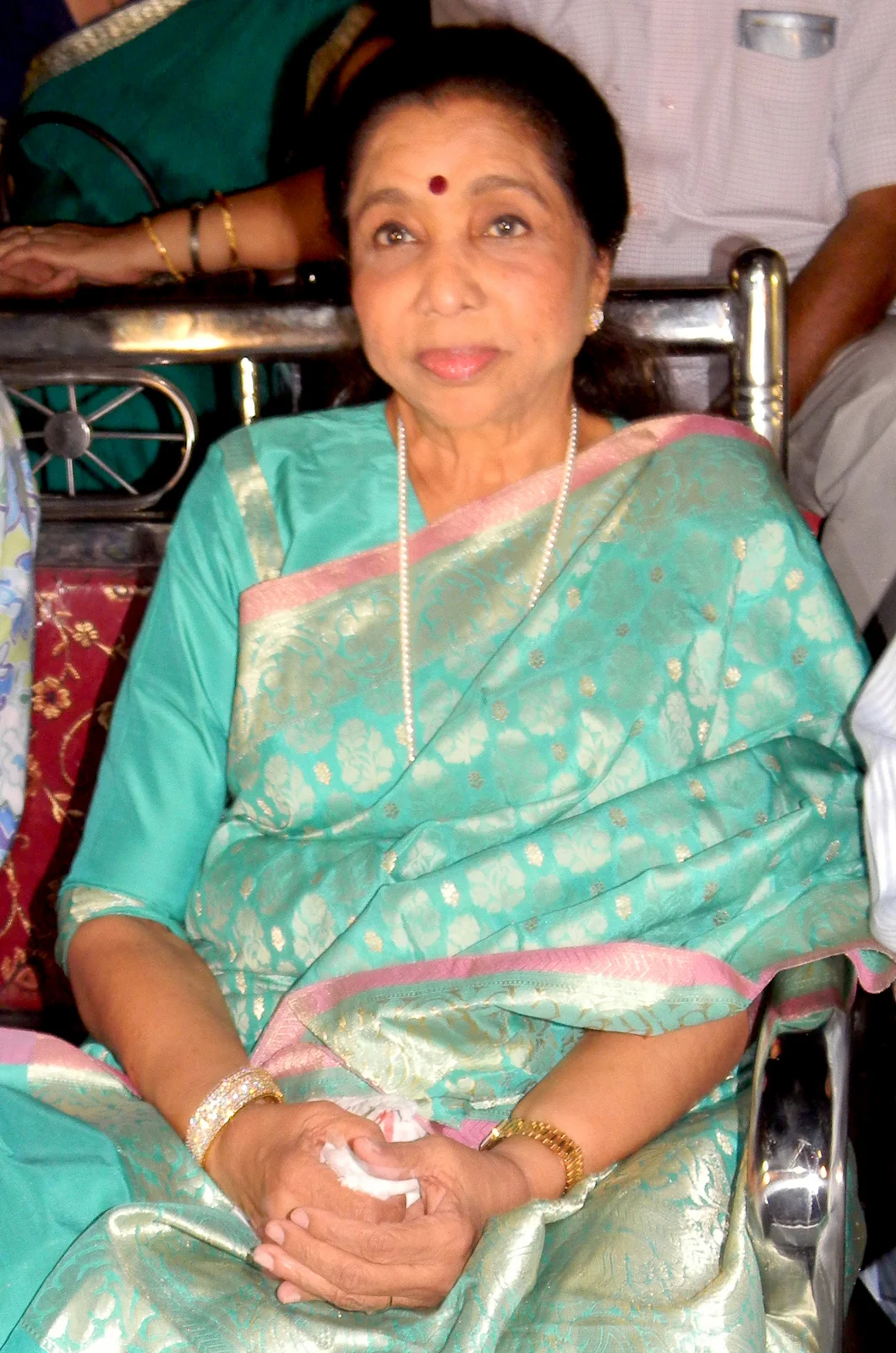
- 10. Wikimedia Commons / Krupasindhu MuduliComplete 2011 event portrait and CC BY-SA rights
Photographer’s own-work CC BY-SA 3.0 grant and sole full-frame upload inspected; metadata and complete frame retained.