In this biography
Quick facts
- Born
- 10 January 1940
- Birthplace
- Fort Kochi, Kingdom of Cochin (now Kerala, India)
- Country
- India
- Nationality
- Indian
- Known for
- Malayalam and multilingual playback, Carnatic concerts and Chitchor songs
- Full name
- Kattassery Joseph Yesudas
- Training
- RLV Music Academy, Swathi Thirunal College and individual Carnatic teachers
- Early film recording
- Recorded in 1961 for Kalpadukal
- Chitchor collaboration
- Ravindra Jain’s compositions and words; Hindi film released in 1976
Why this life matters
His work connects classical training and popular film music while demonstrating how a recognisable singer can serve many composers and screen characters.
Timeline
Key moments
Born in Fort Kochi
His father Augustine Joseph was a singer and stage actor.
Carnatic education
Institutional study and individual teachers shaped a continuing musical practice.
A first film recording and release
The recording for Kalpadukal preceded the film’s release.
A multilingual playback career
Malayalam work developed alongside other Indian-language industries.
Chitchor
Ravindra Jain’s songs brought a distinctive Hindi-film romantic register.
Kerala Assembly tribute
The legislature marked the golden jubilee of his singing career.
Learning and selected appearances
Interviews and recent reporting describe music practice and a quieter public life in the United States.
Fort Kochi and a family’s musical inheritance
Kattassery Joseph Yesudas was born on 10 January 1940 in Fort Kochi, then in the Kingdom of Cochin and now part of Kerala. His father Augustine Joseph was a musician and stage actor. The initials K. J. therefore abbreviate a personal name, rather than marking a separate performer.
The combination of a performing household and formal musical study shaped his early life. RLV Music Academy and Swathi Thirunal College of Music appear in accounts of his education. Sources disagree on completion of the latter course, so this profile records study without asserting a graduation unsupported by a consistent record.
Teachers and a practice that did not end with success
His Carnatic education included work with K. R. Kumaraswamy Iyer, Vechur Harihara Subramania Iyer and Chembai Vaidyanatha Bhagavatar. Sangeet Natak Akademi’s account of Kumaraswamy Iyer independently places Yesudas among his pupils. Teacher lineages are relationships of instruction, not a claim that each pupil sounds identical to a guru.
In a 2024 interview, Yesudas described himself as still learning and trying to preserve the voice entrusted to him. He also discussed online teaching. That testimony provides a useful correction to the idea that classical training is merely a certificate acquired before the real work of popular singing begins.
Film recording and the movement between languages
Yesudas’s early recording for Kalpadukal took place in 1961, before the film’s release in 1962. A 2012 Kerala Assembly tribute marked the golden jubilee of that beginning. Its place in a chronology should be kept separate from claims about when the first recording was heard in cinemas.
Malayalam playback became the centre of a much wider career including Tamil, Hindi, Kannada and Telugu work. The singer’s recognisable tone had to carry different words, composers’ intentions and actors’ situations. Song totals vary widely in retrospective profiles, so no exact career total or world-record claim is used here.
Chitchor and a different scale of Hindi-film romance
In Basu Chatterjee’s Chitchor, released in 1976, Yesudas sang Ravindra Jain’s compositions. Saregama’s original-song credits name Jain as both composer and lyricist of Gori Tera Gaon Bada Pyara. Amol Palekar’s screen character and Yesudas’s recorded voice are different parts of the performance.
The film’s mistaken identity story gives music a role in developing attraction before social status is clarified. Shantanu Ray Chaudhuri reads the village song as a moment when Geeta encounters her surroundings through Vinod’s affection. That is a critic’s interpretation of narrative function, rather than a claim that the singer himself wrote the scene.
A public voice can also be challenged
Yesudas’s devotional repertoire and statements about music crossing religious divisions have contributed to his public image. That image does not remove the need to examine other public remarks. In 2014, comments criticising women wearing jeans prompted protests and criticism from National Commission for Women chairperson Lalitha Kumaramangalam.
The criticism concerned women’s freedom and responsibility for how others behave. A biography should record the specific dispute without treating admiration for a singer as agreement with all his views. It should equally avoid turning an objectionable statement into an unsupported allegation about conduct beyond what the reporting establishes.
Sources for this section: [6]
A quieter later life and the continuity of music
A 2024 interview described Yesudas living with family in Dallas, continuing to learn and releasing recordings through Tharangini. September 2026 reporting documented a rare public appearance at the Kerala Association of Dallas’ golden-jubilee event. These are dated observations, not a claim that he has permanently retired or remains available for a particular concert.
His long career connects the concentrated demands of a Carnatic recital with the collaborative demands of playback. Listening to those forms side by side can reveal different uses of the same trained voice, while keeping classical composition, film composition and vocal interpretation distinct.
Quick answers
Frequently asked questions about K. J. Yesudas
- What does K. J. stand for?
- Kattassery Joseph. K. J. Yesudas and Kattassery Joseph Yesudas refer to the same singer.
- Who composed Gori Tera Gaon Bada Pyara?
- Ravindra Jain, who also wrote its words. Yesudas sang it for the 1976 film Chitchor.
- Is he only a film playback singer?
- No. Carnatic concerts, devotional recordings and continuing musical study are substantial parts of his career.
Keep exploring
Lives connected to this story
- Bhimsen Joshi
Compare another vocalist’s relationship between classical training, devotional repertoire and a popular audience.
- Asha Bhosle
Explore a fellow playback singer whose changing vocal personas offer a different route through Indian film music.
Sources and further reading
Explore the evidence
These references support the biography and offer further reading. Official records, first-person accounts and independent reporting provide different perspectives; image records document attribution and licensing.
- 1. Kerala KaumudiFort Kochi, full name and 10 January 1940 birth
- 2. Press Trust of India / NDTV2012 Kerala Assembly tribute: training and early recording
Contemporary 2012 report supports training and early recording but says graduated; other accounts say course not completed. No graduation claim is adopted, and its then-current award totals are not treated as current.
- 3. Sangeet Natak AkademiK. R. Kumaraswamy Iyer citation: Yesudas as pupil
- 4. Malayala Manorama / Onmanorama2024 interview: learning, recordings and life in Dallas
- 5. Gulf News10 September 2026 report: selected public appearances
September 2026 report confirms a recent appearance and living status; no unverified retirement, health condition or future performance is inferred.
- 6. Press Trust of India / The Indian Express2014 criticism of comments on women’s clothing
- 7. Saregama MusicGori Tera Gaon Bada Pyara: original song and creative credits
- 8. Rajshri Productions / Apple TVChitchor: 1976 film and central mistaken identity
- 9. Shantanu Ray ChaudhuriChitchor at 50: music, status and Geeta’s choice
Named critic’s indexed March 2026 essay consulted; direct opening failed. Its National Award identification for child actor differs from common Filmfare mislabelling; no unsupported award detail is repeated.
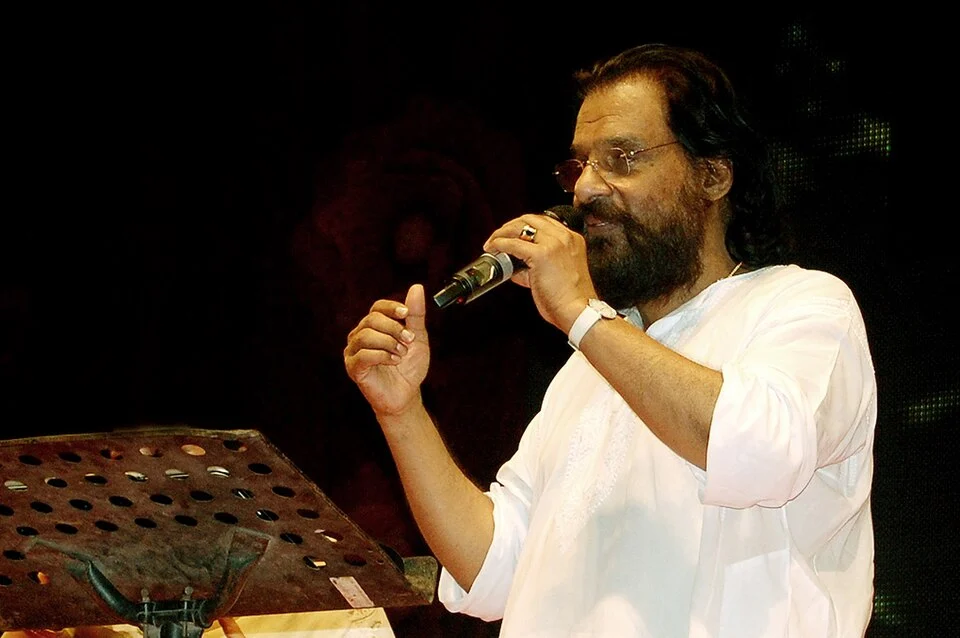
- 10. Wikimedia Commons / Anees KodiyathurOriginal author upload, explicit dual licences and complete photograph
Exact raw wikitext explicitly includes CC BY-SA 3.0 alongside GFDL-user-ml with migration=redundant. CC permission is not inferred from automatic GFDL conversion; original author upload log and copyright-holder attribution are retained. Earlier E P Sajeevan contributed image rejected for uncorroborated creator grant.